Countries Archives: Brazil

Agua de Beber

COUNTRY: Brazil
LANGUAGE: Portugese

“Agua de Beber” is a deservedly iconic “bossa nova” song, performed with groovy perfection by vocalist Astrud Giberto and composer/pianist Antonia Carlos Jobim.  Bossa Nova (“new way”) became popular in the 1950s when samba met jazz in the wealthier neighborhoods near the beaches of Rio de Jeneiro in Brazil, departing from the straightforward “1-2” beat of traditional samba, adding syncopation and sparse,  romantic melodies.

How to sing with Jay each week in your home or classroom Support All Around This World on Patreon Enjoy interactive All Around This World lessons in your home or classroom

Brazil for kids — Teach kids about Samba Drumming

The rhythms of SAMBA, Brazil’s most prominent form of music and dance, originated in Africa — likely Angola — and emerged as a distinct sound in impoverished urban neighborhoods around Rio de Janeiro in the late-19th century. While Brazilians dance samba as part of their massive Carnival celebrations, Ssmba isn’t only music, it’s more than just a way of life; the word “samba,” goes one of the many legends of the term’s origins, comes
from an Angolan language and means: “to pray.”

One of the most exciting elements of samba is the onslaught of percussion instruments ensembles bring forth when they perform. While every instrument has its own sound and serves its own particular purpose, the cumulative effect is meant to so energize a listener that s/he has not choice but to dance. Some of the primary percussion items include the…

CAIXA:
Very similar to a snare drum, though it has two or four wires/cables/snares that run along the top of the drum, rather than along the bottom like the typical drum kit snare. The caixa is played with drumsticks and either suspended around the neck on a strap or held on the shoulder to send the sharp rhythm out over a procession. Often musicians play several types or caixas with several types of rhythms. Hear the caixa in action.

CUICA:
The cuica is a Brazilian “talking drum” (or, more descriptively, “laughing drum”). The drum only has one head. The drummer makes the distinct “laughing” sound by putting a hand inside the instrument and rubbing a wet cloth across a resonating cane of bamboo. Listen to the cuica and, if you understand Portuguese, learn about it too.

SURDO:
The surdo is a large bass drum that provides the deep, underlying percussive motion for a procession. Performers tune two surdos to different notes and play them in both complementary rhythm and tone, emphasizing the downbeats of the measure. A third surdo plays a rhythm, known as a “cutter,” between the first two surdo beats. Watch some surdo drums at work in the forefront of this performance by PhillyBloco.

PANDEIRO:
The pandeiro is a kind of tambourine that has a single head and jingles (“pratinelas”) arranged in pairs around its frame. Some masterful pandeiro playing.

TAMBORIM:
A small single-headed hand drum hit by a thin stick to make a sharp sound that cuts across all the other percussion, usually on an off-beat. Often the tamborim players lead the procession. Watch the smiling Tamborim Unidos da Tijuca in motion in 2009.

TIMBAL
(also spelled as TIMBAU): The timbal is a conical Brazilian kettle drum most often found in Bahia. (Not to be confused with the Cuban timbales.) Watch timbal drummers on the move with Percussao Brasileira.

More information:

The History of Samba | Want to learn to samba? Start here. | Want your baby to teach you how to samba? Start here.

COUNTRY: Brazil
KEY INSTRUMENTS: Agogô, Banjo (4-string), Bass, Caixa, Cavaquinho, Chocalho, Cuíca, Ganza, Güiro, Hand-repique, Pandeiro, Repinique, Saxophone, Surdo, Tamborim, Tantã, Trombone, Trumpet
SONG ON AATW: LATIN AMERICA CD: Bambo du Bambu

[mappress mapid=”16″ center=”-8, -60″ zoom=”3″]

How to sing with Jay each week in your home or classroom Support All Around This World on Patreon Enjoy interactive All Around This World lessons in your home or classroom

Afoxé

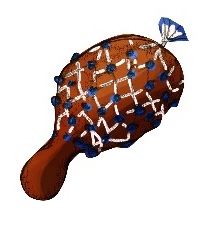
AfoxéAn afoxé is a Brazilian instrument made of a gourd wrapped in a net of beads that makes a loud, sharp noise when shaken. It’s very similar to the African sekere–generally a bit smaller–and is one of the distinctive instruments of an Afro-Brazilian music and an Afro-Brazilian musical genre of the same name.

COUNTRY: Brazil
KEY GENRES: Afoxé


How to sing with Jay each week in your home or classroom Support All Around This World on Patreon Enjoy interactive All Around This World lessons in your home or classroom

Agogô

An agogô is a pair of connected bells–one larger, one smaller–that a percussionist strikes with a stick to maintain a rhythm in Afro-Brazilian music. The agogô originated in Africa–it is prominent throughout West Africa, and is believed to have originated in the Yoruba communities of Nigeria–and is similar to the African gankogui bells.

COUNTRY: Brazil
KEY GENRES: Afoxé, Capoeira, Samba

How to sing with Jay each week in your home or classroom Support All Around This World on Patreon Enjoy interactive All Around This World lessons in your home or classroom

Yemen–Travel


“There can’t be many places left in the world that could make God smile, but Yemen is one of them….” So starts the LonelyPlanet.com entry on Yemen. Do the Lonely Planet travel writers love Yemen? You bet: “To travel in this most traditional of Islamic countries, surrounded by a people whom the Prophet once described as as the most gentle-hearted of men,” they continue, “is a privilege you will not quickly forget.” Yemen is not a standard
tourist destination, which both means there is little infrastructure in place to accommodate a foreign visitor and there’s also not an onslaught of visitors from the outside to poke, prod and over-photograph any of its most interesting destinations. If you do go to Yemen, gushes Lonely Planet, you’ll find “a little of everything,” such as:

— San’a, the capital, the world’s oldest city, which is still mysterious yet welcoming after all these years. [Watch this video, which makes San’a seem pretty darned funky.]
— Suqutra (Socotra) Island, “the Galapagos of the Indian Ocean,” which is said to a place in which you can find the secret of life. [Look at these incredible photos of Socotra’s unbelievable flowers and plants.]
— Shaharah, a fortified village that is difficult to reach but well worth the effort. [You can see for yourself in this video.]
— the Wadi Hadramawt oasis. [This video, some of which is shot by hot air balloon–seriously!–takes you through the desert on camels, so when you finally reach the oasis you understand how happy travelers were to arrive.]
— Zabid, which is not only a UNESCO World Heritage Site, its the hottest city on earth.

If you’re curious about what kind of adventures you may have if you get yourself to Yemen, visit the Yemeni entries on the seasoned traveler Joe’s travelblog called, “Joe’s Trippin.'” Joe, who lived and worked in Aden for several months until his unwilling and
abrupt departure
, will take you on a virtual tour of some of his out-of-Aden explorations. Thinking of going to the beach down of al Khokha? Don’t bother. It’s overrated.
Same with the coastal city Hodaidah. Sierra Castle, though..? That’s worth the long, hot, sweaty, uphill hike.

New Zealand–Language

(the guy at 1:05 is awesome)

New Zealand has two main languages you may expect–English, the colonial language, and Maori, the local Polynesian language–and one you probably wouldn’t; in 2006 New Zealand became the first country in the world to make a sign language one of its official languages. New Zealand Sign Language is now officially legal for use in the court system and to gain access to government services.

When Europeans first made contact with islanders on Aeotearoa most of them spoke Maori. In the Treaty of Waitangi (1840), England promised protection of the Maori language. Whether or not the British agreed to safeguard the language, when rural Maori moved to the cities, which they did in great numbers in the mid 1900s they spoke English to get by, often instead of using their own language.Today only about 70,000 of 500,000 Maori (out of a total New Zealand population of 4 million) are native speakers.

Less than one percent of people in New Zealand communicate using New Zealand Sign Language, but its official recognition gives it credence as a legitimate means of communication. Want to learn New Zealand Sign Language? First of all, great idea: “Thumb’s up!!” Second, you can get started here.

To say hello: look at this PDF worksheet. To say goodbye…look at the same PDF worksheet.

More information:

Twenty-nine of New Zealand’s many ways to say hello | Read the 2006 “New Zealand Sign Language Act” | “Deaf Aotearoa” invites you to celebrate “NZ Sign Language Week” | New Zealand History Online’s “100 Maori words every New Zealander should know

Pandereta

The pandereta is a tambourine–a small, round, handheld frame drum with jingles–that one plays with a Spanish or Latin American flair. Though the pandereta is present in Spain, it is very much a part of the Brazilian samba percussion ensemble.

COUNTRY: Brazil, Spain

KEY GENRES: Samba


How to sing with Jay each week in your home or classroom Support All Around This World on Patreon Enjoy interactive All Around This World lessons in your home or classroom

Hand-repique

The hand-repique is a small, cylindrical Brazillian drum that his played with the hands. The musician hits both the drum head and the body, creating a variety of sounds that help fill out the samba percussion section. Wikipedia’s entry on the hand-repique suggests this for the drum’s origins: ” It was invented by musician Ubirany, founder and percussionist with the band ‘Fundo de Quintal’. The hand-repique is derived from another percussion instrument, the ‘Repinique‘. Ubirany started to use the repinique in its band but felt it was too uncomfortable to play, since this instrument is made to be originally played with a drumstick. So he adapted it, adding a few mufflers on the inside, lowering the hoop and taking the bottom skin off it.” Makes sense!

COUNTRY: Brazil
KEY GENRES: Pagode, Samba

How to sing with Jay each week in your home or classroom Support All Around This World on Patreon Enjoy interactive All Around This World lessons in your home or classroom

Amazonian (Brazil, Colombia, Ecuador, Peru)

There really is no “Amazonian” genre of music–the Amazon is the second longest river in the world and a substantial diversity of people live along its banks and in the forests around it–however, most of the indigenous people who live near the Amazon, make music that finds similar inspiration in nature. For example, the Ticuma, the most populous indigenous group in the Amazon region, celebrate life events with days of dancing accompanied by locally made flutes, rattles made of seeds and a long hollowed log-drum called a “maguaré.” The Yanomami are not known to have a tradition of using instruments to accompany their singing, but since outside visitors introduced flutes they have started making wind instruments out of bamboo or animal bones. Mongabay.com introduces us to the Amazon and some of the people that live around it.

COUNTRY: Brazil, Colombia, Peru
KEY INSTRUMENTS: A capella, hand drums, Flutes

[mappress mapid=”16″ center=”-8, -60″ zoom=”3″]

How to sing with Jay each week in your home or classroom Support All Around This World on Patreon Enjoy interactive All Around This World lessons in your home or classroom

Pagode (Brazil)

Pagode originated in the early ’80s as a festive, fun, highly danceable subgenre of samba that has come to be associated–not always favorably–with lighthearted pop. Pagode performers introduced new instruments into the samba batteria, such as the 4-string banjo (louder than the traditional cavaquinho), the tan-tan (a brighter-sounding surdo, played with the hands and used to keep the main beat) and the hand-repique (used especially to emphasize rhythmic turnarounds). The genre’s lyrics are more satirical and slang-laden than samba lyrics from other genres, and often come with a bite.

COUNTRY: Brazil
KEY INSTRUMENTS: Cavaquinho, Banjo (4-string), Guitar, Hand-repique, Pandeiro, Repinique, Tambourine, Tan-tan
SONG ON AATW: LATIN AMERICA CD: A Canoa

[mappress mapid=”16″ center=”-8, -60″ zoom=”3″]

How to sing with Jay each week in your home or classroom Support All Around This World on Patreon Enjoy interactive All Around This World lessons in your home or classroom