Countries Archives: China

Let’s Build a Yurt! — Central Asia for Kids — All Around This World

A yurt is a sturdy, circular structure prevalent among traditional nomadic peoples of Central Asia like the Kazakh and Uighur of Western China. A yurt requires only sturdy, simple materials, can be built in two hours and is easy to dismantle, making it the nomad’s perfect home.

In class we build yurts with the most portable of all construction materials — our imaginations! (What, you thought I’d say finish nails?)

How to sing with Jay each week in your home or classroom Support All Around This World on Patreon Enjoy interactive All Around This World lessons in your home or classroom

Chinagrass

COUNTRY: China

“Chinagrass” is phenomenal modern Chinese folk music, a blend of ancient traditional songs and sounds from China’s myriad ethnic groups with contemporary instruments and international sounds like American roots rock and punk. The cream of the Chinagrass crop are performers like the Kazahk/Uiguher Mamer, and the international Mongolian sensations, Hanggai.


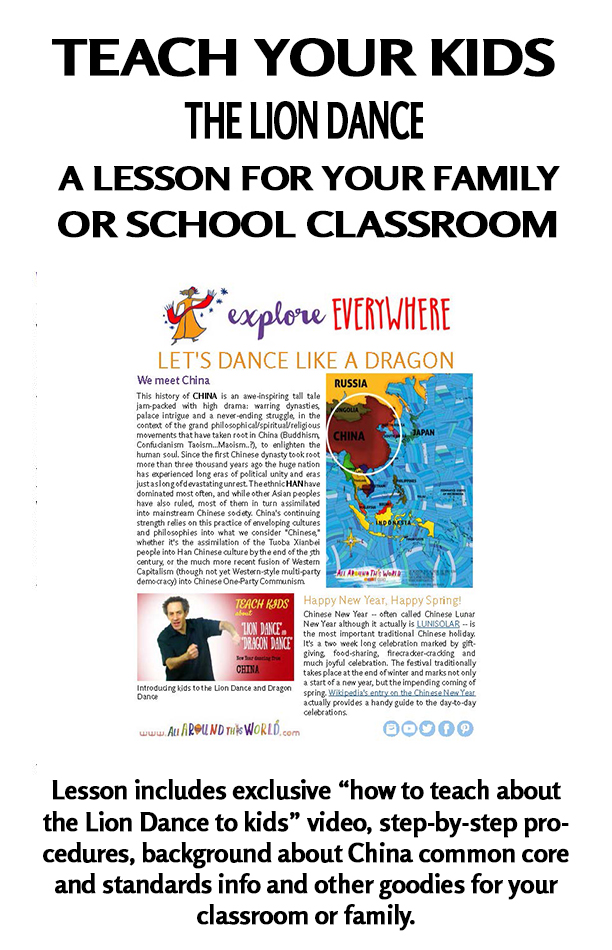
China–Chinese New Year (Lion Dance, Dragon Dance)


China for Kids -- Lion Dance Dragon Dance -- All Around This WorldChinese New Year–often called Chinese Lunar New Year although it actually is lunisolar–is the most important traditional Chinese holiday. It’s a two week long celebration marked by gift-giving, food-sharing, firecracker-cracking and much joyful celebration. The festival traditionally takes place at the end of winter and marks not only a start of a new year, but the impending coming of spring. Wondering how to celebrate the Chinese New Year? Here’s a handy guide, thanks to Wikipedia’s entry on the Chinese New Year:

BEFORE NEW YEAR: In preparation for New Year celebrations families will thoroughly clean their houses to symbolically sweep away the bad spirits (make sure to hide your brooms during the celebration so the new year’s good luck can’t be swept away) and hang red-colored lanterns and paper. The night before the beginning of the festival the family gathers for a huge meal and prepares for the fun to come.

DAY 1:
Visit family, especially elders, set off firecrackers or go to public displays of fireworks, give red envelopes containing gifts and do the lion dance (more on the lion dance below)

DAY 2: married daughters visit birth parents, be nice to dogs
— the second day of the Chinese New Year is considered every dog’s symbolic birthday!

DAY 3: known as “chì gǒu ri,” loosely translated as “the God of Blazing Wrath.” Not a great day to visit with family or socialize.

DAY 5: The birthday of the Chinese god of wealth.

DAY 7: Renri, “the common man’s birthday,” is the day when everyone is accepted to have grown one year older.

DAY 8: dine with family again to officially end the holiday.

If you want to keep going beyond the celebration’s formal end you’ll find another week of festivities ahead.

DAY 9: Offer prayers to the Taoist Jade Emperor, who rules heaven.

DAY 13: A day dedicated to General Guan Yu, the Chinese God of War.

DAY 15
: The day of the Lantern Festival; light a lantern outside your house to guide the spirits of your ancestors home. (Fifteen days is a long time for any relatives to visit, whether or not they’re alive.)

LION DANCE and DRAGON DANCE:
The lion dance and the dragon dance are two different dances performed as part of Chinese new year celebrations. In the lion dance, two performers hidden inside the brightly-colored costume of a lion perform a choreographed, martial arts-like series of steps. You can learn the Lion Dance just like Christian and Teeny did | Does the dance look hard? It is. But these guys will teach you how to do it. (There are no lions in China, by the way, so this is pure symbolism.)

In the dragon dance, between several and several dozen people parade together holding a colorful dragon above their heads on poles. See the dragon dance here. (There are no dragons in China, by the way, so this is pure symbolism.)

In class we’re going to listen to lion dance music but dance both like lions and dragons.

More information:
Curious about the Chinese calendar?: (What year is it on the Chinese calendar? There are actually three answers.) | What is your Chinese zodiac sign and what does that mean?

How to sing with Jay each week in your home or classroom Support All Around This World on Patreon Enjoy interactive All Around This World lessons in your home or classroom

China–Music


According to legend, the founder of Chinese music was Ling Lun, who made bamboo pipes that sounded like the songs of birds. Very much like the songs of birds, Chinese music seems to have always existed. The oldest known written music is a song called “Youlan,” “The Solitary Orchid,” attributed to the great song-smith known as Confucius, who was born in 551 B.C.E. (Confucius also wrote “My Humps.”)

No he didn’t, but from his day for the next two millennia, almost every Chinese emperor valued music as a high art form and prioritized making it part of his court. Over the ages Chinese classical and folk music developed in almost every part of the land, with each of the empire’s many ethnic groups has developing its own musical forms. The most prevalent ethnic group, with almost ubiquitous music, is the Han, who make up more than 90% of China’s population. Han music is “heterophonic,” meaning musicians will play songs that are a version of one melodic line, and, like the Mandarin language, it’s tonal, implying that the music’s shifts from one tone to the next change the music’s meaning. Han folk music is still popular today at life cycle events like traditional Han-style weddings, and often includes a soloist on an oboe called a suona (which you really have to see to believe).

A different kind of music is integral to the life of another Chinese ethnic group: the Tibetans. (Well, “Chinese” depending on who you ask.) Chanting is an essential part of Tibetan Buddhist music, both in private meditation and public festivity. There are secular Tibetan genres as well, such as nangma, which is highly-rhythmic and meant to accompany dance, and an ornate classical form of singing called gar, which is used in ceremonies to honor respected people.

The expansion of musical freedom in China today, coupled with unprecedented advances in communication, has enabled local Chinese musicians to not only revive their ethnic music, but to share their explorations widely with others, for example, through YouTube. Want to hear some ethnic Chinese music? Check out songs from: Miao | Mongolians | Yi and Wa | Zhuang | Hakka | Hmong | Uyghurs

In the early part of the 20th century Chinese musicians who went abroad as part of the “New Culture Movement” returned with enthusiasm for Western music. The Chinese Communist government preferred to formally support Chinese folk, and launched a substantial campaign to adapt local folk music into revolutionary songs, such as its conversion of a Shaanxi song into the anthem, “The East is Red.” The Chinese Communists borrowed heavily in this era from Soviet Communists, who had pioneered the art (?) of music as State propaganda, and even created a non-threatening pan-Chinese form of music called guoyue to try to replace more original, and less revolutionary, forms.

Despite this State support of non-Western music, a hybrid of Chinese folk and Western jazz called shidaiqu became popular throughout the ’20s and ’30s, especially in Shanghai. At the same time Mandopop, which we’ll discuss more next week, was forming, resulting in the musical domination of seven popular singing stars known as “the seven great singing stars.” (More about them next week too.) Much of this public musical exploration ended in 1949 when the Communist Party declared Chinese popular music to be pornographic. Instead, during the Cultural Revolution the Maoists promoted “revolutionary songs” as the only acceptable form of music. This anti-pop orientation continued for decades, lasting well into the 1980s, though State censorship didn’t always succeed in squelching musical expression. In fact, after the Chinese cracked down on pro-democracy demonstrators in Tiananmen Square in 1989, new forms of Westernized-Chinese music such as a politically defiant form called “Northwest Wind” began as a way to counter the government. “Northwest Wind” soon became known as Chinese rock. (We’ll learn a bit about Northwest Wind/Chinese rock pioneer Cui Jian below.) Rather than overtly crush Chinese rock in the 1990s the Chinese government realized that it could control the form by not allow it access to state-owned media and concert halls, limiting its ability to develop mainstream appeal.

Even though Chinese musicians are now more free than ever to create any kind music they want, decades of State-determined music has led to a lack of the infrastructure necessary to support a robust music industry. Taiwan generates most Mandopop, and while Hong Kong is at the center of Cantopop (more about that next week too), that industry is still removed from the Chinese economic mainstream. This will no doubt change, and Chinese businesses will find a way to profit from Chinese popular music. The real question about the future of Chinese popular music lies with Chinese musicians. After decades of Communist State censorship and the self-censorship that invariably goes with it, will Chinese musicians exhibit the open-minded innovation that creating innovative music demands?

In class we’re going to listen to:

— “Nothing to My Name” by Cui Jian
Cui Jian (pronounced “sway jen”) is generally acknowledged to be the father of Chinese rock. Born in 1961 of Korean-Chinese parents, Cui Jian was a classically trained trumpet player who joined the Beijing Philharmonic at the age of 20. By the end of the ’80s he’d strayed from the classical tradition and started to play guitar-based Western pop songs. In 1986 he debuted “Nothing to My Name,” which electrified the burgeoning Chinese underground music scene by fusing Chinese and Western music and lyrical themes. On its face “Nothing to My Name” is a love song but many, such as the student protesters in Tienanmen Square in 1989 who adopted it as their anthem, view it as a thinly veiled political statement of discontent with the Communist regime. Throughout the ’90s Cui Jian became an icon of the Chinese underground, both for his innovative music and his overt defiance of Communist leader; his appearance in 2003 on stage with The Rolling Stones was a milestone moment for Chinese rock. Though Cui Jian could rest on his laurels as a Chinese cultural legend he continues to tour, to make music that blends East with West, and to sing about topics that irk the authorities.

More information:
Meet Cui Jian over mutton hotpot | Wikipedia on Cui Jian | Delve deep into “Nothing To My Name” | See Cui Jian burst through the fog while performing “Nothing to My Name” on YouTube | There are many photos of Cui Jian in action at his official website

— “Flowers” by Hanggai
Hanggai is a groundbreaking band that crosses cultural boundaries within China by forging rural Inner Mongolian sounds with modern, Beijing-based punk-rock in a style known as “Chinagrass.” Band leader Ilchi, who cites his influences as “Pink Floyd, Radiohead, Rage Against the Machine, Secret Machines, Electralane and Neil Diamond,” explores his Mongolian heritage through Hanngai by embracing rural instruments and learning the ancient art of throat-singing.

More information:
Hanggai on Wikipedia | “Hangin’ With Hanggai” — a Spinner Magazine interview with Ilchi | See Hanggai rock out on “Flowers” live

China–Language


There are 292 documented living languages in China which include both Han Chinese and minority languages (Uyghur, Tibetan, Mongolian, etc.). Linguists break them into six distinct language groups — check out China’s language map to see what languages dominate which parts of the country. China’s official language is Standard Mandarin, also known as Putonghua. Formal Chinese policy encourages the development of national languages, but local languages have an increasingly difficult time thriving, especially in republics like Tibet that are the subject of “sinicization.”

Chinese “letters” aren’t simply letters at all, but “ideographs” (known more accurately as hanzi or “sinograms”) composed of one or more (usually two or three) of the language’s 214 radicals. The combination of radicals indicates not strict pronunciation but meaning, sound or a combination of the two. Watch this video for a refreshingly clear introduction to Chinese characters, including an explanation of how Chinese characters convey not sounds, like in Roman script, but ideas. (As an interesting sidelight, this video explains, the mechanism people once used to write scripts has an effect on the way they look. For example,

— Latin scripts were scratched into wax tablets with a stylus, which allowed for both straight lines and curves
— Runic letters were carved into wood, which has a grain in which horizontal lines would be lost, so there are only vertical and diagonal marks
— Many ancient scripts like some in India were written on banana leaves and therefore have many curves and few straight lines
— Chinese script was written in a brush so there are no circles, which are hard to do in brush strokes.)

In the 1950s a standardized “Romanization” system based upon Mandarin pronunciation began to appear on street signs and on storefronts. Those who understand Roman characters can approach the language more instinctively, but pronouncing Mandarin…? That’s no simple feat.

The main Chinese languages are “tonal,” meaning that the way one pronounces the words drastically effects the meaning. One way to think about this is through an example used in the WiseGeek.com introduction to tonal languages. You pronounce the word “present” differently whether you are using it as a verb — to give, or “present,” a gift to someone [pri-zent] — or as an adjective indicating that the time is now [prezuhnt].

In class we’re going to do our present Mandarin greetings (no, not present. Present!):

Hello: Nî hâo
Goodbye: Zài Jiàn

More information:
Everyculture.com’s introduction to the languages of China | Wikipedia categorizes China’s languages | What is a tonal language?

China–History


Chinese history is an awe-inspiring tall tale jam-packed with high drama: warring dynasties, palace intrigue and a never-ending struggle, in the context of the grand philosophical/spiritual/religious movements that have taken root in China (Buddhism, Confucianism Taoism…Maoism..?), to enlighten the human soul. The first Chinese dynasty took root more than three thousand years ago. Since then China has experienced long eras of political unity and eras just as long of devastating unrest. The ethnic Han Chinese have dominated most often, and while other Asian peoples have also ruled, most of them in turn assimilated into mainstream Chinese society. China’s continuing strength relies on
this practice of enveloping cultures and philosophies into what we consider “Chinese,” whether it’s the assimilation of the Tuoba Xianbei people into Han Chinese culture by the end of the 5th century, or the much more recent fusion of Western Capitalism (though not yet Western-style multi-party democracy) into Chinese One-Party Communism.

To tell the story of China in any satisfying way one must at least try to start at the beginning. With three thousand years of history there are many Chines dynasties, yet we have so little time. Here’s a quick glance at some highlights:

— The Zhou Dynasty (1045-256 B.C.):
China’s ancient and imperial periods stretch waaaaaaay back to the Zhou Dynasty, during which the origins of Chinese culture, literature and philosophy start to develop. Taoism (meaning, essentially, “the path” or “the way” and referring to a philosophy/religion based upon “Three Jewels”–compassion, moderation, and humility, enabling one to achieve Harmony with the Universe) and Confucianism (a bit more about that below) developed in this period.

The Qin Dynasty (221-206 BC)
The Qin Dynasty marked the beginning of what historians refer to as “Imperial China.” The Qin Emperor united an empire using the utilitarian philosophy of “Legalism,” which asserted that a ruler should use three tools to govern his subjects:

xx “Fa”: the principle that all people beneath the ruler are equal before the law
xx “Shu”: the ruler must employ special “secret” tactics to keep control of the state, and
xx “Shi”: it’s the leadership position, not the ruler’s individual personality, that is the center of power.

Emperor Qin Shi Huang asserted Legalism harshly by forcing subjects to obey the law and defer to imperial power, leading to an event known as the burning of books and burying of scholars in which he attempted to “unify” all philosophical thought to match his. Those who did not burn banned books were taken into custody and forced to build the Great Wall, which was initiated in this period.

Han Dynasty (202 B.C.-220 A.D.):
The Han Dynasty, the first to open westward trade routes along ‘the Silk Road,” was also the first Chinese dynasty to embrace the religion/philosophy of Confucianism. K’ung Fu Tzu (“Confucius”), who lived from 551-478 B.C., proposed that human beings have the potential to develop virtue and become morally perfect. The basic tenets of Confucianism are:

xx Li: includes ritual, propriety, etiquette, etc.
xx Hsiao: love within the family: love of parents for their children and of children for their parents
xx Yi: righteousness
xx Xin: honesty and trustworthiness
xx Jen: benevolence, humaneness towards others; the highest Confucian virtue
xx Chung: loyalty, trying conscientiously to do one’s duty

Sounds nice.

Tang Dynasty (618-907):
Under the reign of Tang Dynasty Emperor Gaozu, Buddhism became the empire’s predominant religion. The Tang introduced the “equal-field system” which gave families imperial land grants based not on their wealth but their needs.

Ming Dynasty (1368-1644):
During the Ming Dynasty cities such as Nanjing and Beijing grew in power, industrializing to produce paper, silk and porcelain. Trade increased with outside powers, especially the Japanese.

The Qing Dynasty (1644–1911):
The “Manchus,” from northeastern China, founded this dynasty, forcing Han Chinese to adopt Manchu hairstyles and clothing. The dynasty faced local rebellions, giving power to local warlords as a way to retain power. There was much corruption and imperial family in-fighting which lead to the weakening of the rulers. At the start of the 20th century the Boxer Rebellion” threatened China when “the Boxers,” an animist, anti-authoritarian religious society otherwise known as “The Righteous and Harmonious Fists,” rose against the Emperor. An “eight nation alliance” consisting of forces from Britain, Japan, Russia, Italy, Germany France, Austria and The United States contributed to the force that put down the rebellion.

The end of the Empire & the Chinese Civil War:
The age of Imperial China came to a close in the 1920s when revolutionary general Sun Yat-sen and his allies in the Communist Party of China (CPC) set out to unify the fragmented empire into a republic. When Sun died in 1925 Chaing Kai-shek took control of the Nationalist Party (the Kuomintang/KMT) and embarked on a military campaign to bring most of south and central China under republican control. Chaing then turned on the Communist Party of China and drove them from their bases. The CPC reorganized under Mao Zedong (Mao Tse-tung) and fought the KMT throughout a 14 year long Japanese occupation (1931-1945). Eventually the CPC and the KMT united to fight the Japanese, but after Japanese surrendered in World War II the Chinese Civil War continued. Despite a massive Red Army retreat known as “the Long March,” by 1949 Mao’s Communist troops had defeated Chaing Kai-shek’s Republicans, who only retained control of Taiwan. Chaing and his forces relocated there and vowed to continue the fight. (More about Taiwain in next week’s featured-country e-mail.)

— A Bit About Mao and Maoism:
Mao Tse-tung (Mao Zedong), son of an initially poor but eventually prosperous farmer from China’s Hunan Province rose through the ranks of the Chinese Communist Party to lead it to victory in the Chinese Civil War and eventually become the Party’s most powerful force. Like Marx, Mao believed in revolution against feudalists and capitalists, but China, Mao asserted, was so far from being industrial nation that waiting for industrial workers to rise up against their bosses would never work. Mao believe “peasants” would have to be at the core of China’s Communist Revolution. Throughout his thirty year reign China certainly industrialized and urbanized; however, “Chairman Mao’s” detractors blame him and his
policies for a staggering 100 million deaths.

— The People’s Republic of China
On October 1, 1949, Mao declared victory in the Civil War and proclaimed the People’s Republic of China (PRC). Mao set out immediately to equalize the classes in China, ostensibly aiming to raise the people’s level of education and healthcare through collective industrialization. In practice this meant relentlessly consolidating the Chinese economy into a centrally planned, Soviet-style system, overhauling China’s land ownership system, redistributing land to landless peasants, persecuting landlords and merchants and destroying historical and cultural artifacts and buildings, condemning them as remnants of feudalism.

— “The Great Leap Forward” and “The Cultural Revolution”
Starting in 1958 Mao’s “Great Leap Forward” collectivized industry in rural areas; whether or not as a direct effect, China’s agricultural system crumbled. Facing famines that resulted in tens of millions of deaths, Mao consolidated his power through purges and forced “re-education.” Mao’s “Cultural Revolution” began in 1966, forcing strict loyalty to the Communist Party, forbidding free expression so completely that educational life almost came to a complete halt. The Cultural Revolution continued until Mao’s death in 1976.

Those who look harshly on Mao’s reign declare the Great Leap Forward an utter failure resulting in unprecedented loss of life and decry the Cultural Revolution as a despotic period of mind-control. Others who consider Mao note that under his rule educational and health care standards did increase, and the nation took a collective leap forward toward modernization. The Chinese Communist Party leader who followed Mao, Deng Xiaoping, described Mao’s legacy as “7 parts good, 3 parts bad.” Not everyone’s Mao-good-to-Mao-bad ratio would be quite as generous.

Deng Xioping and China’s “Economic Reforms and
Openness”:

By 1980 Deng had consolidated power as head of the Communist Party of China and led China through a period of de-collectiviztion of agriculture and industry. During this period Chinese were able to speak more freely than had been allowed during the Cultural Revolution, and to engage in more public discourse about society…though Chinese independent thought had its limits.

— Tiananmen Square:
In April of 1989 Hu Yaobang, a popular reformer who had been forced out of the Chinese Communist leadership, passed away. Tens of thousands of Chinese, predominantly students, flooded Beijing’s Tiananmen Square in anticipation of his funeral. This public outpouring of support for Hu continued past his funeral and escalated into full scale protests that lasted for weeks. Tension increased daily as people around the world watched via live video feed on newly minted 24 hour news networks like CNN. International observers openly speculated that the protests may mark the beginning of the end of one-party rule in China. On June 4th Chinese Premier Li Peng’s People’s Liberation Army squelched this notion by advancing on the protesters, clearing the square with live rounds that killed hundreds, if not thousands. Protest leaders who escaped faced imprisonment and other forms of persecution. The Chinese Community Party was not ready to give up power just yet.

After Tiananmen, Deng retired and passed on leadership to Jiang Zemin, who escalated the pace of economic (though not political) transformation within the context of Deng’s vision: “Socialism with Chinese Characteristics.” Jiang’s reforms resulted in an economic boom, raising millions of increasingly-urban Chinese out of poverty. However, free market reforms also led to unprecedented wealth inequality, skyrocketing unemployment due to the shutting of state owned industry and environmental degradation as a result of rapid industrialization.

Today, under President Hu Jintao, China’s economy continues to grow at an extraordinary clip, though political and human rights reforms haven’t quite kept pace. Urban Chinese are undeniably more wealthy than they’ve every been, and are more free than ever to use their wealth as they see fit.

More information:
Wikipedia on China | That huge terracotta army of 7,000 life-sized warrior-statues dates way back to the Qin Dynasty | “Mandarin” not only refers to the Mandarin language, but can also mean a high-ranking Chinese bureaucrat | What’s so great about the Great Wall of China? (sorry, you really can’t see it from space) | The Cultural Revolution = “10 Years of Catastrophe” | MorningSun.org: a “panoptic” perspective on the Cultural Revolution | Cultural Revolution-era propaganda aplenty | Marxists.org’s take on the Cultural Revolution: “The Cultural Revolution was aimed at smashing the Chinese Communist Party, and re-building an administration owing allegiance to Mao alone.” | Nixon “opens” China/China “opens” Nixon | China’s “One Child Policy”: still just for Han Chinese in urban areas, but of course still controversial | What does Hong Kong’s return to China have to do with opium? (more about Hong Kong in next week’s featured country e-mail) | Did you know the fortune cookie is an American invention?
Kazakhstan and Xinjiang–Music

As one may imagine from learning about Uyghur history–a land located on geographic crossroads, a people who were part of many empires over two thousand years–Uyghur music is a nuanced mix of Central Asian, Chinese and many other influences. Uyghur traditional music is based on the “muqam,” an intricate set of melodies and modes that create a musical context for epic songs, dances and rhythms.

In music class we heap high praise on Mamer: Mamer is Khazak, not Uighur, but he’s from Xinjiang where he lives on the grasslands, plays the dombura and finds musical inspiration. Mamer’s 2009 debut album, Eagle, seamlessly blends Khazak folk music with Western alt-country, ushering in the age of an entire new genre of music called Chinagrass. Listen to Eagle. It’s fantastic.

How to sing with Jay each week in your home or classroom Support All Around This World on Patreon Enjoy interactive All Around This World lessons in your home or classroom

Kazakhstan and Xinjiang–Language

Kazakh is a Turkic language that boasts around 13 million speakers, most of whom live in Kazakhstan but others who dwell in Russia and Kazakh subregions of Xinjiang in Western China. Uyghur is also a Turkic language spoken by about 10 million people in Central Asia, 9 million of whom live in Xinjiang.

Kazakh is related closely to Kyrgyz. Uyghur is close enough to Uzbek that linguists sometime dispute whether they’re two different languages.

How to sing with Jay each week in your home or classroom Support All Around This World on Patreon Enjoy interactive All Around This World lessons in your home or classroom

Kazakhstan and Xinjiang–Overview

This week in class we visit Kazakstan, a landlocked Central Asian nation that is physically larger than Western Europe but has less than twenty million people. For a thousand years the Kazakh people were nomads who traveled with their livestock back and forth on the wide-open steppe. By the 16th century, Kazakh tribes united to form a distinct Kazakh people with their own language and culture. In the mid- 20th century the Soviet integrated Kazakhstan into the USSR, forcing hundreds of thousands of Kazakhs out of the nation and millions of non-Kazakhs in. Kazakhstan was the last former Soviet republic to declare independence, which it did in 1991.

We also spend some time in class this week in Western China — specifically in the Xinjiang Autonomous Region, and, even more specifically, with the Uyghurs.

Some spell it “Uyghur,” others spell it “Uighur,” some do a little of both. All spellings lead to the same basic pronunciation — “”wee-gar” — and the same several thousand year history of the same fiercely independent people. Most Uyghurs live in the Xinjiang Autonomous Region, which Uyghurs who are eager for political independence from China refer to as “East Turkestan.” Over the last few years international attention has focused on Xinjiang, with international human rights organizations accusing China of severely mistreating the Uyghur people.

Uyghur culture is as ancient and rich as Uighur history. In music class we largely dispense with the politics and enjoy some of images, music and language from Western China.

How to sing with Jay each week in your home or classroom Support All Around This World on Patreon Enjoy interactive All Around This World lessons in your home or classroom

Lesson 8: Kazakhstan and Xinjiang

This week in music class we venture to the vast Central Asian nation of Kazakhstan and to the Xinjiang Autonomous Region of Western China where we pay a visit to the Uyghurs.


START HERE:

OVERVIEW: “Kazakstan is a landlocked Central Asian nation that is physically larger than Western Europe but has less than twenty million people….”

MUSIC: As one may imagine from learning about Uyghur history, Uyghur music is a nuanced mix of Central Asian, Chinese and many other influences . . .

LANGUAGE: Uyghur is a Turkic language spoken by about 10 million people in Central Asia, 9 million of whom live in Xinjiang . . .

How to sing with Jay each week in your home or classroom Support All Around This World on Patreon Enjoy interactive All Around This World lessons in your home or classroom