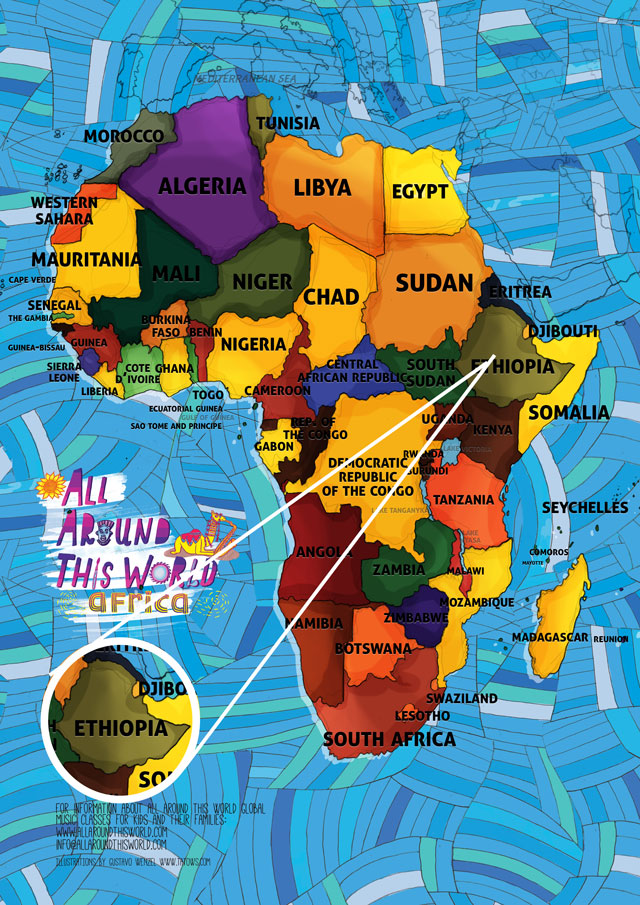
A washint is a small “end-blown” flute musicians from the Amahara people of Ethiopia played in their traditional songs and to accompany the melodic telling of history tales. There are many variations but in general the washint has from four to six finger holes.
A kebero is a conical hand drum that is present in music from Eastern Africa, especially in countries like Eritirea, Ethiopia and Sudan. The drum is double-headed though the musician usually plays one side, hanging the drum on a strap over a shoulder. East African Orthodox Christians use large keberos in their rituals and celebrations.
Most contemporary Ethiopian music draws heavily on traditional Egypt’s Coptic modes and melodies, so much so that telling the difference between traditional (bahalawi) and modern (zemenawi) musicians isn’t always easy. For example, one of the most prominent Ethiopian music styles is ETHIO-JAZZ, which arose in the 1960s after Ethiopian musician Mulatu Astatke fell in love with American jazz while studying and traveling in the West. Returning to Ethiopia, he blended ancient Ethiopian scales with syncopated jazz rhythms. Astatke (read an interview with him here) has long been a legend in the Ethiopian jazz world, but found international fame most recently when his song “Yekermo Sew†appeared in the soundtrack of the Jim Jarmusch movie, “Broken Flowers.” Take a look at Astatke and his band performing “Yagelle Tezeta†live. You may also enjoy Alemayehu Eshete, known as the “Ethiopian Elvis.” You can see Eshete here with his band of “ferenje” [foreigners].)
The Ethiopian “eskista” is the nation’s most beloved, most iconic dance. “Eskista” means “dancing shoulders” in Amharic, and dance our shoulders shall!
Eskista dancers generally form rows or line up in groups and actively engage everyone in the room with their shoulder shakes and shimmies. The dance is public form of enjoyment and not just for private couples.
Still, the eskista is far more than just a party dance. Traditionally different kinds of eskistas tell different stories or teach myriad life lessons. Some eskista moves simulate body movements Ethiopians make in the course of a day, others the motion of animals, more even the slithering bobs of a snake.
In class we dance the Eskista to our favorite Ethiopian song, “Nanu Nanu Ney.”
Ethiopia is a culturally vibrant country with phenomenal food, generous people and the benefit of a couple thousand years of political independence.
Our pages and lessons about Ethiopia for kids, including ample historical, musical and cultural content, are still to come.
We are revising the AllAroundThisWorld.com site and are currently using a new (better!) site — ExploreEverywhere.com — to tell you all about our curriculum offerings and how to become one of our teachers. That said, if you were on ExploreEverywhere, you clicked to find more information about a song or lesson, and landed here, you’re in the right place! Some links may be broken and a detail or two may be out of date…but close the popup window and enjoy!