Countries Archives: Iceland

Greenland for Kids — Ice Fishing — All Around This World

In Greenland, Iceland and other Nordic countries the winters are darned cold, and with darned cold comes icy ponds that are right for fishin’. After eons of fishing in the cold the Inuit have figured out what to do to conquer the thick ice that sits between all of us and our very chilly fish. All we need is:

— an ice auger: a large drill to cut through the ice
— a spud: an ice-pick shaped like a wedge
— a “split shot”: a lead weight
— a “jigging rod”: a regular fishing rod, and
— a “tip up”: a contraption that allows you to lower a line down into the ice and that “tips up” a spring-loaded flag to alert you when the fish takes your bait so you can reel in the fish by hand.

How to sing with Jay each week in your home or classroom Support All Around This World on Patreon Enjoy interactive All Around This World lessons in your home or classroom

Iceland–Music


Other than a few early Irish monks and the occasional wave of Norse and Danish settlers, Iceland remained isolated from the rest of the world for centuries. Icelandic music therefore grew in sort of a vacuum, with unique melodies, rhythms and narrative themes developing over many generations. For example, in the “hákveða” (“heavy foot”) rhythm, a particular rhythm only found in Iceland, singers place a special emphasis on the last word of each sentence they sing. For example, listen to an original version of the Icelandic song we know from class, “Ólafur Liljurós,” and listen to the emphasis on the “hann” in the lines “villir hann” and “stillir hann.” (Meet an Icelandic instrument known as the langspil. Meet
an Icelandic instrument known as the fiðla. Meet them both together.)

Also, according to Wikipedia’s entry on the music of Iceland, Icelandic folk songs “are often about love, sailors, masculinity, hard winters and elves, trolls and other hidden people.” That sounds awesome.

Though European dances like the polka and waltz became popular in Iceland when Danish settlers introduced them in the early 18th century, somewhat of a roots revival has brought back older Icelandic cultural dances like the vikivaki, which has been a staple on the Icelandic scene since the 11th century. (Enjoy a traditional Icelandic dance known as the Á Sprengisandi. Or take a look at the Langisandur.)

RIMUR:
Rimur are epic Icelandic tales which performers sing poetically and most often without backing instruments. Most rimur have their origin in the Viking Age Eddic poetry of the Skalds which is dense with poetic metaphor and cryptic, complicated rhymes. Forgive the darkness of this video but sing along to a short taste of rimur performed by Gunnar Hrafn Hrafnbjargarson.

ICELANDIC POPULAR MUSIC:
Iceland may have a minuscule population–less than 325,000, if you’re curious–but it has somehow produced a disproportionate number of internationally known musicians. Icelandic bands don’t all share any particular unifying sound, but the best known Icelandic performers seem to be utterly confident in the creating music that sounds unlike popular music from anywhere else in the world. For example, music from the band Sigur Rós (“Victory Rose”) has a mesmerizing, almost transcendental air about it. Watch Sigur Rós perform “Staralfur,” which is a song–confirming the Wikipedia quotation above–about
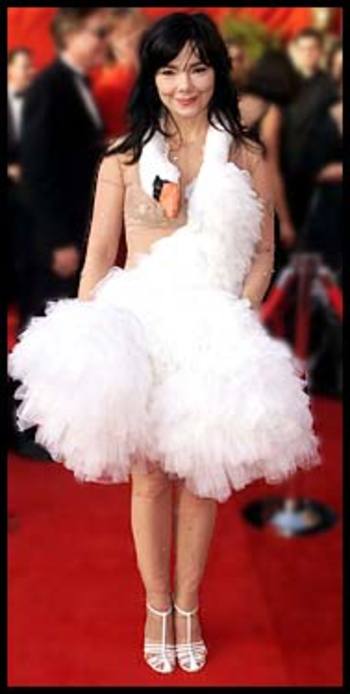
little elves. By far the most famous Icelandic musician is the entirely unique singer/songwriter/actress/performer/duck, BJÖRK. Björk is the daughter of a well-known Icelandic union leader, Guðmundur Gnnarsson, but her musical talents catapulted her to fame far beyond Iceland’s tiny borders. Since her early days as the lead vocalist of the Icelandic band, SUGARCUBES, Björk has created music that combines jazz and folk and electronica and rock and classical composition, and has invented a sound that’s only her own. (Watch a performance of “Earth Intruders.” No one else makes music like that.) [Watch Björk perform, “All is Full of Love.”

Watch Björk perform “It’s Oh So Quiet.”]

Lesson 11: Iceland

Other than a few early Irish monks and the occasional wave of Norse and Danish settlers, Iceland remained isolated from the rest of the world for centuries. Icelandic music therefore grew in sort of a vacuum, with unique melodies, rhythms and narrative themes developing over many generations. For example, in the “hákveða” (“heavy foot”) rhythm, a particular rhythm only found in Iceland, singers place a special emphasis on the last word of each sentence they sing. For example, listen to an original version of the Icelandic song we know from class, “Ólafur Liljurós,” and listen to the emphasis on the “hann” in the lines “villir hann” and “stillir hann.” (Meet an Icelandic instrument known as the langspil. Meet an Icelandic instrument known as the fiðla. Meet them both together.) Also, according to Wikipedia’s entry on the music of Iceland, Icelandic folk songs “are often about love, sailors, masculinity, hard winters and elves, trolls and other hidden people.” That sounds awesome.

Though European dances like the polka and waltz became popular in Iceland when Danish settlers introduced them in the early 18th century, somewhat of a roots revival has brought back older Icelandic cultural dances like the vikivaki, which has been a staple on the Icelandic scene since the 11th century. (Enjoy a traditional Icelandic dance known as the Á Sprengisandi. Or take a look at the Langisandur.)

RIMUR:
Rimur are epic Icelandic tales which performers sing poetically and most often without backing instruments. Most rimur have their origin in the Viking Age Eddic poetry of the Skalds which is dense with poetic metaphor and cryptic, complicated rhymes. Forgive the darkness of this video but sing along to a short taste of rimur performed by Gunnar Hrafn Hrafnbjargarson.

ICELANDIC POPULAR MUSIC:
Iceland may have a minuscule population–less than 325,000, if you’re curious–but it has somehow produced a disproportionate number of internationally known musicians. Icelandic bands don’t all share any particular unifying sound, but the best known Icelandic performers seem to be utterly confident in the creating music that sounds unlike popular music from anywhere else in the world. For example, music from the band Sigur Rós (“Victory Rose”) has a mesmerizing, almost transcendental air about it. Watch Sigur Rós perform “Staralfur,” which is a song–confirming the Wikipedia quotation above–about little elves.
By far the most famous Icelandic musician is the entirely unique singer/songwriter/actress/performer/duck, BJÖRK. Björk is the daughter of a well-known Icelandic union leader, Guðmundur Gnnarsson, but her musical talents catapulted her to fame far beyond Iceland’s tiny borders. Since her early days as the lead vocalist of the Icelandic band, SUGARCUBES, Björk has created music that combines jazz and folk and electronica and rock and classical composition, and has invented a sound that’s only her own. (Watch a performance of “Earth Intruders.” No one else makes music like that.) [Watch Björk perform, “All is Full of Love.” Watch Björk perform “It’s Oh So Quiet.”]
Olafur

Country: Iceland
Language: Icelandic

Genre: Icelandic

Olafur Liljuros is an Icelandic folk song with a fascinating rhythm. Says wikipedia in its “Music of Iceland” entry, “Iceland’s isolation meant that, until the 19th century, foreign influences were virtually absent, which resulted in the maintenance of a particular rhythm, called ‘hákveða’, lost in other Nordic countries and considered one of the main characteristics of Icelandic folk music. Hákveða refers to a special emphasis placed on some of the words of a song, often the last word of each sentence in each verse.”

The basic story of the original version of Ólafur Liljuros involves a lot of intrigue (and quite a bit of blood). For a blow by blow account, read Silver_Biscuit’s translation and summary on Wordreference.com.

Original Lyrics:

Ólafur rode with rocks ahead
Led astray, he was calm,
He found before himself an elf-dwelling
There the red flame burnt
Mild blew the breeze from under the rocks ahead

Lyrics of All Around This World version:

Olaf rode with cliffs ahead
Villir hann, stillir hann
He found an elf who teased him, but Olaf he stayed calm
Olaf rode with cliffs ahead, he found an elf who teased him but Olaf he stayed calm.

How to sing with Jay each week in your home or classroom Support All Around This World on Patreon Enjoy interactive All Around This World lessons in your home or classroom