Countries Archives: Nigeria

Sekere

A sekere is a hollowed gourd surrounded by a “skirt” of beads that clatter against it when shaken. Sekere.com tells us that though “the sekere gourd has a small bulbous ‘head’ atop a thin ‘neck’ attached to a suddenly large, round ‘belly,’…the ironic thing about the sekere gourd is that the “perfect” one is not always the best for the musician. Sometimes, imperfections work in the musician’s favor.” The sekere is loud. The sekere is awesome!

How to sing with Jay each week in your home or classroom Support All Around This World on Patreon Enjoy interactive All Around This World lessons in your home or classroom

Talking drum

The “talking drum,” also known in various countries as the “dondo” or the “dundun,” is a West African hourglass drum a percussionist can manipulate to mimic a human voice. The drummer does this by constricting the ropes that run along its sides to tighten or loosen the drum head and by using a mallet to hit the head in particular ways to elicit particular sounds. (Watch Nigerian master drummer Ayan Bisi Adeleke make his drum talk.) Historically, West Africans used the tones they created on talking drums to communicate important messages from village to village, such as the announcement of a celebration or a warning about coming attack. This was especially useful for drummers “talking” in tonal languages such as Nigeria’s Yoruba, as you can hear in this example from Youtube, or in the Bantu language Bulu, an account of which you’ll find in this 1942 Time Magazine article: “Formerly every Bulu man and almost every woman had a special drum signature, like a radio program’s theme song–a cryptic sentence full of jungle implications. Sample talking drum names: ‘Even if you dress up finely, love is the only thing’; ‘The giant wood rat has no child, the house rat has no child’; ‘You’ll die of witchcraft at midnight.'”

How to sing with Jay each week in your home or classroom Support All Around This World on Patreon Enjoy interactive All Around This World lessons in your home or classroom

Ashiko

The ashiko is a West African drum that originated in Nigeria’s “Yorubaland.” It is a powerful percussion instrument, with an animal skin head and a cylindrical body. Despite the fact that drummers all over the world play ashikos and drums influenced by them, like the Afro-Cuban congas, these drums never seem to get the respect they deserve. Ashikos are not djembes! They’re NOT just “counterparts to a djembe!” They’re NOT just drum “between a conga and a djembe!” As DRUMatic Innovation emphatically reminds us, “an ashiko is an ashiko.”If you’re curious about the difference between an the two drums, these drummers on harmonycentral.com want to tell you.

iframe src=”//www.youtube-nocookie.com/embed/cttmCl1W5ws” width=”560″ height=”315″ frameborder=”0″ allowfullscreen=”allowfullscreen”>

How to sing with Jay each week in your home or classroom Support All Around This World on Patreon Enjoy interactive All Around This World lessons in your home or classroom

Fuji

Fuji is a Nigerian genre that arose as a popular manifestation of the improvised “Were music” Muslims play in Nigeria’s Yoruba areas to wake neighbors for fasting during Ramadan. Fuji started in the 1960s when “ajiwere” bands started to add elements of many Nigerian genres to their up-all-night musical performances. Today the most popular fuji music, like that of Adewale Ayuba, is upbeat, danceable and uses electronic instruments.

How to sing with Jay each week in your home or classroom Support All Around This World on Patreon Enjoy interactive All Around This World lessons in your home or classroom

Afrobeat

Known as “The Black President,” Fela Anikulapo Kuti began his career in the early ’60s playing highlife in clubs around West Africa and the UK. In the late ’60s, Fela encountered the American Black Power movement and American funk, both in the body of James Brown. Fela fused highlife and Brown’s hard-living funk to create AFROBEAT and he fused Pan-Africanism and Black Power with his music to become one of the most powerful musicians of all time. See Fela in performance (in the rain) in 1971: shot soon after the Nigerian Civil War by Eric Clapton/Cream drummer and Fela friend Ginger Baker. AFROBEAT’s rhythms are dense and driving, with multiple different rhythms layering upon one another at once to provide both depth and constant motion.

How to sing with Jay each week in your home or classroom Support All Around This World on Patreon Enjoy interactive All Around This World lessons in your home or classroom

Juju Music

The many musical styles of Nigeria are an extraordinary fluid mix of traditional African rhythms and Western jazz, funk, hip hop and soul. Powerful Nigerian musicians such as Fela Kuti and King Sunny Ade have both influenced and were influenced by generations of Western musicians King Sunny Ade (known in Nigeria as KSA) is one of the fathers of JUJU MUSIC, a Nigerian form of party music that added Yoruba percussion to West African “palm-wine.”Ade’s long-time rivalry with juju-evangelist-turned-Christian-evangelist “Chief Commander” Ebenezer Obey helped make JUJU wildly popular in Nigeria from the ’60s until the ’80s. Watch KSA on YouTube performing “Me Le Se.” (Visit the Chief Commader on Facebook.)

How to sing with Jay each week in your home or classroom Support All Around This World on Patreon Enjoy interactive All Around This World lessons in your home or classroom

Nigeria–Music

Nigerian music is an extraordinary fluid mix of traditional African rhythms and Western jazz, funk, hip hop and soul. Nigerian musicians  have both influenced and were influenced by generations of Western musicians.

All Around This World really shouldn’t be choosing favorites, BUT….. All Around This World’s favorite musician of all time is Fela Kuti, who was a powerful, complicated, FEARLESS musician who used his talents as a performer, lyricist and instrumentalist to directly confront both the debilitating injustices of colonialism and dangerously dictatorial Nigerian regimes. Known as “The Black President,” Fela began his career in the early ’60s playing highlife in clubs around West Africa and the UK.  In the late ’60s, Fela encountered the American Black Power movement and American funk, both in the body of James Brown.  Fela fused highlife and Brown’s hard-driving funk to create Afrobeat, and he fused Pan-Africanism and Black Power with his music to become one of the most politically powerful musicians of all time.  See Fela in performance (in the rain) in 1971: shot soon after the Nigerian Civil War by Eric Clapton/Cream drummer and Fela friend Ginger Baker.

We’re also big fans of:
King Sunny Ade (known in Nigeria as KSA) Ade is one of the fathers of juju music, a Nigerian form of party music that added Yoruba percussion to West African “palm-wine.”  Ade’s long-time rivalry with juju-evangelist-turned-Christian-evangelist “Chief Commander” Ebenezer Obey helped make juju wildly popular in Nigeria from the ’60s until the ’80s.

More information: Watch KSA on YouTube performing “Me Le Se” | Visit the Chief Commader on Facebook.

Babatunde Olatunji: “Akiwowo.” Nigerian percussion legend Olatunji is known throughout Africa as master of many of the continent’s most complex and culturally meaningful rhythms.  He is most recognized in the West for his collaborations with the Grateful Dead’s Mickey Hart, though those in-the-know also have him to thank for inspiring comedian Andy Kaufman to learn to play the conga.  You can see him on YouTube performing with “Drums of Passion.”

 

How to sing with Jay each week in your home or classroom Support All Around This World on Patreon Enjoy interactive All Around This World lessons in your home or classroom

Nigeria–Language

Click here to learn how to take class online with Jay

[wpspoiler name=”Another language of Nigeria–talking drum” open=”true” style=”aatw-video”][/wpspoiler]

There are 510 living languages in Nigeria, but in music class we actually try our hand at one of them: Yoruba.

Unlike Nigeria’s other main ethnic groups, the Igbo, most of whom are Christians (although some claim the Igbo once were, and still may be, Jews), and the Hausa, most of whom have been Muslim since the 11th century, some Yoruba, while also practicing Islam and Christianity, maintain close connections to their ancient polytheistic religion. Yoruba beliefs spread to the West via the slave trade and form the basis of several religions, such as Cuban Santeria and Haitian voudo.

How to sing with Jay each week in your home or classroom Support All Around This World on Patreon Enjoy interactive All Around This World lessons in your home or classroom

Lesson 8: Nigeria

All Around This World’s exploration of Africa includes sing-along, dance-along classroom and homeschool lessons about Nigeria for kids . . . Meet the world through music –“come to class” with Jay.

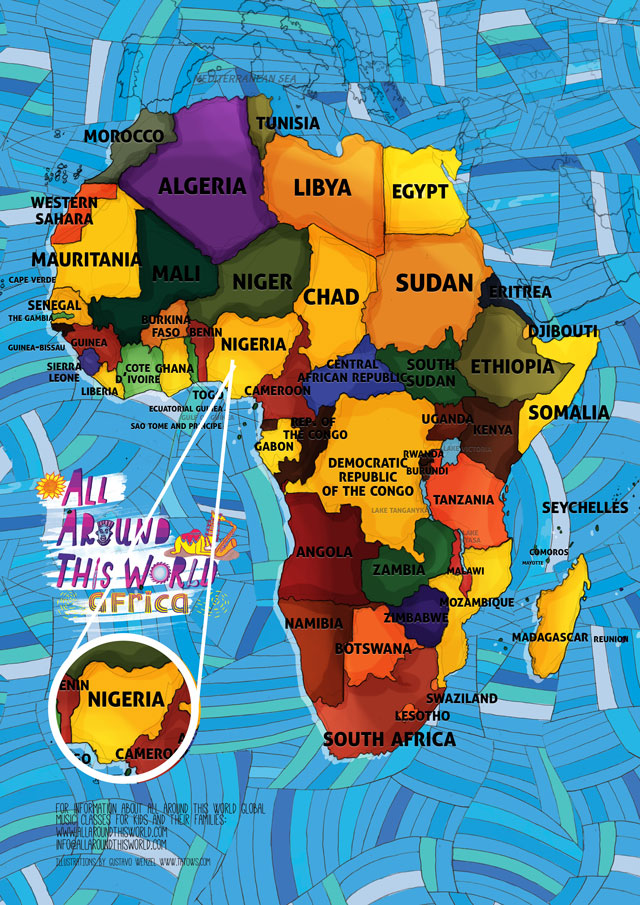
All Around This World Map of Africa Featuring Nigeria for kids

LonelyPlanet.com‘s entry on Nigeria calls it a “country of extremes,” in which great wealth exists side by side with great poverty, a place where interreligious conflicts, unrest in the oil-rich Niger Delta region and infamous 419 scams give it a constant public-relations black eye…yet despite the nation’s reputation for chaos and corruption, Nigerian people, proud of their 250 ethnic groups, their literary titans, their musical legends and of course Nollywood, report that they are the happiest people in the world. Musically, Nigeria makes us all very happy. Just bringing Afrobeat icon Fela Kuti forward would have been enough, but Nigerian music offers us more and more and more.


START HERE:

MUSIC: Nigerian music is an extraordinary fluid mix of traditional African rhythms and Western jazz, funk, hip hop and soul . . .

LANGUAGE: There are 510 living languages in Nigeria . . .

How to sing with Jay each week in your home or classroom Support All Around This World on Patreon Enjoy interactive All Around This World lessons in your home or classroom