Countries Archives: Uruguay

Uruguay for Kids — Gauchos

all-around-this-world-south-america-teach-kids-about-gauchos-2

LET’S SPEND THE DAY WITH URUGUAYAN GAUCHOS

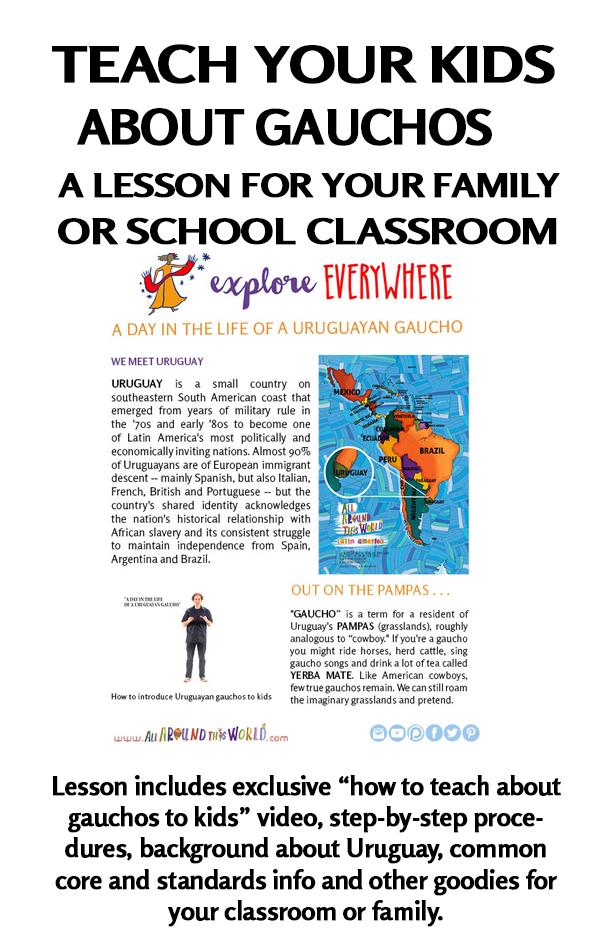
“GAUCHO” is a term for a resident of Uruguay’s PAMPAS (grasslands), roughly analogous to “cowboy.” If you’re a gaucho you might ride horses, herd cattle, sing gaucho songs and drink a lot of tea called YERBA MATE. Like American cowboys, few true gauchos remain. We can still roam the imaginary grasslands and pretend.

Before we can become gauchos we must dress appropriately: BOMBACHAS DE CAMPO (comfy cotton pants with button at the ankle), ALPARGATAS (rope sole and canvas shoes), PONCHO, and a HAT!! (hats differ regionally, but you might wear your BOINAS [beret] around town).

PLEASE NOTE: The lesson and embedded video are NOT “How to be a Gaucho” tutorials. The goal of this lesson is to provide the tools for you to treat your very youngest students to their first introduction to gauchos and to inspire you to get up and enjoy a conceptual “day in the life of a gaucho” together. Ideally the lesson will be the first step on your and your students’ road to further Gaucho exploration.

How to sing with Jay each week in your home or classroom Support All Around This World on Patreon Enjoy interactive All Around This World lessons in your home or classroom

Murga (Argentina, Uruguay)

Murga is a rambunctious form of public musical theater performed primarily during Carnival in Argentina and Uruguay. There are usually over a dozen performers in a murga–Wikipedia very specifically says “a maximum of 17”–and they’re almost always men. The group performs a play that consists of theatrical, satirical songs and broad dances. Each  ensemble performs in several neighborhoods throughout Carnival. The percussion battery consists of a bombo (a bass drum a drummer attaches to him or herself with a strap and plays horizontally), a redoblante (snare) and platillos (loud cymbals).

COUNTRY: Argentina, Uruguay
KEY INSTRUMENTS: Bombo, Platillos, Redoblante

[mappress mapid=”16″ center=”-8, -60″ zoom=”3″]

How to sing with Jay each week in your home or classroom Support All Around This World on Patreon Enjoy interactive All Around This World lessons in your home or classroom

Milonga (Argentina, Uruguay)

Nowadays the term “milonga” is just as likely to refer to a form of Argentinian/Uruguayan music–a musical predecessor of tango–as it is to a party or even a nightclub where people meet so they can dance tango. Originally the music consisted of songs performed by Argentinian and Uruguayan “gauchos” who fused Spanish habanera and Afro-Uruguayan candombe. Singers would improvise lyrics–often off-color lyrics–and accompany themselves with instrumentation as simple as a single guitar. As the genre caught on with immigrants from Europe and Africa and developed into tango, milonga ensembles grew into orchestras, and dance parties became tango extravaganzas. Let Libertango teaches more about the difference between milonga and tango.

COUNTRY: Argentina, Uruguay
KEY INSTRUMENTS: Accordion, Guitar

[mappress mapid=”16″ center=”-8, -60″ zoom=”3″]

How to sing with Jay each week in your home or classroom Support All Around This World on Patreon Enjoy interactive All Around This World lessons in your home or classroom

Repinique

A repinique is a double-headed drum that’s a key component of the Brazilian samba bateria. Because it has a tone high enough to be heard through the sounds of the rest of the members of the bateria musicians can use it to solo or play lead.

COUNTRY: Brazil, Uruguay
KEY GENRES: Candombe, Samba


How to sing with Jay each week in your home or classroom Support All Around This World on Patreon Enjoy interactive All Around This World lessons in your home or classroom

Bandoneon

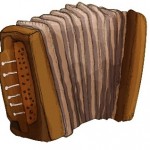
BandoneonThe bandoneon is a kind of concertina that is central to the Argentinian and Uruguayan tango. The instrument was originally conceived in Germany in the mid-1800s and traveled with European sailors to Argentina in the late 1800s. The bandoneon is also popular in Lithuania. (Don’t miss the Jurbarkas bandoneon ensemble!)

COUNTRY Argentina, Uruguay
KEY GENRES: Tango

[wpspoiler name=”Adios Nonino Bandoneon Solo” open=”true” style=”aatw-video”][/wpspoiler]

How to sing with Jay each week in your home or classroom Support All Around This World on Patreon Enjoy interactive All Around This World lessons in your home or classroom

Candombe (Uruguay)

Candombe is Afro-Uruguayan music that originated with African slaves who arrived in Uruguay starting in the mid 1700s. “Candombe” was the generic name for their dances; the Africans called their drums, and the place they gathered to perform their music, “tangó.” In the early 1800s the Uruguayan government tried to ban the genre, fearing the cultural expression would lead to insurrection. By the mid 1800s when Uruguay abolished slavery, African dancing had become an inextricable part of Uruguayan culture. Candombe.com presents this history and then goes on to discuss the three different drums (tambores) that perform together in an ensemble called a “cuerda” to compose the genre’s unique rhythm–tambor piano, tambor chica, and tambor repinque. The basic rhythmic pulse is called the “madera” (“wood”) and is similar to the Afro-Cuban 3-2 son clave.

More:

Ruben Rada and Hugo Fattoruso perform live in 1987

Hugo Fattoruso and Tambores de Cuareim perform “Caminando”

More fun drumming

COUNTRY: Uruguay
KEY INSTRUMENTS: Candombe drums (chico, repique, piano)

[mappress mapid=”16″ center=”-8, -60″ zoom=”3″]

How to sing with Jay each week in your home or classroom Support All Around This World on Patreon Enjoy interactive All Around This World lessons in your home or classroom