Countries Archives: Zanzibar

Taarab

A stunning example of the mix of East African, Arabic, Persian and South Asian influences found in Eastern Africa is Zanzibar’s taarab, which is dramatic Swahili orchestral music which features instruments from several continents: Middle Eastern oud and dumbek, Indian tabla, western electric keyboards, and the “Japanese taishokoto, described here as “a banjo/typewriter key hybrid. According to Zanzibar.net, “taarab rhythms reflect traditional dances like chakacha, Indian film scores, Cuban rumba, and various Zairean and East African dance musics. Perhaps most importantly, the genre’s lyrics radiate with the allusive intricacies of Swahili poetry and showcase the beauty of this long, literary tradition.” Zanzibari music isn’t all taarab, though that’s rightfully where most overviews of Zanzibar’s music start. For a one shot overview of Zanzibar’s music, take a look at this YouTube video called “Zanzibar: Taarab — an Ocean of Melodies.” It does start with a taarab performance, featuring orchestral arrangements including an oud, but then it moves on to some East African ngoma drumming (at 4:14), some dance and drumming with more of an Asian feel (5:22), some hip-shaking African dance (5:55) and back to a great multi-influenced melody, featuring floor patting and clapping worthy of any “All Around This World” music class (starts at 8:01).

For more information:

Wikipedia: the Music of Tanzania | More info | Zanzibari Ngoma drumming | Kidumbak: “a diminutive kind of taarab” | The Dhow Countries Musical Academy: “Music for Education. Music for Employment. Music for Enjoyment.”


How to sing with Jay each week in your home or classroom Support All Around This World on Patreon Enjoy interactive All Around This World lessons in your home or classroom

Africa for Kids — Celebrate Mwaka Kogwa

LET’S CELEBRATE MWAKA KOGWA

In class we celebrate Mwaka Kogwa, a joyous, several day long Zanzibari festival that marks the arrival of Nairuz, the new year on the Shiraz (Persian, now Iranian) calendar. The most extensive Mwaka Kogwa festivities take place in Makunduchi, on the southeastern coast of Zanzibar, but wherever you celebrate Mwaka Kogwa, Mwaka Kogwa just wouldn’t be Mwaka Kogwa without several important observances:

THE FIGHT:
In Makunduchi, two brothers from the southern part of the area fight two brothers from the north. Tradition dictates that if people have a chance to fight at the beginning of the year they’ll vent their frustrations and live the rest of the year in peace. The weapon of choice? Banana stems!

SINGING:
While the fighting is going on, women sing songs in Kikae, a local Swahili dialect, about love and living in the village. Men reply in unison, taunting the women in a back and forth exchange.

THE HUT:
When the fight is almost done a local magician goes inside a nearby small coconut thatch hut, sets the hut ablaze, runs outside and flails himself onto a nearby bush. Everyone around then puts out of the fire. This represents the notion that if someone’s house does catch on fire throughout the year, everyone will survive.

THE LARGE ROCK:
The “sheha” (paramount chief) sits in a small, sparse hut near a huge magical rock that is supposed to be able to keep people from falling into a well during the celebration.

AFTER THE FIGHT:
Everyone eats at a big open banquet. Later that evening, everyone dresses up in his or her Mwaka Kogwa best and dances all night long.

PLEASE NOTE: The lesson and embedded video are NOT “How to celebrate Mwaka Kogwa” tutorials. The goal of this lesson is to provide the tools for you to treat your very youngest students to their first introduction to the festival and to inspire you to get up and enjoy our version of it together. Ideally the lesson will be the first step on your and your students’ road to further Zanzibari exploration.

Mwaka Kogwa 2010

How to sing with Jay each week in your home or classroom Support All Around This World on Patreon Enjoy interactive All Around This World lessons in your home or classroom

Zanzibar–Music


Like almost all prominent elements of Zanzibar’s culture, Zanzibari music is a mix of East African, Arabic, Persian and South Asian influences. Zanzibar’s most popular music is taraab, dramatic Swahili orchestral music which features instruments from several continents: Middle Eastern oud and dumbek, Indian tabla, western electric keyboards, and the “Japanese taishokoto,” which is “a banjo/typewriter key hybrid.” According to Zanzibar.net, “taarab rhythms reflect traditional ngoma dances like chakacha, Indian film scores, Cuban rumba, and various Zairean and East African dance music. Perhaps most importantly, taarab lyrics radiate with the allusive intricacies of Swahili poetry and showcase the beauty of this long, literary tradition.”

Zanzibari music isn’t all taarab, though that’s rightfully where most overview of Zanzibar’s music start. For a one shot overview of Zanzibar’s music, take a look at this YouTube video called “Zanzibar: Taarab — an Ocean of Melodies.” It does start with a taarab performance, featuring orchestral arrangements including an oud, but then it moves on to some East African ngoma drumming (at 4:14), some dance and drumming with more of an Asian feel (5:22), some hip-shaking African dance (5:55) and back to a great multi-influenced melody, featuring floor patting and clapping worthy of music class (starts at
8:01).

For a more comprehensive overview, Buda Musique — producer of the indispensable Ethiopian music collection, Ethiopiques — has created “Zanzibara,” which currently consists of five compilation CDs, featuring everything from taarab (on “Zanzibara 2: the Golden Age of Mombasa Taarab”) to sizzling big band “muziki wa danci” (dance music) on “Zanzibara 5: Hot in Dar, le son de la Tanzanie: 1978-1983.” Click on each CD’s image in the overview and you’ll be able to sample some tunes from each one.

For more information:
Wikipedia: the Music of Tanzania | More about Taarab | Zanzibari Ngoma drumming | Tanserve.co.uk’s helpful list of Zanzibari bands | Kidumbak: “a diminutive kind of taarab” | The Dhow Countries Musical Academy: “Music for Education. Music for Employment. Music for Enjoyment.”

How to sing with Jay each week in your home or classroom Support All Around This World on Patreon Enjoy interactive All Around This World lessons in your home or classroom

Zanzibar–Language

Zanzibar is generally regarded as the birthplace of Swahili, the predominant language of Eastern Africa. Swahili is mainly a language of the Eastern African Bantu people, but it reveals Zanzibar’s past as a trading and traveling hub by featuring many words and forms borrowed by from Persian and Arab visitors. Zanzibaris call the language “Kiswahili,” so that’s what we’ll call it.

More information:
A history of Swahili | The Institute of Kiswahili | Some common Swahili proverbs

How to sing with Jay each week in your home or classroom Support All Around This World on Patreon Enjoy interactive All Around This World lessons in your home or classroom

Zanzibar–When you go there

Is Zanzibar’s “allure legendary?” It is, according to Lonely Planet.com’s page about Zanzibar. LonelyPlanet describes Zanzibar as, “One of East Africa’s great trading centers, the archipelago has been for centuries a crossroads of culture, a melting pot of influences where Africa, India and Arabia meet, a complete change of pace from the mainland, a place where life’s rhythms are set by the monsoon winds and the cycles of the moon.” Sounds like legendary allure to me.

If you do make it to Zanzibar, you may want to go during the Festival of the Dhow Countries, which is East Africa’s most extensive arts and film festival, reveling in the culture of Africa, India, Pakistan, Iran, the Gulf States and the Indian Ocean Islands. You could also time your trip to coincide with Eid-ul-Hajj, marking the end of Ramadan — Zanzibar celebrates the occasion with a four day festival.

How to sing with Jay each week in your home or classroom Support All Around This World on Patreon Enjoy interactive All Around This World lessons in your home or classroom

Zanzibar–Overview

What exactly is Zanzibar and why is it so hip? Most every hip city has a hip Zanzibar nightclub, like Los Angeles, New York and, of course, Lviv, Ukraine. What makes Zanzibar such an enticing, velvet-rope-inspiring place?

Zanzibar is an archipelago in the Indian Ocean just off the African coast of Tanzania that consists of two main islands — Zanzibar, known logally as Unguja, and Pemba, and several smaller islets. For nearly a thousand years Zanzibar has been a trading and travel center where Persians, Arabs and Indians blended economically, linguistically and culturally with East Africa.

In 1964 Zanzibar, at the time a British protectorate, united with the mainland country of Tanganyika to form Tanzania (the “Tan” from Tanganyika and the “Zan” from Zanzbiar — a portmanteau). Under the Pan-Africanist leadership of Julius Nyerere, Zanzibar joined Tanzania in pursuing “Ujamaa” socialism, which emphasized egalitarianism, extended family, cooperative agriculture and communal ownership of the economy, and was supposed to enable Tanzania to become independent from foreign aid. Despite Ujamaa socialism — or because of it? — Tanzania has run a rocky economic and political road since independence. The country functionally dismantled most Ujamaa policies after Nyerere left the presidency in 1985.

Today, Zanzibar functions as a semi-autonomous part of Tanzania, boasting its own government, known as the Revolutionary Government of Zanzibar. But Zanzibar isn’t internationally hip because of its politics. Instead, Zanzibar is best known beyond its borders for its sandy beaches, coral reefs, its many resorts that attract wealthy international travelers, and the ancient historic town called “Stone Town.” Could pristine beaches and posh resorts be more hip than egalitarian socialism? At Newark, New Jersey’s, legendary Club Zanzibar, people were probably disco dancing too hard to care.

More information: Wikikipedia on Zanzibar | Overview of Zanzibar’s culture | Keeping Stone Town stoney | About Nyerere | Wikipedia on Ujamaa Socialism–not a great review | More about Ujamaa— a rosier view | Nyerere’s “Arusha Declaration”

One last note. Arguably Zanzibar’s most famous son is legendary musician Farrokh Bulsara; we all know him better as Freddie Mercury of Queen. Born in Zanzibar in 1946, Bulsara’s parents were Zoroastrian Parsees who worked closely with the British colonial government. When Farrokh was nine his parents sent him to boarding school in India, where he started studying piano. The rest, as they say, is history. (Okay, this is the real “Bohemian Rhapsody.”) Mercury never returned to Zanzibar, though some aren’t too upset about that. In 2006 a Zanzibari festival and AIDS benefit to mark the 60th anniversary of Mercury’s birth became a touchpoint for cultural and religious controversy, as a traditional Islamic group protested what it saw as a glorification of Mercury’s flamboyant Western lifestyle, including his sexual orientation. Authorities canceled the celebration. However, in the hearts of the oh-so-many Queen fans, Mercury rocks on.

How to sing with Jay each week in your home or classroom Support All Around This World on Patreon Enjoy interactive All Around This World lessons in your home or classroom

Lesson 4: Tanzania/Zanzibar

All Around This World’s exploration of Africa includes sing-along, dance-along classroom and homeschool lessons about Tanzania for kids . . . Meet the world through music –“come to class” with Jay.

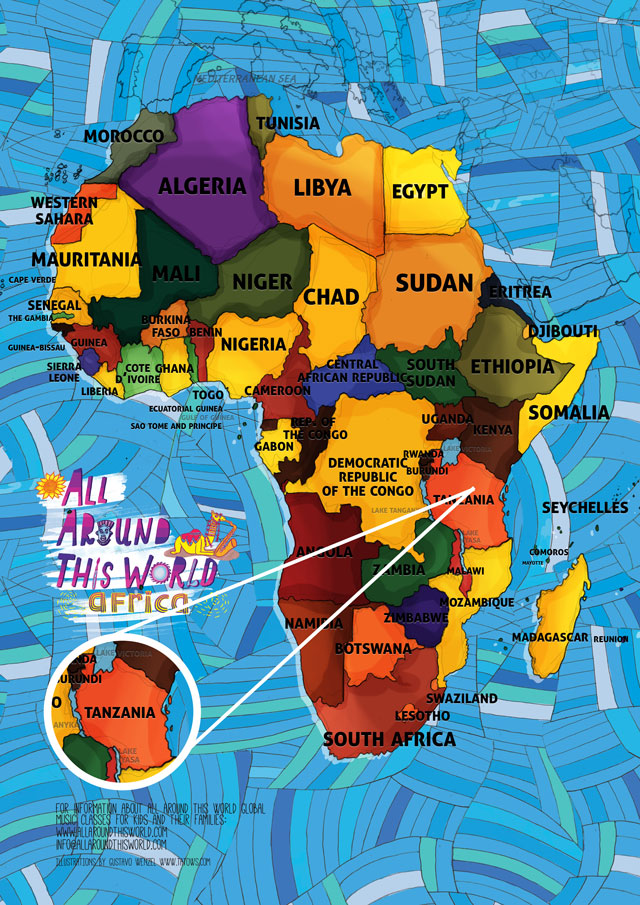
All Around This World map of Africa featuring Tanzania for kids

This week in music class All Around This World families bound across Africa with such exuberance that we overshoot the Eastern coast and land in the Indian ocean. When we claw for shore we’wind up in Zanzibar, which we’ll find about 25 miles east of the East African country of Tanzania. What does one do when one finds oneself on an island about 15 miles east of Tanzania? Let’s find out.


START HERE

OVERVIEW: What exactly is Zanzibar and why is it so hip? What makes Zanzibar such an enticing, velvet-rope-inspiring place . . . ?

MUSIC: Like almost all prominent elements of Zanzibar’s culture, Zanzibari music is a mix of East African, Arabic, Persian and South Asian influences . . .

LANGUAGE: Zanzibar is generally regarded as the birthplace of Swahili, the predominant language of Eastern Africa . . .

WHEN YOU GO THERE: Is Zanzibar’s “allure legendary?” It is, according to LonelyPlanet.com’s page about Zanzibar . . .

MWAKA KOGWA: In music class we celebrate Mwaka Kogwa, a joyous, several day long Zanzibari festival that marks the arrival of Nairuz, the new year on the Shiraz (Persian, now Iranian) calendar . . .

How to sing with Jay each week in your home or classroom Support All Around This World on Patreon Enjoy interactive All Around This World lessons in your home or classroom