Timbales come in sets of two shallow, high-pitched drums, to which a percussionist often attaches other instruments like cymbals, cowbells and claves. Timbales appear in Latin musical genres from salsa to mambo to reggaeton. Sometimes a percussionist hits the top of the timbales, other time s/he keeps time hitting the sides. A little bit about the timbales, Enjoy a timbale solo, or two, or three.
The guiro is a staple percussion instrument found in many Latin-American types of music. Traditionally it is made of a hollow gourd with parallel notches cut into a side; musicians play it by scraping a wooden stick along the ridges.
Salsa is Puerto Rico’s most danceable musical export. The musical progeny of Cuban son from which it borrows its signature 3-2 and 2-3 clave patterns, the genre may have started in Cuba and Puerto Rico but really took root in the ’60s and ’70s in New York City where Puerto Rican immigrants fused son, mambo and little guaracha to make an extraordinary new musical form. Stars like Frankie Ruiz, Willie Colon, and Panamanian superstar Rubén Blades brought the music to the U.S., to Latin America, and by the mid ’70s to the world. Salsa bands are usually ambitions affairs, featuring many percussion instruments and horns, though the basic stripped-down ensemble consists of just claves, güiro, timbale, cowbell and congas. If you want to build your own rhythm, take a look at Stephen’s salsa page or the Salsa Beat Machine where you’ll be able to turn on and off the instruments as if you were leading your own big band. Speaking of which, see Colon and Blades together make a powerful duo on “Tiburon.”
GENRE: Salsa
A rockin’ salsa tune by New York-based Willie Colon and Puerto Rican vocalist Hector Lavoe. The “murga” Lavoe is singing about is a reference to the groups of street musicians that gather during Carnival and march from spot to spot playing songs and getting people to dance. [wpspoiler name=”Willie Colon performs La Murga” style=”aatw-video” open=”true”][/wpspoiler]
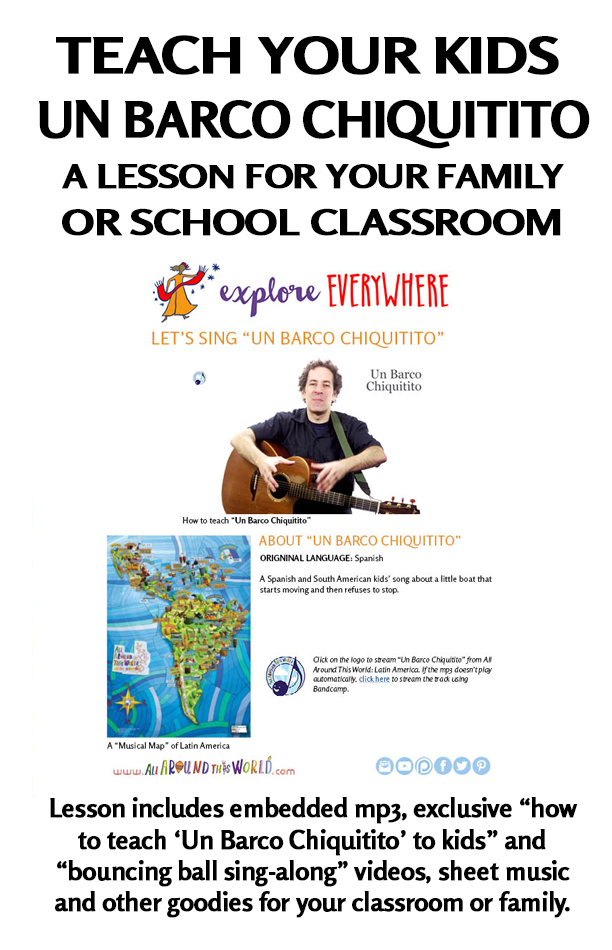
“Barco chiquitito” is a Spanish song about a boat — a fantastic little boat, in our opinion. There are several versions of this song, but in the most widely sung, there is a little boat that can’t set sail for seven weeks, during which time provisions start to run out. In one translation, crew members get so hungry they eat their boots “with red sauce and a walnut,” get very sick and have to turn back. While our version is still a Spanish song about a boat, we not only let the ship sail, but say that it’s unable to stop sailing, then we also sing about an airplane that can’t stop flying, and, in class, we go through other modes of transport and say they can’t stop going either (a car, a bicycle, a pogo stick….).
Instruments on CD: Bass, Congas, Drum kit, Piano, Timbales, Trombone, TrumpetLYRICS OF ALL AROUND THIS WORLD VERSION
Habia una vez un barco chiquitito
Habia una vez un barco chiquitito
Habia una vez un barco chiquitito
Que no podia, no podia, no podia parar.
Once upon a time there was a little boat
Once upon a time there was a little boat
Once upon a time there was a little boat
And it could, and it could, and it could not stop.
Credits
Vocals: Tony Perez Bass: Rob Hagopian Piano/Keyboard: John Stengel Trombone: James Negron
Trumpet: Nelson Miranda Drums/percussion: Francois Zayas Percussion: Arturo Stable
Drums, keyboard and bass engineered and co-produced by Mark Wolfe at Audio Mind.
We are revising the AllAroundThisWorld.com site and are currently using a new (better!) site — ExploreEverywhere.com — to tell you all about our curriculum offerings and how to become one of our teachers. That said, if you were on ExploreEverywhere, you clicked to find more information about a song or lesson, and landed here, you’re in the right place! Some links may be broken and a detail or two may be out of date…but close the popup window and enjoy!