Pagode originated in the early ’80s as a festive, fun, highly danceable subgenre of samba that has come to be associated–not always favorably–with lighthearted pop. Pagode performers introduced new instruments into the samba batteria, such as the 4-string banjo (louder than the traditional cavaquinho), the tan-tan (a brighter-sounding surdo, played with the hands and used to keep the main beat) and the hand-repique (used especially to emphasize rhythmic turnarounds). The genre’s lyrics are more satirical and slang-laden than samba lyrics from other genres, and often come with a bite.
The cavaquinho is a Brazilian instrument, a small four-stringed cousin of a guitar. The instrument originated in Portugal but has become important in Brazil as a staple of both Choro and Samba, and is also found in Cape Verde, former Portuguese-colonized islands off the West African coast.
COUNTRY: Brazil, Cape Verde, Portugal KEY GENRES: Choro, Morna, Samba
Choro is a type of instrumental “lament” that originated in Rio in the 19th century. The original choro trio consisted of a flute, guitar and cavaquinho (which actually looks like a small, four-stringed guitar). Samba and bossa nova eventually replaced choro as Brazil’s main musical form, but amateur choro circles called “rodas de choro” kept it alive. Today it is undergoing somewhat of a revival.
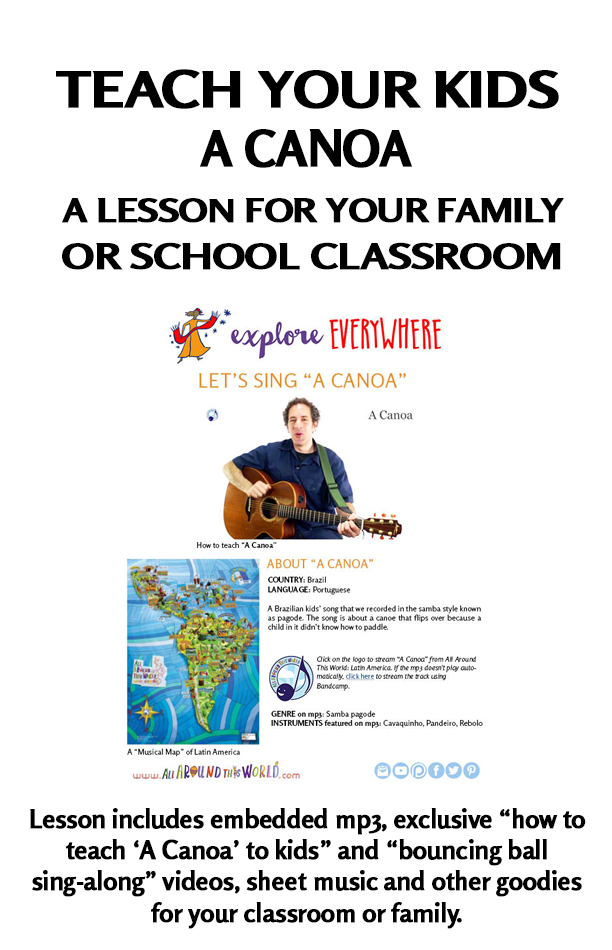
A Brazilian children’s song that we recorded in the samba style known as pagode. The song is about a canoe that flips over because the child we’ve chosen as our captain doesn’t know how to paddle.
The canoe flipped and who made it flip was it you?
It was because of Molly, now what are we going to do?
Paddle left and paddle right, paddle left and paddle right, paddle left and paddle right, paddle left and
paddle right.
A canoa virou, quem deixou ela virar
Foi por causa da [child’s name], que não soube remar
Siriri prá cá, siriri prá lá, siriri prá cá, siriri prá lá
Siriri prá cá, siriri prá lá, siriri prá cá, siriri prá lá
Credits
Translation and arrangement by Jay Sand. Instrumental arrangement by Alex Shaw and Arturo Stable.
Brazilian percussion, vocals and engineering: Alex Shaw
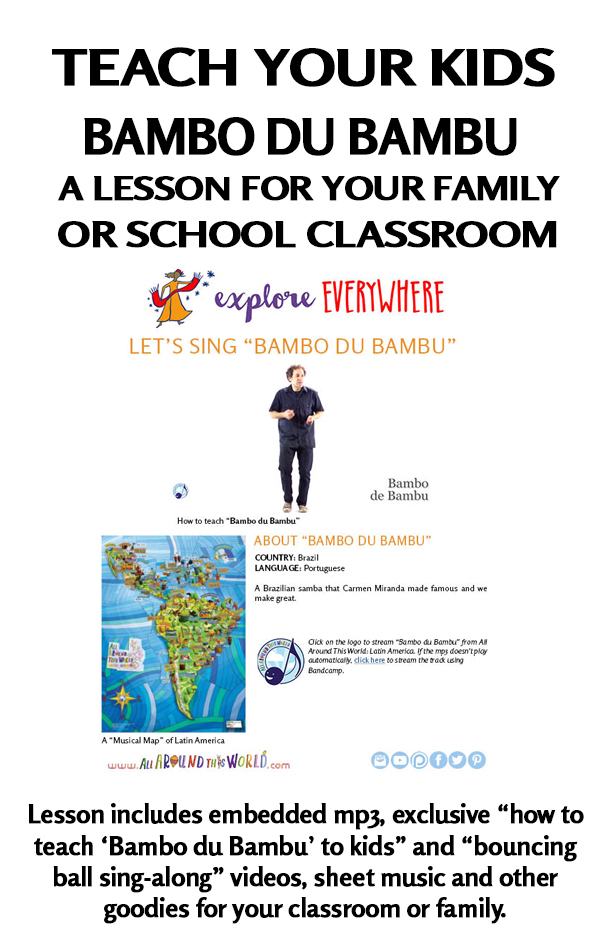
A samba song for kids from Brazil, initially recorded in 1939 by Carmen Miranda, then again in 1940 as part of a legendary yet, for decades, unreleased recording Native Brazilian Music, a joint U.S./Brazilian goodwill endeavor coordinated on the Brazilian end by iconic composer Heitor Villa-Lobos. The original is an embolada, a fast-paced, often-improvised song style popular in northeastern Brazil in which vocalists challenge each other, competing lightly based on verbal and vocal ability. Found on the Smithsonian Folkways album, Music of the World’s Peoples: Vol. 3.
NOTE: The title of the song, “Bambo du Bambu,” is nonsensical, grammatically and otherwise. All Around This World decided to keep it for our samba song for kids because it was the title of a well-known recording of the song from the 1950s.
Country: Brazil Language: Portuguese Genre on CD: Samba
We dance bambo du bambulelê, we dance bambo de bambulalá
We dance bambo du bambu we’re dancing the samba with our mother, brother, sister and papa, oh!We dance bambo du bambu we’re dancing the samba with our mother, brother, sister and papa, oh!
We dance samba samba samba samba samba samba samba samba samba samba samba with mama
We dance samba samba samba samba samba samba samba samba samba samba with papa
A recent version of Bambo du Bambo performed by Ney Matogrosso, with much inspiration from Carmen Miranda
We are revising the AllAroundThisWorld.com site and are currently using a new (better!) site — ExploreEverywhere.com — to tell you all about our curriculum offerings and how to become one of our teachers. That said, if you were on ExploreEverywhere, you clicked to find more information about a song or lesson, and landed here, you’re in the right place! Some links may be broken and a detail or two may be out of date…but close the popup window and enjoy!