Instruments Archives: Pandeiro

Brazil for kids — Teach kids about Samba Drumming

The rhythms of SAMBA, Brazil’s most prominent form of music and dance, originated in Africa — likely Angola — and emerged as a distinct sound in impoverished urban neighborhoods around Rio de Janeiro in the late-19th century. While Brazilians dance samba as part of their massive Carnival celebrations, Ssmba isn’t only music, it’s more than just a way of life; the word “samba,” goes one of the many legends of the term’s origins, comes
from an Angolan language and means: “to pray.”

One of the most exciting elements of samba is the onslaught of percussion instruments ensembles bring forth when they perform. While every instrument has its own sound and serves its own particular purpose, the cumulative effect is meant to so energize a listener that s/he has not choice but to dance. Some of the primary percussion items include the…

CAIXA:
Very similar to a snare drum, though it has two or four wires/cables/snares that run along the top of the drum, rather than along the bottom like the typical drum kit snare. The caixa is played with drumsticks and either suspended around the neck on a strap or held on the shoulder to send the sharp rhythm out over a procession. Often musicians play several types or caixas with several types of rhythms. Hear the caixa in action.

CUICA:
The cuica is a Brazilian “talking drum” (or, more descriptively, “laughing drum”). The drum only has one head. The drummer makes the distinct “laughing” sound by putting a hand inside the instrument and rubbing a wet cloth across a resonating cane of bamboo. Listen to the cuica and, if you understand Portuguese, learn about it too.

SURDO:
The surdo is a large bass drum that provides the deep, underlying percussive motion for a procession. Performers tune two surdos to different notes and play them in both complementary rhythm and tone, emphasizing the downbeats of the measure. A third surdo plays a rhythm, known as a “cutter,” between the first two surdo beats. Watch some surdo drums at work in the forefront of this performance by PhillyBloco.

PANDEIRO:
The pandeiro is a kind of tambourine that has a single head and jingles (“pratinelas”) arranged in pairs around its frame. Some masterful pandeiro playing.

TAMBORIM:
A small single-headed hand drum hit by a thin stick to make a sharp sound that cuts across all the other percussion, usually on an off-beat. Often the tamborim players lead the procession. Watch the smiling Tamborim Unidos da Tijuca in motion in 2009.

TIMBAL
(also spelled as TIMBAU): The timbal is a conical Brazilian kettle drum most often found in Bahia. (Not to be confused with the Cuban timbales.) Watch timbal drummers on the move with Percussao Brasileira.

More information:

The History of Samba | Want to learn to samba? Start here. | Want your baby to teach you how to samba? Start here.

COUNTRY: Brazil
KEY INSTRUMENTS: Agogô, Banjo (4-string), Bass, Caixa, Cavaquinho, Chocalho, Cuíca, Ganza, Güiro, Hand-repique, Pandeiro, Repinique, Saxophone, Surdo, Tamborim, Tantã, Trombone, Trumpet
SONG ON AATW: LATIN AMERICA CD: Bambo du Bambu

[mappress mapid=”16″ center=”-8, -60″ zoom=”3″]
How to sing with Jay each week in your home or classroom Support All Around This World on Patreon Enjoy interactive All Around This World lessons in your home or classroom

Pagode (Brazil)

Pagode originated in the early ’80s as a festive, fun, highly danceable subgenre of samba that has come to be associated–not always favorably–with lighthearted pop. Pagode performers introduced new instruments into the samba batteria, such as the 4-string banjo (louder than the traditional cavaquinho), the tan-tan (a brighter-sounding surdo, played with the hands and used to keep the main beat) and the hand-repique (used especially to emphasize rhythmic turnarounds). The genre’s lyrics are more satirical and slang-laden than samba lyrics from other genres, and often come with a bite.

COUNTRY: Brazil
KEY INSTRUMENTS: Cavaquinho, Banjo (4-string), Guitar, Hand-repique, Pandeiro, Repinique, Tambourine, Tan-tan
SONG ON AATW: LATIN AMERICA CD: A Canoa

[mappress mapid=”16″ center=”-8, -60″ zoom=”3″]

How to sing with Jay each week in your home or classroom Support All Around This World on Patreon Enjoy interactive All Around This World lessons in your home or classroom

Pandeiro

A pandeiro is a kind of hand drum that has become essential to Brazilian samba and several other Brazilian genres like Choro, and capoeira. The drum is small and has jingles around its rim. The musician holds the pandeiro in one hand and strikes the other side with the other hand.

COUNTRY: Brazil, Puerto Rico
KEY GENRES: Capoeira, Choro, Plena, Samba

How to sing with Jay each week in your home or classroom Support All Around This World on Patreon Enjoy interactive All Around This World lessons in your home or classroom

Capoeira (Brazil)

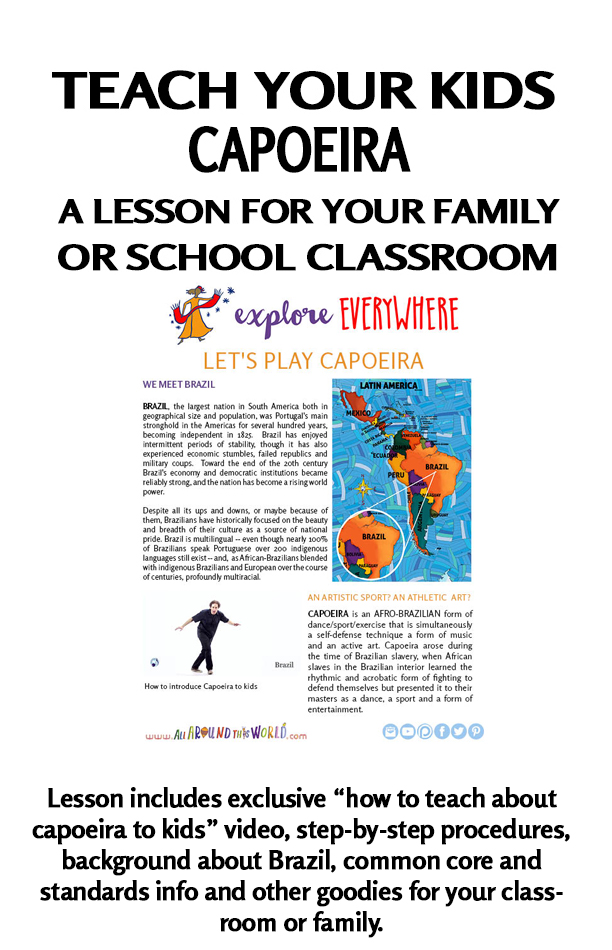
All Around This World lesson for classrooms and homeschool -- Capoeira from BrazilCapoeira is a thrilling traditional Afro-Brazilian sport that features its own pulsating call-and-response folk music.  The art form arose during the time of Brazilian slavery, when African slaves in the Brazilian interior likely learned the acrobatic form of fighting to defend themselves but presented it to their masters as a dance, a sport and a form of entertainment.

The Philadelphia chapter of the Fundaçao Internacional de Capoeira Angola describes the form of sport and music as, “a dance fight, a playful sparring involving style, wit, flexibility and strategy. Capoeira weaves intricate movements, spirituality, mental and physical discipline, fight, and philosophy into a unique ‘game.’

As an African-Brazilian art form, it was used by enslaved Africans to combat the colonial oppression of the Portuguese rulers. Its practitioners used this powerful weapon during revolts and in defense of the Quilombos (African communities/nations of formally enslaved Africans who organized according to African cultural forms). It is very rhythmic and ritualistic, and like many other African based traditions, is transmitted from master to student.

Played in a circle, the ‘roda’ (game) of Capoeira Angola is infinitely varied with an unlimited combination of movements of all parts of the body. This art form is beautiful to watch, featuring acrobatics, choreographed rituals and varied dance steps.”

The game/sport/dance is almost always performed/played with musical accompaniment, most often with an ensemble centering around a berimbau. Just listening to the music will make you want to throw your legs in the air.

Learn about the genre’s instruments.

PLEASE NOTE: The lesson and embedded video are NOT “How to play/dance Capoeira” tutorials. The goal of this lesson is to provide the tools for you to treat your very youngest students to their first introduction to capoeira and to inspire you to get up and move together. (Your capoeira moves can’t be any worse than mine!) Ideally the lesson will be the first step on your and your students’ road to further capoeira exploration.


[mappress mapid=”16″ center=”-8, -60″ zoom=”3″]

How to sing with Jay each week in your home or classroom Support All Around This World on Patreon Enjoy interactive All Around This World lessons in your home or classroom

Plena (Puerto Rico)

Plena, also nicknamed “el periodico cantado (“the sung newspaper”), formed as a distinct Puerto Rican musical genre in the late 1800s when sugar cane plantation laborers, manual workers and former slaves moved to the urban areas and communicated the news of the day to each other through music and dance. A plena ensemble consists of a variety of percussion instruments such as guiros, congas, timbales, maracas and panderos (small tamborines), as well as a 4-stringed Puerto Rican guitar known as a cuatro. The plena has no fixed rhythmic form, but, unlike bomba which is primarily African, weaves in a multitude of rhythms from Puerto Rico’s Spanish, African and Taino cultures. Enjoy the plena by grooving along with these gentlemen, who obviously are celebrating after having just came back from a great day together shopping at the red shirt store.

COUNTRY: Puerto Rico (U.S.)
KEY INSTRUMENTS: Accordion, Bass, Cuatro, Guiro, Pandeiro, Saxophone, Trombone
SONG ON AATW: LATIN AMERICA CD: La Luna


[mappress mapid=”16″ center=”-8, -60″ zoom=”3″]

How to sing with Jay each week in your home or classroom Support All Around This World on Patreon Enjoy interactive All Around This World lessons in your home or classroom

Samba (Brazil)

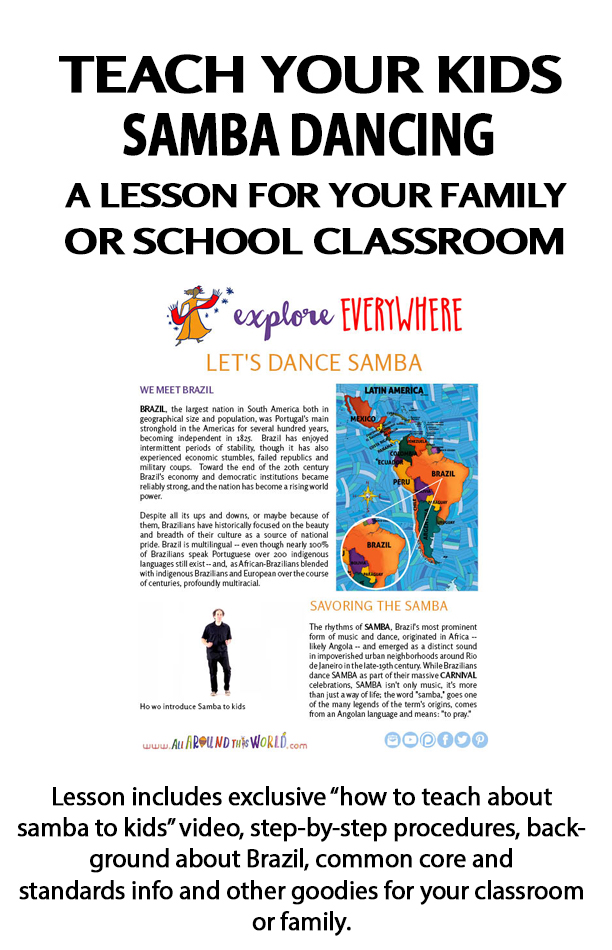
All Around This World lesson for classrooms and homeschool -- Let's Dance Samba from BrazilSamba is Brazil’s most prominent and arguably its most joyous music and dance form (though just one of many!). While Brazilians dance samba in public as part of their massive Carnival celebrations, parading in breathtaking numbers–literally in the tens of thousands, all members of community-building musical institutions known as samba schools–through the heart of Rio’s aptly named Sambadrome, they also dance at almost any time throughout the year, in almost any venue, to mark almost every occasion. (Check out a percussion unit practicing for Carnival.) The genre isn’t only music, it’s more than just a way of life; the word “samba,” goes one of the many legends of the term’s origins, comes from an Angolan language and means: “to pray.”

The distinctive dance motion and its energizing 2/4 rhythms may be an eastern Brazilian interpretation of rhythms that originated in Angola, the Congo, or even as a development of batuque music from Cape Verde, but is just as likely an amalgam of all those and more. It is certainly a form that began in Africa, traveled in the deep, dark holds of slave ships to the New World, and began to emerge as a distinct sound in impoverished urban neighborhoods around Rio de Janiero in the late-19th century. The first popular samba recordings appeared in the early 1920s and rapidly became part of Brazil’s soul.

Samba has now grown to become a blanket genre with a number of sub-genres, such as samba-enredo (the kind of samba performed at Carnival), samba-cancao (samba song), samba de breque (in which the song stops, or “brakes,” and the vocalist fills the spaces with declarations), samba-pagode (a form of party music that has become identified with pop), samba-reggae, and many more.

PLEASE NOTE: The lesson and embedded video are NOT “How to samba” tutorials. The goal of this lesson is to provide the tools for you to treat your very youngest students to their first introduction to samba and to inspire you to get up and dance together. (Your dance moves can’t be any worse than mine!) Ideally the lesson will be the first step on your and your students’ road to further samba exploration.

PERCUSSION:

One of the most exciting elements of samba is the onslaught of percussion instruments ensembles bring forth when they perform. While every instrument has its own sound and serves its own particular purpose, the cumulative effect is meant to so energize a listener that s/he has not choice but to dance. Some of the primary percussion items include the…

CAIXA:
Very similar to a snare drum, though it has two or four wires/cables/snares that run along the top of the drum, rather than along the bottom like the typical drum kit snare. The caixa is played with drumsticks and either suspended around the neck on a strap or held on the shoulder to send the sharp rhythm out over a procession. Often musicians play several types or caixas with several types of rhythms. Hear the caixa in action.

CUICA:
The cuica is a Brazilian “talking drum” (or, more descriptively, “laughing drum”). The drum only has one head. The drummer makes the distinct “laughing” sound by putting a hand inside the instrument and rubbing a wet cloth across a resonating cane of bamboo. Listen to the cuica and, if you understand Portuguese, learn about it too.

SURDO:
The surdo is a large bass drum that provides the deep, underlying percussive motion for a procession. Performers tune two surdos to different notes and play them in both complementary rhythm and tone, emphasizing the downbeats of the measure. A third surdo plays a rhythm, known as a “cutter,” between the first two surdo beats. Watch some surdo drums at work in the forefront of this performance by PhillyBloco.

PANDEIRO:
The pandeiro is a kind of tambourine that has a single head and jingles (“pratinelas”) arranged in pairs around its frame. Some masterful pandeiro playing.

TAMBORIM:
A small single-headed hand drum hit by a thin stick to make a sharp sound that cuts across all the other percussion, usually on an off-beat. Often the tamborim players lead the procession. Watch the smiling Tamborim Unidos da Tijuca in motion in 2009.

TIMBAL
(also spelled as TIMBAU): The timbal is a conical Brazilian kettle drum most often found in Bahia. (Not to be confused with the Cuban timbales.) Watch timbal drummers on the move with Percussao Brasileira.

More information:

The History of Samba | Want to learn to samba? Start here. | Want your baby to teach you how to samba? Start here.

COUNTRY: Brazil
KEY INSTRUMENTS: Agogô, Banjo (4-string), Bass, Caixa, Cavaquinho, Chocalho, Cuíca, Ganza, Güiro, Hand-repique, Pandeiro, Repinique, Saxophone, Surdo, Tamborim, Tantã, Trombone, Trumpet
SONG ON AATW: LATIN AMERICA CD: Bambo du Bambu

[mappress mapid=”16″ center=”-8, -60″ zoom=”3″]

How to sing with Jay each week in your home or classroom Support All Around This World on Patreon Enjoy interactive All Around This World lessons in your home or classroom

9. A Canoa

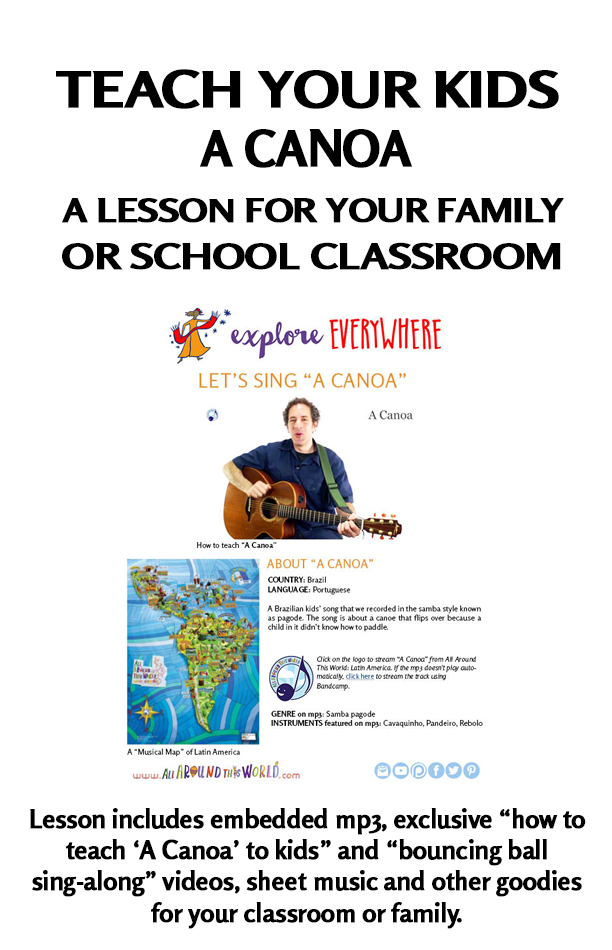
All Around This World lesson for classrooms and homeschool -- Brazilian children's songA Brazilian children’s song that we recorded in the samba style known as pagode. The song is about a canoe that flips over because the child we’ve chosen as our captain doesn’t know how to paddle.


Country
: Brazil
Language: Portuguese
Genre on CD: Samba pagode
Instruments on CD: Cavaquinho, Pandeiro, Rebolo

LYRICS OF ALL AROUND THIS WORLD VERSION

The canoe flipped and who made it flip was it you?
It was because of Molly, now what are we going to do?
Paddle left and paddle right, paddle left and paddle right, paddle left and paddle right, paddle left and
paddle right.

A canoa virou, quem deixou ela virar
Foi por causa da [child’s name], que não soube remar
Siriri prá cá, siriri prá lá, siriri prá cá, siriri prá lá

How to sing with Jay each week in your home or classroom Support All Around This World on Patreon Enjoy interactive All Around This World lessons in your home or classroom

Credits

Translation and arrangement by Jay Sand. Instrumental arrangement by Alex Shaw and Arturo Stable.

Brazilian percussion, vocals and engineering: Alex Shaw

Guitar: Patricio Acevedo


3. Bambo du Bambu


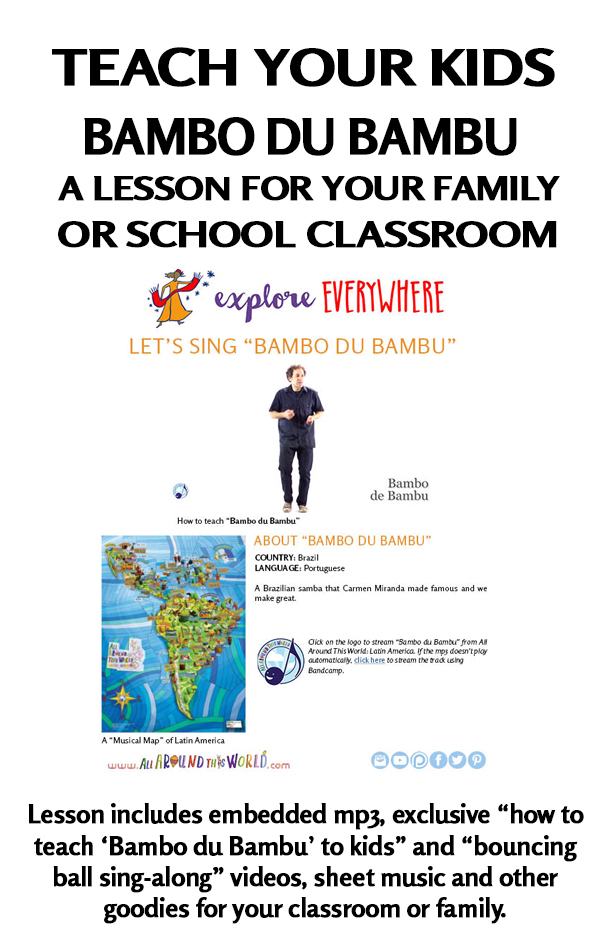
An All Around This World classroom and homeschool lesson about Brazil -- "Bambo du Bambu" -- A Samba song for kidsA samba song for kids from Brazil, initially recorded in 1939 by Carmen Miranda, then again in 1940 as part of a legendary yet, for decades, unreleased recording Native Brazilian Music, a joint U.S./Brazilian goodwill endeavor coordinated on the Brazilian end by iconic composer Heitor Villa-Lobos. The original is an embolada, a fast-paced, often-improvised song style popular in northeastern Brazil in which vocalists challenge each other, competing lightly based on verbal and vocal ability. Found on the Smithsonian Folkways album, Music of the World’s Peoples: Vol. 3.

NOTE: The title of the song, “Bambo du Bambu,” is nonsensical, grammatically and otherwise. All Around This World decided to keep it for our samba song for kids because it was the title of a well-known recording of the song from the 1950s.

Country: Brazil
Language: Portuguese
Genre on CD: Samba

Instruments on CD: Agogo, Caixa, Cavaqhinho, Cuica, Ganza, Pandeiro, Surdo, Tamborim


LYRICS OF ALL AROUND THIS WORLD VERSION

We dance bambo du bambulelê, we dance bambo de bambulalá
We dance bambo du bambu we’re dancing the samba with our mother, brother, sister and papa, oh!We dance bambo du bambu we’re dancing the samba with our mother, brother, sister and papa, oh!
We dance samba samba samba samba samba samba samba samba samba samba samba with mama
We dance samba samba samba samba samba samba samba samba samba samba with papa

A recent version of Bambo du Bambo performed by Ney Matogrosso, with much inspiration from Carmen Miranda

How to sing with Jay each week in your home or classroom Support All Around This World on Patreon Enjoy interactive All Around This World lessons in your home or classroom

Credits

Brazilian percussion and vocals: Alex Shaw

Percussion engineering: Alex Shaw

Vocals engineering: Erich Miller
"Bambo du Bambu" © Alpha Film Music on behalf of Smithsonian Folkways Recordings,
translation and arrangement by Jay Sand with permission, Instrumental arrangement by Alex Shaw and Arturo Stable.
A version of the original track appears on, the Smithsonian Folkways release, "Music of the World's Peoples: Vol. 3"