Instruments Archives: Tambora

Tambora

A tambora is a bass drum that appears in various forms in various parts of Latin America. It is usually a double-headed drum, sometimes carried and sometimes fixed on a stand, sometimes with cymbals attached to provide for varying types of sound.

COUNTRY: Colombia, Dominican Republic, Peru
KEY GENRES: Cumbia, Merengue, Vallenato

How to sing with Jay each week in your home or classroom Support All Around This World on Patreon Enjoy interactive All Around This World lessons in your home or classroom

Bachata

COUNTRY: Dominican Republic

Over the last several decades another music of the people, bachata, a form of bolero-based Dominican blues, has developed in neighborhood bars and brothels. BACHATA musicians sing about pain, struggle and the troubles of daily life, most often with a hearty string of double entendres. The original Dominican bachata dance involves a lot of hip swaying and emphasizes the 1-2-3 and 5-6-7 counts of an eight count pattern, with the hips “popping” on beats 4 and 8.
See the King of BACHATA, Luis Vargas, performing a song called “Venom”

“The typical bachata group consists of five instruments: lead guitar, rhythm guitar, electric bass guitar, bongos and güira.The rhythm guitar is also known as a Segunda and serves the purpose of adding syncopation to the music. Bachata groups mainly play a simple style of bolero (lead guitar instrumentation using arpeggiated repetitive chords is a distinctive characteristic of bachata), but when they change to merengue based bachata, the percussionist will switch from bongo to a tambora drum. In the 1960s and 70s, maracas were used instead of güira. The change in the 1980s from maracas to themore versatile güira was made as bachata was becoming more dance oriented.”

Merengue (Dominican Republic)

The Dominican Republic is known for Merengue, which evolved from Dominican folk to become infectious, mambo-inspired dance music. Dictator Rafael Trujillo, an avid Merengue dancer who, once of humble origins, had been barred from elite dance clubs, declared the genre as music of the people and required urban dance bands to include it in their shows. The basic rhythm– 1-2, 1-2 — is simple, straightforward and highly danceable. Let Joe and Sarah teach you all about it: “If you can walk, you can dance the Merengue.”

COUNTRY: The Dominican Republic
KEY INSTRUMENTS: Accordion, Bass, Guiro, Guitar, Saxophone, Tambora, Trumpet
SONGS ON THE AATW: LATIN AMERICA CD: Cachumbambe, Goodbye, We Are Happy

[mappress mapid=”16″ center=”-8, -60″ zoom=”3″]

How to sing with Jay each week in your home or classroom Support All Around This World on Patreon Enjoy interactive All Around This World lessons in your home or classroom

Vallenato (Colombia)

Vallenato (“born in the valley”) music is a popular Colombian folk music that originated in Colombia’s Caribbean region. The genre developed when musical Colombian farmers, traveling from village to village with their cattle in an era before mass communication, became important to local communities as the bearer of important news. While many vallenato performers still share stories of Colombian daily life through intimate song, pop-music superstars like Carlos Vives have brought the genre to the masses. Watch Vives perform “La Gota Fria.”

COUNTRY: Colombia
KEY INSTRUMENTS: Accordion, Bass, Caja Vallenata (tambora), Guacharaca

[mappress mapid=”16″ center=”-8, -60″ zoom=”3″]

How to sing with Jay each week in your home or classroom Support All Around This World on Patreon Enjoy interactive All Around This World lessons in your home or classroom

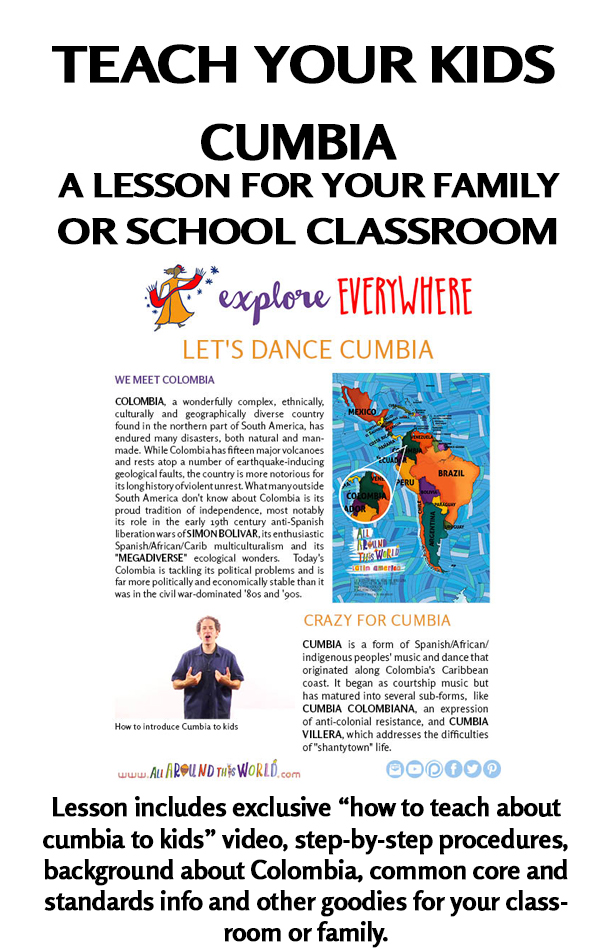
Cumbia (Colombia, Mexico, Peru)

All Around This World Lesson for Classrooms and Homeschool -- Let's Dance CumbiaCumbia is a genre of music that originated on Colombia’s Caribbean coast as a ritual courtship dance of African slaves. At first only drums and claves accompanied the dance, but as Spanish colonial influence seeped into the music, guitars began to appear. Says Wikipedia, “According to legend, the accordion was added after a German cargo ship carrying the instruments sank as a load of accordions washed ashore on the northwest coast of Colombia.” Whether or not this is true, it’s a great story. Other instruments are:

tambora, a large two-headed drum that the drummer plays with sticks,

maracas and cajon (at 3:30–more about the cajon below), and sometimes

the congas, a Cuban hand drum with African ancestry.

Put that all together to a 4/4 “two-step” rhythm and you get…cumbia, cumbia and more cumbia!

Today the genre has spread beyond Colombia popular all over Latin America, especially in Mexico. “Andean Cumbia” blends the indigenous music of Andean nations such Bolivia, Ecuador and Peru with the rhythmic beat. In Peru it has even developed into a distinct subgenre known as Chicha.

A primer

PLEASE NOTE: The lesson and embedded video are NOT “How to dance the Cumbia” tutorials. The goal of this lesson is to provide the tools for you to treat your very youngest students to their first introduction to cumbia and to inspire you to get up and dance together. (Your dance moves can’t be any worse than mine!) Ideally the lesson will be the first step on your and your students’ road to further cumbia exploration.

COUNTRY: Colombia, Mexico, Peru
KEY INSTRUMENTS: Accordion, Cajon, Claves, Congas, Guitar, Maracas, Tambora
SONGS ON AATW: LATIN AMERICA CD: Niño Colla, Tambobambino

[mappress mapid=”16″ center=”-8, -60″ zoom=”3″]
How to sing with Jay each week in your home or classroom Support All Around This World on Patreon Enjoy interactive All Around This World lessons in your home or classroom

23. Goodbye (Adios!)

When All Around This World classes visit Latin America we use our beloved “We Are Happy” as our Spanish goodbye song. SEE YA!

Country: Uganda (original)/Dominican Republic
Language: originally Luganda
Genre on CD: Merengue
Instruments on CD: Piano, Trombone, Trumpet

LYRICS:

We say goodbye, but we’re not sad,
because of all the fun we had
We are happy, we are happy on this day

¡Adios everybody! (“Goodbye” in Spanish),
Tchau everybody! (“Goodbye” in Portuguese),
Ayo everybody! (“Goodbye” in Garifuna),
[A-wa-lyah] everybody! (“I’m leaving” in Quechua)

How to sing with Jay each week in your home or classroom Support All Around This World on Patreon Enjoy interactive All Around This World lessons in your home or classroom

Credits

VocaLs: Jay Sand

Piano/Keyboard: John Stengel

Drums/percussion: Francois Zayas

Engineering and co-production of drums, keyboard and bass by Mark Wolfe, AudoMind, Philadelphia

Vocals engineered by Erich Miller, Philadelphia

You can listen to the original verson of "We Are Happy" on the Smithsonian Folkways release, Abayudaya: Music from the Jewish People of Uganda.
"We Are Happy" and "Hello" © Gershom Sizomu and J.J. Keki, arrangement by Jay Sand with permission, Instrumental arrangement by Arturo Stable

1. We Are Happy (Hola!)

We sing “We Are Happy” as our hello song at the beginning of every All Around This World Latin America class, changing the greeting to match the featured country of the week. “We Are Happy” didn’t start as a Spanish hello song, but instead as a mashup of two songs the Abayudaya of Uganda sing to greet important visitors to Nabugoye Hill, which is a small area a few miles outside of the Eastern Ugandan city of Mbale. The Abayudya of Uganda are a small community of about 500 Luganda-speaking Bagandans who have been practicing Judaism for over 80 years. Abayudaya community leaders Rabbi Gershom Sizomu and his brother JJ Keki wrote the two greeting songs and led the community in singing them for Jay when he first visited in late 1999.

Country Uganda (original)/ On CD:Dominican Republic
Language: this “Spanish hello song” was originally in English, Luganda and Hebrew
Genre on CD: Merengue
Instruments on CD: Piano, Trombone, Trumpet

[wpspoiler name=”Lyrics of All Around This World: Latin America version” open=”true” style=”aatw-video”]Ooh, bop bop bop! Ooh, bop bop bop.
We are happy, we are happy on this day.

¡Hola everybody! (“Hello” in Spanish),
Bom dia everybody! (“Good morning” in Portuguese),
Buiti binafi everybody! (“Good morning” in Garifuna),
Imaynallam everybody! (“How are things going?” in Quechua)[/wpspoiler]

How to sing with Jay each week in your home or classroom Support All Around This World on Patreon Enjoy interactive All Around This World lessons in your home or classroom
bbb

Credits

Vocals: Jay Sand

Piano/Keyboard: John Stengel

Drums/percussion: Francois Zayas

Instrumental engineering: Mark Wolfe, AudioMind, Philadelphia

Vocals engineered by Erich Miller, Philadelphia

You can listen to the original verson of "We Are Happy" on the Smithsonian Folkways release, Abayudaya: Music from the Jewish People of Uganda.
"We Are Happy" and "Hello" © Gershom Sizomu and J.J. Keki, arrangement by Jay Sand with permission, Instrumental arrangement by Arturo Stable

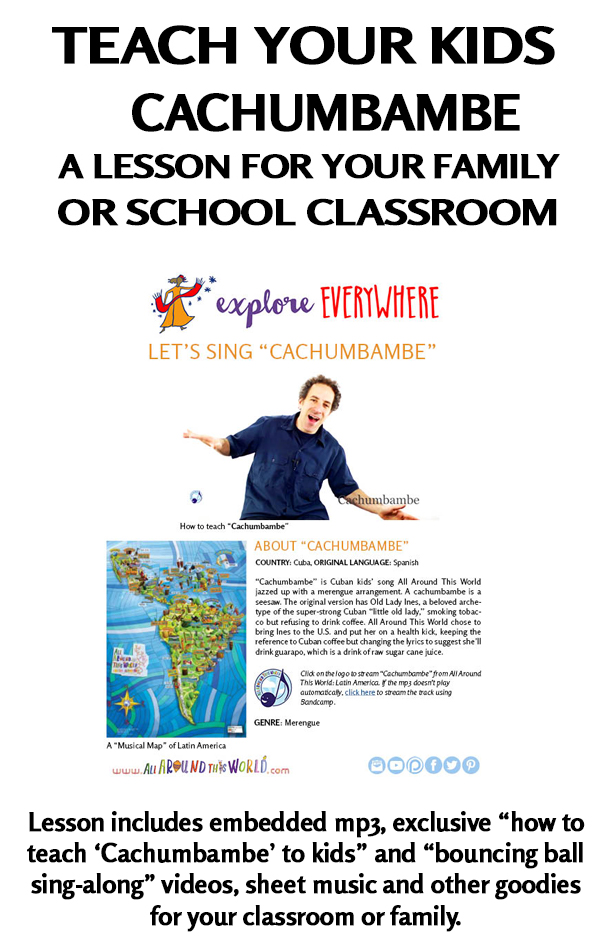
6. Cachumbambe


An All Around This World lesson about Cuba for kids -- "Cachumbambe" -- A Cuban kids song This is a Cuban kids song All Around This World jazzed up with a merengue arrangement. A cachumbambe is a seesaw. Take a listen to this version from the Florida Folklife from the WPA Collections, 1937-1942, currently held by the Library of Congress.
The original version has Old Lady Ines, a beloved archetype of the super-strong Cuban “little old lady,” smoking tobacco but refusing to drink coffee. After much deliberation, All Around This World chose to bring Ines to the U.S. and put her on a health kick, keeping the reference to Cuban coffee but changing the lyrics to suggest she’ll drink guarapo, which is a drink of raw sugar cane juice. How dare we do such a thing to a Cuban kids song?? Not as a slight to the tradition of the hardy Cuban woman! We decided to bring Ines to the U.S. in song in a way that American kids may be more inclined to relate to her, and nowadays cigar-smoking grannies in the U.S. are few an far between. Though, in retrospect, we certainly could have kept a little kick in her and had her eschew the guarapo in favor of a thick cup of coffee. In class we’re able to right this wrong by letting the kids know that Ines may occasionally choose a mild sugary beverage, but she didn’t live long enough to earn the right to be called “Old Lady Ines” by playing it safe.

Thanks to Nestor Baguier for helping us see the light.

Country: Cuba
Language: Spanish
Genre on CD: Merengue

Instruments on CD Bass, Congas, Drum kit, Piano, Trombone, Trumpet


LYRICS OF ALL AROUND THIS WORLD VERSION

Cachumbambe,
La vieja Ines,
Que bebe guarapo y no toma cafe.

Cachumbambe,
Old lady Ines
She will drink guarapo but she won’t drink cafe.

How to sing with Jay each week in your home or classroom Support All Around This World on Patreon Enjoy interactive All Around This World lessons in your home or classroom

Credits

Vocals: Tony Perez
Bass: Rob Hagopian
Piano/Keyboard: John Stengel

Trumpet: Nelson Miranda

Trombone: James Negron

Drums/percussion: Francois Zayas
Percussion and addtional percussion engineering: Arturo Stable
Engineering and co-production of drums, bass and keyboard by Mark Wolfe at Audio Mind.

Vocals and horns engineered by Erich Miller

"Cachumbambe" is traditional, Englsh lyrics and Arrangement by Jay Sand. Instrumental arrangement by Arturo Stable.