[Information about berber music coming soon.]



[Information about berber music coming soon.]
The bendir is a frame drum that has been popular in Northern African countries like Morocco and Algeria for hundreds if not thousands of years. A bendir player usually holds the drum with the left hand, keeping it vertical and stable by keeping the thumb in a hole in the frame, and strikes it with the right hand, buzzing the snares that are stretched inside. It is mainly a secular instrument but may make an appearance during Sufi rituals.
While traditional music of Morocco draws from Arab, Berber and Andalusian classical and folk influences, contemporary Moroccan music, like the increasingly popular Moroccan rai, is a pulsing, vibrant music that often mixes traditional Arabic scales and rhythms (hear some Arabic rhythms such as “chiftitelli” and “ayoub” courtesy of “Pete Lockett: Multi Percussionist”) with modern synthesized effects reminiscent of disco. The genre originated in, and is most influential, in Algeria, where the expressive music–“rai” means “opinion”–has been a thorn in the political side of successive Algerian governments since the ’70s. Most of the internationally popular rai musicians are Algerian expatriates whose music inspires political resistance and resonates with the fierce independence of the Algerian people. Common contemporary instruments used in the music, according to Afropop.org, are: “cheesy keyboards, grunge guitar, reggae organ, sizzling drum machines, and often disco’s pumping beat.”
Learn more: The Year of Desert Rose: RAI Goes Bigtime | Clearing up myths… | Watch a very smiley Cheb Hanino perform “Wach Eddak,” a performance in which Hanino seems elated, as does a guy in a red sweater-vest who’s dancing with an oud, and as are most of the members of the audience…except one rather skeptical couple (watch closely or you’ll miss them) | Cheb Khaled is one of the the world’s best known and most beloved pop RAI artists. Take a look at Khaled in live in Casablanca
The ’90s were a politically violent time in Algeria and destructive civil war is usually not a great atmosphere for happly-go-lucky backpacking; according to Lonely Planet there is still little infrastructure for the independent traveler. Those who do travel to Algeria receive such a warm welcome that they’re telling their friends to come too, which may ultimately transform the country into a travelers’ oasis.
All Around This World’s exploration of Africa includes sing-along, dance-along classroom and homeschool lessons about Algeria for kids . . . Meet the world through music –“come to class” with Jay.
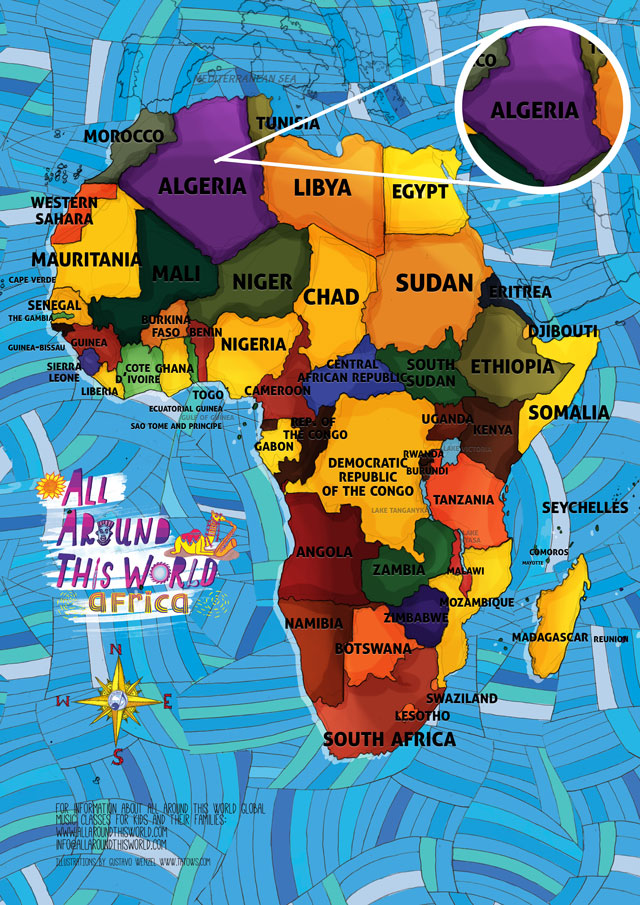
This week in music class All Around This World ventures to North Africa seeking explorations in Algeria for kids, embracing this historic home of Berbers and Barbary pirates, a land of vast Saharan deserts and lush, green oases, a country that has been ruled by the Carthaginians, Romans, Ottomans and French, yet experienced its most difficult civil war [note: some content in this link is just for grown-ups] only after becoming independent. Algeria is the birthplace of Camus and Derrida, who left to philosophize in Europe, and Frantz Fanon, who came there to practice psychiatry and ultimately to make revolution. About 99% of the Algerian population is Sunni Muslim and the country has the reputation of being less-than-supportive of gender equality, though 70 % of Algeria’s lawyers, 60% of university students are women. In our music class we build connections to Algeria for kids by listening to rousing Rai, singing about a long walk in the desert, and jiggling our bellies.
START HERE:
— MUSIC: Algeria’s dominant musical export is Rai, a pulsing, vibrant music that often mixes traditional Arabic scales and structures with modern synthesized effects reminiscent of disco . . .
— IMAGES: Flickr’s Algerian photo spread provides one image after another of its breathtaking natural landscape, interspersed with images of what must be its other national treasure — the Algerian national soccer team . . .
— WHEN YOU GO THERE: The ’90s were a politically violent time in Algeria and destructive civil war is usually not a great atmosphere for happly-go-lucky backpacking.