As we’ve been told, “Tribulchay” is a song in the northwestern South American Quechua that references the search by someone in love for the approval of his beloved’s parents — “Where is your father, where is your mother, my dear, show me first your mother, my dear show me first your father, if I knew your father, my dear, if I knew your mother, maybe my I would be your love.” In class we don’t look for love, but instead we look for — and usually find! — our ears, bellies and toes.
An ocarina is a “vessel flute” that appears in many parts of the world, but is especially central to music in South America’s Andean mountains. There are many variations, but generally an ocarina is has a small space that traps air, a mouthpiece that enables a musician to blow into the enclosed space, and a number of finger holes for the musician to use to change the tone.
COUNTRY: Colombia, Ecuador, Peru KEY GENRES: Many Andean genres
The siku (sometimes called the “zampoña”) is one of the traditional panpipes of the Andes mountains. Because villages in the Andes were traditionally very difficult to reach from one another, members of isolated Andean communities developed their own local variants of siku, including their own tuning and way of playing.
COUNTRY: Bolivia, Peru KEY GENRES: Many Andean genres
The rondador is a set of bamboo panpipes that are wrapped together, ordered by diminishing size, and that a musician plays by blowing across the open pipe tops. Ecuador considers the rondador to be its natural instrument.
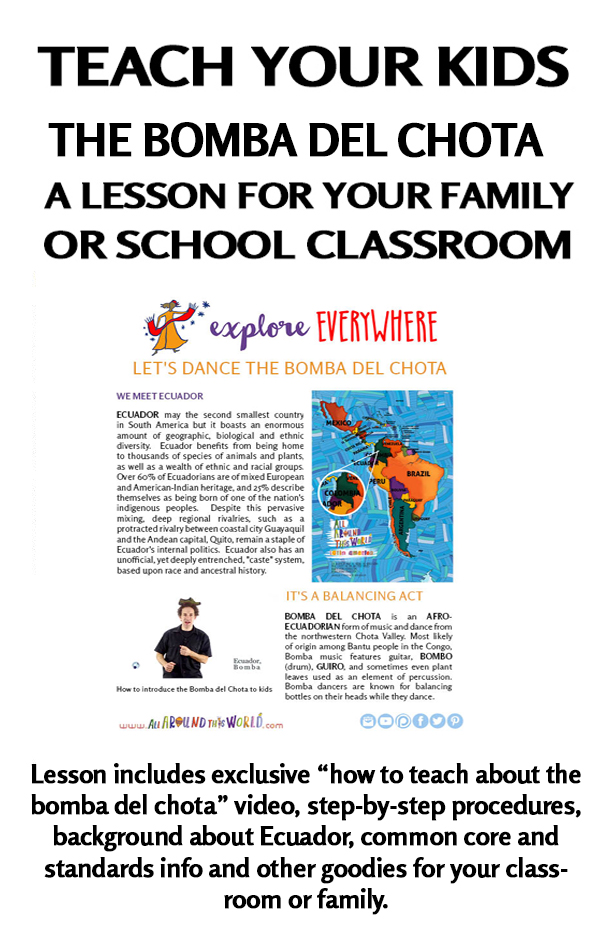
The Bomba del Chota originated with African ancestors’ of today’s Afro-Ecuadorians who arrived in Ecuador in the late sixteenth century when several slave-bearing ships crashed on the country’s coast. Today there are two main sub-genres of Afro-Ecuadorian music:
— the marimba-based music of Esmeraldas, which has direct ties to African (Bantu) genres that use marimba, and
— the more Spanish-influenced yet still distinctly African “bomba” from the Chota Valley.
As a group Afro-Ecuadorians fare slightly better (economically and socially) than Ecuador’s indigenous population, but they still face poverty and many other entrenched challenges. For many, Afro-Ecuadorian music is a statement of cultural separateness and an expression of Afro-Ecuadorian cultural and political pride.
PLEASE NOTE: The lesson and embedded video are NOT “How to dance the Bomba del Chota” tutorials. The goal of this lesson is to provide the tools for you to treat your very youngest students to their first introduction to Ecuadorian bomba and to inspire you to get up and dance together. (Your dance moves can’t be any worse than mine!) Ideally the lesson will be the first step on your and your students’ road to further Ecuadorian bomba exploration.
The bombo is a bass drum that appears throughout Latin America in a variety of contexts and musical styles, from Ecuadoran bomba music to Argentinian folk.
The quena is a traditional bamboo or wooden flute used in many kinds of music found in the Andean mountains. A common quena has six finger holes and one hole for the thumb. The musician controls the airflow with both his or her mouth and fingers, creating a naturally rich tone.
The charango, a small, high pitched Bolivian/Andean stringed instrument that traditionally was made from the shell of an armadillo, is a staple instrument of Andean music. The charango first appeared in South America in the 1800s, though its exact origin is unclear. Was it a descendant of the vihuela, which the Spanish brought with them when they colonized? Did indigenous musicians who had learned to play Spanish vihuelas and guitars create such a small instrument in order to be able to hide it when Spanish authorities prohibited them from performing their own music? Whatever its origins, the charango’s bright sound has become a characteristic of several Andean genres, like Andean Cumbia, Huayno and Pasillo
Huayno is a genre of music and dance that originated with and isstill popular among Quechua-speaking people in Peru’s AndesMountains. According to Coyote Crossing’s huayno overview, the genre distinguishes itself from other Latin musics in that its rhythm stresses the first beat and follows that with two short beats.
In class we a Peruvian huayno song, called “Tribulchay.” Watch Hugo Carrillo’s exuberant performance of “Tribulchay” and try to listen for the music’s rhythmic first beat/two short beats. If you want to learn more, get your hands on Jon Cohen’s documentary, “Dancing with the Incas,” but if you just want a quick listen, enjoy Javier Lizares on YouTube playing an Andean stringed instrument known as the charango.
COUNTRY: Ecuador, Peru and other Andean countries KEY INSTRUMENTS: Accordion, Charango, Guitar, Harp, Quena, Mandolin, Saxophone, Siku (panpipe), Violin
The so-called “rhythm of Ecuador,” pasillo is a Spanish-influenced music popular in Ecuador, Colombia, Venezuela and Panama with a 3/4 meter and a feel similar to the Viennese waltz. It’s a romantic music, often performed on a guitar or on charango, that accompanies an equally romantic dance.
We are revising the AllAroundThisWorld.com site and are currently using a new (better!) site — ExploreEverywhere.com — to tell you all about our curriculum offerings and how to become one of our teachers. That said, if you were on ExploreEverywhere, you clicked to find more information about a song or lesson, and landed here, you’re in the right place! Some links may be broken and a detail or two may be out of date…but close the popup window and enjoy!