Countries Archives: Mexico

Accordeon

The Latin American “accordeon” is a three row accordion based on the original one-row button accordions brought to Mexico by Central and Eastern European settlers. In the 1930s pioneering accordion player Narcisso Martinez connected with Santiago Almeida who played the Mexican guitar-like bajo sexto. Martinez left the bass parts to Almeida and played the melody on the accordeon, creating what quickly became the ubiquitous conjunto sound Learn about the life and musical achievements of Narciso Martinez and his essential partnership with Almeida.

How to sing with Jay each week in your home or classroom Support All Around This World on Patreon Enjoy interactive All Around This World lessons in your home or classroom

Quijada

The quijada is a jawbone of a donkey used as a percussion instrument in Mexico and Peru. The musician holds half of the jawbone in one hand and hits the other with a stick, causing the teeth to rattle. The instrument first appeared in Peru among African slaves but became important in both African and indigenous communities. Today it’s still a staple instrument in Afro-Peruvian music, and is essential to Mexico’s son jaorhco

COUNTRY: Mexico, Peru
KEY GENRES: Afro-Peruvian, Son Jaorhco

FEATURED ON: La Guacamaya (AATW: Latin America)

How to sing with Jay each week in your home or classroom Support All Around This World on Patreon Enjoy interactive All Around This World lessons in your home or classroom

Son Jarocho (Mexico)


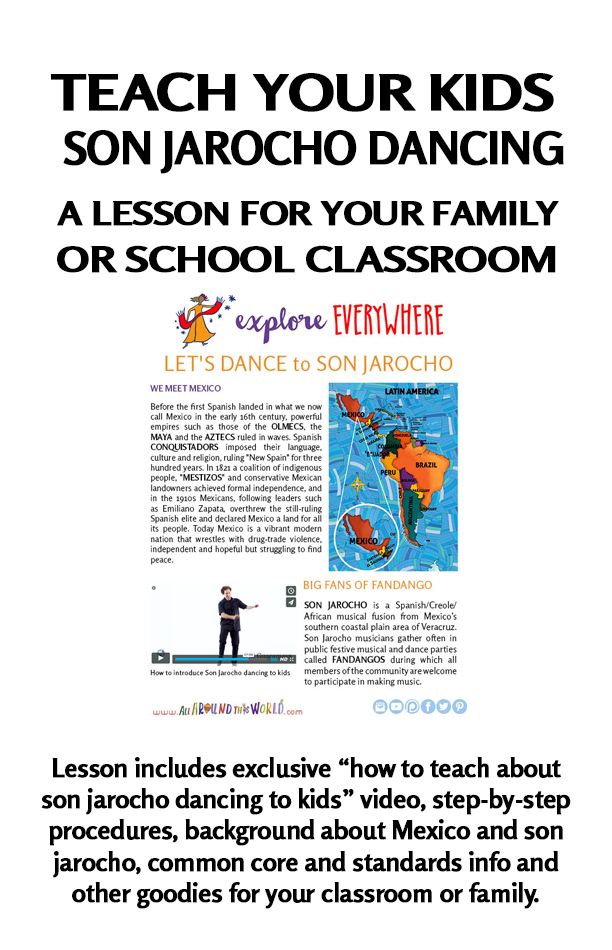
All Around This World lesson for classrooms and homeschool -- Son Jarocho dancing from MexicoSon Jarocho is a Spanish/Creole/African musical fusion from Mexico’s southern coastal plain area of Veracruz. Son Jarocho musicians gather often in public festive musical and dance parties called fandangos during which all members of the community are welcome to participate in making music.

Instruments particular to the genre include a jarana, a quijada, a requinto, a mariumbula, a harp and a wooden dancing platform known as a tarima that the musicians actually consider a percussion instrument and factor into the arrangement of traditional songs.

Country: Mexico
Language: Spanish
Genre on CD: Son jarocho
Instruments on CD: Jarana, Marimbula, Quijada, Requinto, Tarima

[mappress mapid=”16″ center=”-8, -60″ zoom=”3″]

How to sing with Jay each week in your home or classroom Support All Around This World on Patreon Enjoy interactive All Around This World lessons in your home or classroom

Tejano (Mexico, U.S.)

Tejano music has its roots deep in the Meixcan-American experience. In the 1930s and ’40s, while “working class” Mexican-Americans were listening to and dancing to conjunto music, Mexican-Americans from “upper” classes were enjoying “musica orquestra”–music performed by Mexican and Mexican-American orchestras that, like their popular Cuban counterparts, featured Latin dances like danzones, boleros, mambos. Unlike Cuban orquestas these ensembles also dabbled liberally in American dances such as the boogie, swing and foxtrot, as well as German dances such as redovas, waltzes, mazurkas and polkas. [Let U. Texas teach you about “Orquesta Tejana,” audio samples and all]

In the 1960s and ’70s, the Mexican-American children of the generation that had enjoyed musica orquestra infused conjunto music with more orchestral instrumentation, adding keyboards, brass instruments and percussion. They even replaced the bajo sextos with electric guitars! Vocal styles became more complex, with bands layering multiple harmonies and embracing performance styles that were much more theatrical than the salt-of-the-earth delivery of traditional conjunto singers. This next generation fusion of conjunto music with orquestra instrumental flair became known as “tejano.”

While tejano music is an offshoot of conjunto, “tejano” has become a blanket term that covers three kinds of music:

Conjunto: traditional conjunto music played on accordion, bajo sexto, bass and drum. There are many well-respected conjunto musicians today including “King of Accordion” Ramon Ayala (watch him perfom “Mi Tesoro“) and Flaco Jimenez, son of congjunto pioneer Santiago Jimenez (watch Flaco perform “Hasta La Tumba“). Accordionist Esteban “Steve” Jordan–known as “The Jimi Hendrix of the Accordion–passed away in 2010, but his musical legacy lives on. [Watch Steve Jordan perform with Valerio Longoria.]

Orchestra: a more fully instrumented band that might include bass, drums, electric guitar, synthesizer, a brass section (very important!) and sometimes even an accordion. [Watch Ruben Ramon and the Mexican Revolution performing a set of tejano orchestra classics in 2011.]

Modern: synthesizer-focused dance-pop bands that also have drums, electric guitars, bass and sometimes an accordion. [Watch Grupo Mazz perform modern tejano in the mid-80s | Watch Selena perform “Bidi Bidi Bom Bom” and also “Missing My Baby.” (Let SelenaForever.com introduce you to the too-short life of Selena.)]

NEW-TEJANO:

Since 2000 artists such as A.B. Quintinilla and The Kumbia Kings have created a new tejano music, either by taking current forms and blending them with contemporary forms like hip hop and reggaeton [Watch The Kumbia Kings perform “Boom Boom” at the 17th Annual Tejano Music Awards or like frequent “Tejano Music Award Female Vocalist of the Year” award winner Elida Reyna, producing tejano pop that comfortably crosses musical boundaries. [Watch Elida Reyna and Avante performing, “Playa del Sol” and “Ya Basta” in 2010.]

More information:

The Smithsonian introduces us to Tejano and Conjunto music | The Roots of Conjunto & Tejano music | Watch a clip from the inspiring 1976 documentary, “Chulas Fronteras,” which shows how music weaves into the daily Mexican-American life in the Southwest (and read a very positive review of the film)


COUNTRY: Mexico, U.S.
KEY INSTRUMENTS: Accordion, Bajo sexto, Bass, Drum kit, Saxophone, Synthesizer, Trombone, Trumpet

[mappress mapid=”16″ center=”-8, -60″ zoom=”3″]

How to sing with Jay each week in your home or classroom Support All Around This World on Patreon Enjoy interactive All Around This World lessons in your home or classroom

Conjunto (Mexico, U.S.)

“Conjunto” music of the Mexican-American communities of Southern Texas is a not just form of entertainment and a conjunto gathering not just a lighthearted excuse to dance. The term conjunto, which in Spanish means “set” or “group,” refers both to the coming-together of a diversity of musical influences from Mexico and Southern Texas to form a musically distinct and culturally unique Mexican-American genre, but also to the group of musicians that band together to create that music. Conjuntos are community events that allow Texan Mexicans the ability to celebrate their history and culture. Conjuntos are also bands that play all the good old dances–Mexican, German, and more–to playfully, yet powerfully, channel the past.

“Conjunto” is a mix of influences and styles, all present in South Texas in the late 1800s, that fused to form a genre that is at the same time uniquely Mexican and also a unique product of the American southwest. Though Texas had left Mexican control to become part of the U.S. in the mid-1840, Mexican music, culture and the Spanish language still dominated the region. There may have been a drawn border between Mexico and the States, but people and their culture still flowed freely between the two.

In the 1860s there was turmoil on both sides of the border. During the U.S. Civil War (1860 to 1865), Texas succeeded from the Union and joined the Confederacy, despite the staunch objection and the eventual resignation of its then-governor, Sam Houston. At the same time, below the border, Mexican Conservatives (a coalition of Mexican nobles, the military and the Catholic Church), with the support of French Emperor Napoleon III, who himself was playing a game of international power politics by trying to gain New World influence while the warring U.S. was distracted, ousted liberal President Benito Juarez and replaced the republic with the Second Mexican Empire. Napoleon helped install Austrian Archduke Maximillian as king. Mexican King Maximillian I invited European immigrants to settle in Mexico, inspiring working class Germans to move cross the ocean, but his reign was short-lived. And, so was he. (In 1867, Juarez and his liberals restored the Republic and ordered Maximilian’s beheading.)

At the time of such political and social unrest few could have imagined the cultural effect German immigration would have on northern Mexico. When Germans arrived they brought with them the “button accordion,” as well as popular dances like the polka, mazurka and waltz. After the U.S. Civil War ended, thousands of Germans also immigrated to Texas, joining some German immigrants who had arrived in the 1830s. Mexican and Mexican-American musicians used German immigrants’ accordions to add a European flair to a genre that was already coming together as a mix of a dozen traditional forms and styles.

Texan/Mexican musicians quickly recognized the accordion as an instruments with enough of a presence to become the focal point of a raucous dance band. [Check out a demonstration of the button accordion and see if you agree.] By the turn of the century other instruments had joined the accordion, such as the tololche, or Mexican bass (you can see one in action as part of this ensemble), and more specifically, the “bajo sexto,” which is a Mexican twelve string guitar. Today most conjunto bands use electric bass instead of the tololche, but the bajo sexto and the accordion are a must. [Watch the bajo sexto and accordion work their magic here, here and here]

Using the dynamic combination of the bajo sexto and the accordion as a launch pad, conjunto bands on both sides of the border confidently combined Mexican ranchera-style vocals and the lyrics of corrido ballads with the music for German dances such as the redova, the schottishe, the mazurka, the waltz and the polka. Later in the 19th and early 20th centuries waves of Polish immigrants moving into the Mexican state of Sinaloa and Czechs immigrating into Southern Texas solidified the Mexican/Central European dance connection.

South of the border, this Northern Mexican music with Texan influences is often referred to as “norteño.” Norther of the border, this Southern Texas music became “conjunto.”

Despite the excitement of decades of cultural cross-pollination, conjunto only truly came into its own in the 1930 when Narciso Martinez stepped up with his accordion. In the ’20s American record companies, trying to replicate the success they’d found marketing African-American music, had begun to support Mexican-American recording artists, pushing songs by their chosen musicians into jukeboxes, onto the radio and into public dance performances. Musicians like Martinez, who became known s “El Huracan del Valle” (“The Hurricane of the Valley”), took this support as a license to experiment. Mexican-Americans had been attending dances by Texan bands such as Bob Wills and His Texas Playboys. They were also submerging themselves in blossoming genres like country, blues, European fiddle music and swing. All this musical exploration helped inspire Martinez to depart from traditional German accordion techniques and develop a prancing style that allowed him to focus on creating melodies while his musical partner Santiago Almeida played the bass notes on the bajo sexto. Martinez’s style became a staple of the genre; the cascading accordion defines conjunto music today.

After World War II accordionist Valerio Longoriaa led a rising new generation of Mexican-American musicians. Longoria introduced the modern drum kit into the conjunto to join the contrabass (and eventually the electric bass) which accordionist Santiago Jimenez had added in the ’30s. This rounded out the ensemble. Longoria’s band put an unprecedented emphasis on ranchera-style vocals and also dropped most German dances to focus on the polka. [Watch Valerio Longoria and his son performing in 1990.]

One of the greatest conjuntos of the 1950s was the Kingsville, Texas, ensemble, El Conjunto Bernal. Anchored by accordionist Paulino Bernal and his bajo sexto-playing player Eloy, El Conjunto Bernal helped conjunto music become popular all around the American Southwest. [Watch Eloy’s “El Conjunto Bernal” performing Christian music in a conjunto style]

[mappress mapid=”16″ center=”-8, -60″ zoom=”3″]

How to sing with Jay each week in your home or classroom Support All Around This World on Patreon Enjoy interactive All Around This World lessons in your home or classroom

Corridos (Mexico, Nicaragua)

Corridos are popular narrative songs that tell epic tales of historical struggle and the difficulties of peasant life, particularly in Meixco.Learn about corridos with The Smithsonian’s “Corridos sin Fronteras” | Contemporary Latin-American band, Sparx, sings the traditional corrido, “Ballad of Gregorio Cortez” | Learn about “Narcocorridos,” an emerging genre of corridos written about the exploits of Mexican drug lords

COUNTRY: Mexico, Nicaragua
KEY INSTRUMENTS: Accordion, Guitar
SONG ON AATW: LATIN AMERICA CD: La Llave

[mappress mapid=”16″ center=”-8, -60″ zoom=”3″]

How to sing with Jay each week in your home or classroom Support All Around This World on Patreon Enjoy interactive All Around This World lessons in your home or classroom
-America-musical-map-banner-for-web.jpg” width=”698″ height=”120″ />

Bajo sexto

A bajo sexto is a 12-stringed Mexican instrument that provides the central sound, along with its essential companion–the accordion!–of several genres of music (Conjunto, Norteño, Tejano) that thrive along and across the border between Mexico and the United States.

COUNTRY: Mexico, U.S.
KEY GENRES: Conjunto, Norteño, Tejano

How to sing with Jay each week in your home or classroom Support All Around This World on Patreon Enjoy interactive All Around This World lessons in your home or classroom

Jarana

The jarana is a guitar-like instrument played commonly in son jarocho ensembles in Veraczuz in southern Mexico. Jaranas often provide rhythmic accompaniment to the San Jarocho harp (“arpa jarocha”), which musicians play with a pick and use to make the melody.

COUNTRY: Mexico
KEY GENRES: Son Jarocho
FEATURED ON: Este Torito (AATW: Latin America), La Guacamaya (AATW: Latin America), La Llave (AATW: Latin America)

How to sing with Jay each week in your home or classroom Support All Around This World on Patreon Enjoy interactive All Around This World lessons in your home or classroom

Teponaztli

A teponaztli is a hollow slit-drum that is an important member of an Aztec drumming ensemble. The best teponsztli are works of art as much as they are instruments; the makers carve intricate designs into the sides, often portraying the deities or scenes involving animals.

COUNTRY: Mexico
KEY GENRES: Aztec
FEATURED ON: Mayan Peace Song (AATW: Latin America)

How to sing with Jay each week in your home or classroom Support All Around This World on Patreon Enjoy interactive All Around This World lessons in your home or classroom

Rainstick

A rainstick is a thin, long, hollow tube filled with pebbles or beans. A musician lifts the rainstick vertically and lets the pebbles slide to the bottom, then turns the stick on end so the pebbles can rattle to the new bottom, making the sound of a rainstorm. The stick seems to have first appeared in Aztec communities and used to be made of catcus but today almost anything can be a tube and almost anything can be the pebbles.

COUNTRY: Mexico
KEY GENRES: Aztec, Mayan

FEATURED ON: Mayan Peace Song (AATW: Latin America)

How to sing with Jay each week in your home or classroom Support All Around This World on Patreon Enjoy interactive All Around This World lessons in your home or classroom