Bigi Pokoe is lively Surinamese-Caribbean dance music. Early bigi pokoe bands found inspiration in New Orleans Dixieland Jazz, though today the form has enveloped more Caribbean styles, especially salsa.
Kaseko is Suriname’s own Caribbean dance music that arose from a local genre called Bigi Pokoe which sounds whole lot like New Orleans dance-hall jazz. Kaseko first became internationally known in the 1970s when Surinamese expatriates living in the Netherlands–home to Suriname’s previous colonial power, the Dutch–brought their music and musicianship to Europe.
The dholak is a double-headed hand drum that’s prevalent in Indian, North African, Nepalese and Pakistani music, especially qawwali, Bhangra and various styles of North Indian folk. It doesn’t have the same kind of specific tuning as the tabla, which means it’s used more as folk music accompaniment than as a classical instrument, but that doesn’t mean you can’t play dholak in the game room.
Indian indentured servants who came to Trinidad from 1845 to 1917 brought their music with them and eventually fused it with island music to form a genre called chutney. Traditional chutney music added Indian instruments like the dholak and the harmonium to Caribbean songs, as well as a religious sensibility and, often, vocals in Hindi. Contemporary chutney pioneers like Surinamese vocalist and harmonium player Ramdew Chaitoe became well-known in the ’60s and ’70s all over northeastern South America and the Caribbean . Today chutney has blended with soca to form “chutney soca,” which has become popular international dance music. “What is chutney music?”: a primer | Kuch-Kuch Baby!
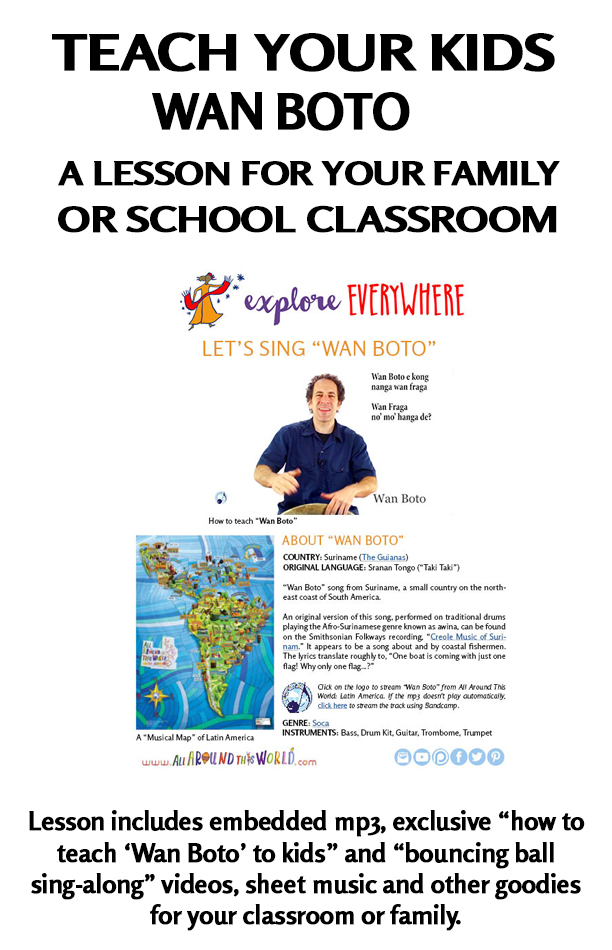
A Caribbean drumming song, originally from Suriname, which is a small country on the Caribbean coast of South America. Unlike any other country in South America Suriname was primarily a colony of the Netherlands, so the culture and colonial language are not Spanish or Portuguese, but Dutch. Suriname has a very diverse population composed of substantial percentages of East Indians (primarily Hindu descendants of Northern Indian laborers who replaced Africans after the abolition of slavery), “Creoles” (people of European descent born in Suriname), Indonesians and “Maroons” (descendants of escaped slaves). There is also an active minority of indigenous people such as Carib, Arawak and Amerindians who retain their original languages and religions. The official language of Suriname is still Dutch, but many in the country speak Sranan (sometimes called Sranan Tongo, or “Taki Taki,”) which is a creole language that draws upon Dutch, English, Portuguese and a few African languages.
An original version of our call-and-response Caribbean drumming song, performed on traditional drums playing the Afro-Surinamese genre known as awina, can be found on the Smithsonian Folkways recording, “Creole Music of Surinam.” It appears to be a song about and by coastal fishermen. The lyrics translate roughly to, “One boat is coming with just one flag! Why only one flag…?”
Language: Sranan Tongo (“Taki Taki”) Genre on CD: Soca
(original genre: Kaseko) Instruments on CD: Bass, Drum kit, Guitar, Trombone, TrumpetLYRICS OF ALL AROUND THIS WORLD VERSION
Wan boto e kong nana wan fraga
Wan fraga no’ mo’ hanga de?!?!
One boat is coming with just one flag
Wan fraga no’ mo’ hanga de?!?! Setish B. and Carlo Jones (on sax) plays kaseko
We are revising the AllAroundThisWorld.com site and are currently using a new (better!) site — ExploreEverywhere.com — to tell you all about our curriculum offerings and how to become one of our teachers. That said, if you were on ExploreEverywhere, you clicked to find more information about a song or lesson, and landed here, you’re in the right place! Some links may be broken and a detail or two may be out of date…but close the popup window and enjoy!