Countries Archives: Taiwan

Hong Kong and Taiwan — Overview

This week we’re going to tell two different stories of two different territories that have two very different relationships with China. Hong Kong was a British colony for over 150 years but is now formally part China. Taiwan was first part of China, then Japan, and is now part of China again…though that depends very much not only on who you ask, but how you ask and why. Telling these two tricky tales is exactly the kind of challenge we here at “All Around This World” enjoy, so let’s get to it!

Hong Kong is a group of 200 relatively small islands of the southeast coast of China that has the distinction of being one of just two “special administrative regions” of China. (The other is Macau.) Hong Kong has been “special” for over two thousand years, when successive imperial Chinese dynasties began to use it as a trading center. Europeans caught on about five hundred years ago, and in the early 16th century the Portuguese tried, and failed, to take it. Two hundred years later the British had more success, but only after winning a war with China over opium.

Opium?

Yes, opium. In the 19th century the British fought two wars with China over opium, the poppy-based narcotic that was growing increasingly popular in Asia at the time. The First and Second Opium Wars were less about opium itself than the British insistence that China remain open to international trade. The British Empire and China’s Qing Dynasty had been jostling about trade for a century, with the Chinese eventually placing strict restrictions on British imports. The British had been especially successful at importing opium to China–at the time an estimated two million Chinese were addicts–and in 1839 sent troops to China to keep both opium (and the profits) flowing. The British won surprisingly easy military victories that not only brought Hong Kong Island into the British Empire, resulted in the legalization of the opium trade in China, but severely weakened the Qing Dynasty. By the end of the century the British had even negotiated to lease territories surrounding Hong Kong Island from China for 99 years. (By the way, by the 1880s an estimated tens of millions of Chinese, if not more, were opium addicts.)

Fast forward about a hundred years, during which, under British rule, Hong Kong had become a densely developed economic powerhouse. As the end of the lease approached, the British and Chinese agreed on the impossibility of separating Hong Kong Island from the other land the British controlled. That raised the stakes of the transfer. Would the British actually return all of highly profitable Hong Kong to Chinese rule? Would intensely capitalist Hong Kong itself consent to becoming part of socialist China? After many years of intense negotiation, the British conceded to the peaceful return all of Hong Kong to China, and on July 1, 1997, that’s what happened.

Since the transfer of sovereignty Hong Kong has operated under the motto, “one country, two systems.” This means China’s central government asserts full control over Hong Kong, but at the same time allows Hong Kong to maintain a capitalist economy and separate political system…at least until 2047, when this part of the agreement expires. As Hong Kong’s “Basic Law” reads, “The socialist system and policies shall not be practised in the Hong Kong Special Administrative Region, and the previous capitalist system and way of life shall remain unchanged for 50 years.” What happens next? No one knows.

The story of Taiwan, an island a bit further up the eastern coast of China than Hong Kong, has an equal number of twists and turns and its future is just as unclear. Today the People’s Republic of China (the political entity that controls the mainland, the one most of us call “China”) claims ownership of the island. At the same time, the Republic of China (the political entity that has long dominated Taiwan), claims both Taiwan and the mainland as their China. Confused? Don’t be ashamed. It’s confusing.

In its two thousand or so years of documented history, Taiwan has rarely been a fully willing, seamlessly integrated part of mainland China. Though the dominant Chinese dynasties may have been aware of Taiwan since the 3rd century A.D., they hadn’t yet overcome the unwilling Taiwanese indigenous population before the Portuguese arrived there in 1544. (They named the island “Formosa,” which means “beautiful.”) The Dutch replaced the Portuguese, the Spanish replaced the Dutch…in 1683 China’s Qing Dynasty booted the Europeans and took charge. The Chinese kept Taiwan for two hundred years, until they lost it to Japan. Japan not only developed Taiwan as an industrial center and used it as a military base, but embarked on an extensive campaign to assimilate Taiwanese people into the Japanese Empire.

MEANWHILE, ON THE CHINESE MAINLAND….

Meanwhile, on the Chinese mainland, the Chinese Civil War (1925 to 1949) raged between the Kuomintang (KMT or Chinese Nationalist Party) and the Chinese Communist Party. The Communists, under the leadership of Mao Zedong, eventually pushed Chiang Kai-Shek’s KMT out and declared the People’s Republic of China. Where did Chiang Kai-Shek and the Nationalists go? To Taiwan, of course.

Why Taiwan? In 1945, when Japan lost big in World War II, the U.S. enabled the Republic of China to accepted the surrender. When Mao’s forces defeated the KMT on the mainland, about two million Nationalists adopted Taiwan, their remaining stronghold, as their home. This was not necessarily the choice of the existing Taiwanese population; for the next four decades the Republic of China held Taiwan under martial law and subsumed Taiwanese indigenous languages and culture beneath all things “Chinese.”

As there was no official end of the Chinese Civil War, the People’s Republic of China still claims Taiwan as part of its territory, while the Republic of China claims the mainland as part of its territory. Since the 1980s, when Republic of China rulers started to allow others in Taiwan more say in the government, there has also been a push on the island to assert independence from both Chinas. Taiwan has a robust free-market capitalist economy and many countries keep trade alive, but the People’s Republic of China doesn’t look kindly on countries that recognize the Republic of China’s political claims. Very few countries have official diplomatic relations with the Republic of China/Taiwan; the United States stopped recognizing the Republic of China in 1979.

Today as Taiwan is still trying to find its place in the world, it’s also struggling to find its internal ethnic and political balance. Around 98% of Taiwan’s population is of Han Chinese ethnicity, but there are significant divisions among them:

— benshengren: descended from early Han Chinese immigrants, often called “native Taiwanese,” 86% of the population, consists of the Hoklo and the Hakka.
— waishengren: composed of people who immigrated from mainland China after the Chinese Civil War (or their descendants), about 12% of the population.
— Taiwanese “aborigines,” 2% of the population, whose ancestors have lived on the island since days of yore.

Recently, the “Taiwanization” movement has encouraged Taiwan’s public and private entities to distance themselves from the People’s Republic of China. Taiwanese pro-democracy reformers have called for increased multi-party freedoms, notably in the Wild Lily student movement in 1990 and the Wild Strawberry student movement of 2008. At the same time the People’s Republic of China has publicly recommitted to its version of “Chinese reunification,” which includes integrating Taiwan economically and politically with the mainland. At the same time, relations between the People’s Republic of China and the Republic of China started to thaw when, in 2005, Communist Party of China general secretary Hu Jintao and the Republic of China’s KMT party chairman Lien Chan shook hands. What does this mean for Taiwanese who want to separate from China? Will the move toward Taiwanization polarize Taiwanese society beyond its capacity to survive in the face of the PRC’s “One China Policy?” In other words…what happens next?

No one knows.

How to sing with Jay each week in your home or classroom Support All Around This World on Patreon Enjoy interactive All Around This World lessons in your home or classroom

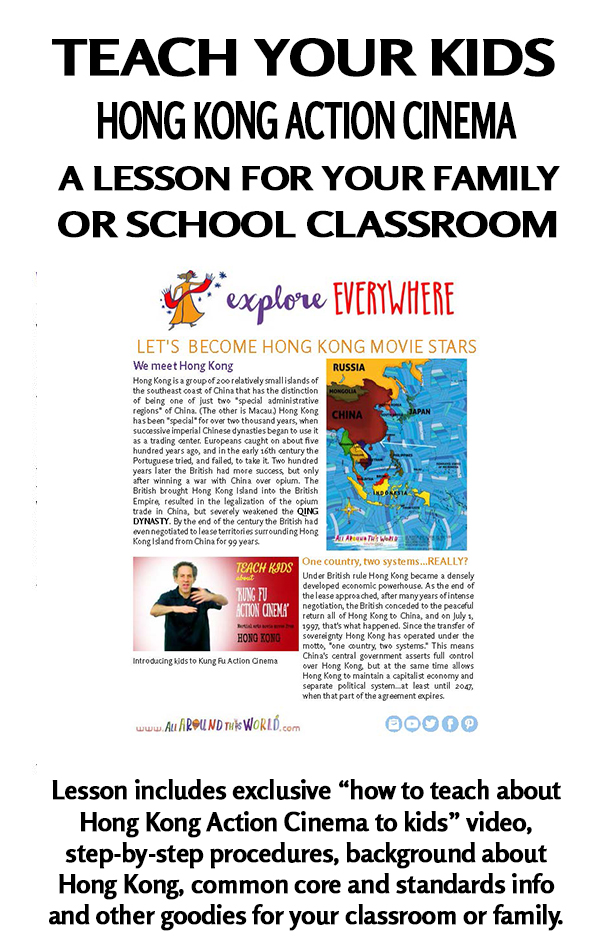
Hong Kong–Action Cinema (Kung Fu)

All Around This World -- Hong Kong Action Cinema

Hong Kong may be rightly proud of its accomplishments as an economic powerhouse and its history and culture may have many intriguing dodges and folds, but worldwide, Hong Kong is perhaps best known as the home of the kick-em-up kung fu movie.

Hong Kong’s film industry started to produce martial arts movies as early as the 1938s, when the Cantonese language film The Adorned Pavillion included the narrative fiction genre called wuxia,
which emphasizes chivalrous and philosophical engagement in the martial arts. By the 1970s a Mandarin-based, grittier and more visually dramatic form of “kung fu” replaced it, and with it came astounding global popularity. In 1973 young martial arts movie star Bruce Lee electrified audiences with Enter the Dragon, which was the first ever English language, US-Hong Kong production. (Lee died soon thereafter, unexpectedly and mysteriously.)

Multiply talented Jackie Chan (“actor, action choreographer, filmmaker, comedian, director, producer, martial artist, screenwriter, entrepreneur, singer and stunt performer,” says the entry about Chan on Wikipedia) became the next huge Hong Kong action film star, blending martial arts and comedic timing in films like the 1985 Police Story that delighted both Eastern and Western fans of the genre. Chan’s Hong Kong movies were usually joyful and engaging, toying with the camp that had defined the genre, such as the overused device of the star of the film fending off numerous attackers who come at him one by one. In 2000 Hong Kong (well, actually Taiwan) cinema soared back toward wuxia with Ang Lee’s elegant Crouchin Tiger Hidden Dragon, which won the Academy Award for Best Foreign Language film and became the highest grossing foreign language movie in American cinematic history. ([this link has kung fu fighting and should be just for grown-ups]: Is this scene from Crouching Tiger Hidden Dragon the best fight scene ever?)

More information:
Wikipedia on Hong Kong Action Cinema | A history of Hong Kong Action Cinema | 15 Kung Fu movies you must see  | Learn Kung Fu for Kids (though you may not want to teach your kids the toe slap kick)

In class we’re going to fight off a hundred attackers with acrobatic kung fu and a smile.

Also, OF COURSE we know that there is much more to the culture of Hong kong than action cinema. All Around This World offers many types of musical experiences and cultural celebrations. This lesson is a touch more frivolous than an ancient cultural dance, but it does give us a chance to, literally, leap into learning about Hong Kong.

How to sing with Jay each week in your home or classroom Support All Around This World on Patreon Enjoy interactive All Around This World lessons in your home or classroom

Hong Kong and Taiwan–Music

CANTOPOP:

In 1949, when the Chinese Communist Party established the People’s Republic of China, one of its first actions was to equate popular music with pornography. When successive waves of emigrants left China for Hong Kong in the ’50s they brought their “pornographic” popular music and began to share it. Well-to-do society in Hong Kong identified Western musicians like Elvis and the Beatles as sophisticated; by the 1960s an English-language pop community thrived in Hong Kong but when Cantonese became an official language in 1974, composers began to use it instead. Cantopop (“Cantonese popular music”) fuses Cantonese-language music with Western styles such as jazz and rock. It increased in popularity throughout the ’70s when vocalist Roman Tam scored several hits with Cantopop TV theme tunes. (Check out this awesome Roman Tan video from 1983.) In the 1980s (“the Golden Age of Cantopop”), Cantopop record sales boomed, performers like Danny Chan and Teresa Teng, former “Queen of Mandarin Songs,” became Cantopop stars, and Cantopop record companies signed musicians to lucrative contracts. This led to an era in the ’90s in which “Four Heavenly Kings” dominated Cantopop music:

— Andy Lau (watch him perform live, sitting on a fake horse)
— Aaron Kwok: (check out his funky ’90s dance to his “Dui Ni Ai Bu Wan”)
— Leon Lai (see him fall in love while fishing in the epic “Everlasting Love”)
— Jacky Cheung (who, by 2002, had orange hair)

Even after the 1997 handover and the change in official language of Hong Kong from Cantonese to Madarain, Cantopop not only didn’t wither, but it actually expanded to become popular throughout China, and, from there, the world!

(A musical aside. If Western listeners consider Cantopop vocals bland, they may be right, at least within a particular context. Because Cantonese is a tonal language any change in pitch results in a changing the meaning of a word. Cantonese singers therefore can’t ad-lib vocal inflections like Western singers, who often go this way, that way and back again. Yes, Cantopop songs hold different constraints for singers than Western songs, but does that make their vocals uninteresting? Not necessarily.)

MANDOPOP:

In China of the 1920’s Mandarin language pop music was known as “shidiaqu,” meaning “music of the time.” Shanghai was its creative and business hub. In the 1930s and 1940s the industry focused on the work of “The Seven Great Singing Stars“:

— Bai Guang: nickname => White Light
— Bai Hong: nickname => White Rainbow
— Li Xianglan: nickname => Yoshiko Otaka
— Yao Lee: nickname => Silvery Voice
— Zhou Xuan: nickname => Golden Voice
— Wu Yingyin: nickname => Queen of the Nasal Voice, which probably sounds better in Mandarin than it does in English, and
— Gong Qiuxia, who must have slept in on nickname day, so people
just knew hims as Gong Oiuxia.

During the reign of Taiwan’s authoritarian Kuonmintang government, especially after the 1949 Communist/Nationalist split (see the “overview” section above), Mandarin became the island’s national language, and also the language of upwardly mobile, educated youth.
Mandarin language pop music took root in Taipei, which soon became the “Cradle of Mandopop,” and began to generate stars in both the Taiwanese and mainland Chinese markets. In the 1980s China really began to open to the world; the industry boomed. Before she began to sing in Cantonese, Teresa Teng became Mandopop’s “queen” and one of its first large scale stars. (Mainland Chinese authorities condemned her music as “bourgeois.”) Teng went on to sing Cantopop, leaving room for Faye Wong to become the Diva of Asia (watch her perform live in Budokan, Japan) and for Jay Chou to rise to the throne as “Mandopop Emperor.”

In class we’re going to listen to:
— “Qing Shan San bu Walkin’ Aoyama” by Stephy Tang.
Stephy Tang started her music career in the teen-pop band called “Cookies” and became somewhat controversial among Cantopop fans–some call her “the Queen of Offkey Singing.” Attempting to grow past the pop, she has starred in over a dozen Cantonese movies and has embarked on a well-reviewed solo career, though she is known
to revert to her teen pop past.

More information:
Wikipedia on Stephy Tang | Cookies: they look oh so happy | All hail the Queen of Offkey singing | A good review for Coloring Stephy

— “Long Zhong Hu Dou” by Miriam Yeung
Miriam Yeung Chin-Wah is a Hong Kong-based actress and Cantopop singer who, says Wikipedia, “is known for performing in comedic films; often as a silly, naive, and clumsy girl. For example,” Wikipedia continues, “in one of her very popular films, Love Undercover, she played a newly graduated police officer who failed every test as a cadet and had entertaining and nonsensical ways of completing her assignments.” Yeung has more recently received good reviews for her role in films such as Elixir of Love, in which she played a princess “who was born with a kind of odor that prevents her from finding a husband, despite her beauty and wealth,” and a “dramedy” called 2 Become 1 in which Yeung played Bingo, an advertising executive with breast cancer. Not silly at all.

More information:
All about Miriam Yeung, courtesy of AsianFanatics.net (nickname? “Big Laughing Aunty.”) | Miriam Yeung’s fun, though kind of confusing, “Thousand Islands Fans Club” website | Watch Miriam Yeung sumo wrestle (sort of) in her video for “Long Zhong Hu Dou”

Hong Kong and Taiwan–Language


The Basic Law of Hong Kong grants Hong Kong two official languages: “Chinese and English.” Explaining the continued presence of English in Hong Kong is easy; English was the sole official language of Hong Kong from 1843 to 1974. The “Chinese” component is more complex. Since the handover, Hong Kong has declared itself “biliterate and trilingual” — in addition to English, Cantonese is the de facto spoken language, but Standard Mandarin is in the picture too. Since the days of Imperial China, successive Chinese governments have promoted Standard Mandarin as Hong Kong’s primary language, but to no avail. Most people in Hong Kong who speak Mandarin more readily use Cantonese or other languages as they go through the day. Proponents of Mandarin were much more successful in Taiwan. Since the 1940s Mandarin has been the only official language of Taiwan’s schools, and much of the population uses it as their primary language. On the other hand, up to 70% of the Taiwanese also speak a language commonly known as “Taiwanese,” which is actually Hokkien. When you’re in Taiwan which should you speak?
According to Wikipedia’s entry on Hokkien:

— in formal settings? Most speak Mandarin
— in informal settings? Most speak Taiwanese

— in urban areas? Most speak Mandarin
— in rural areas? Most speak Taiwanese

— speaking with a young person? Try Mandarin
— speaking with an older person? Try Taiwanese
— speaking with a much older person who came of age during Japan’s pre 1940 rule of Taiwan? Try Japanese

— watching a game show or documentary? Get out your Mandarin dictionary
— watching a soap opera or variety show? Yay Taiwanese!

In class we’re going to say hello and goodbye in Taiwanese/Hokkien:

Hello: Li ho
Goodbye: Pêng-an

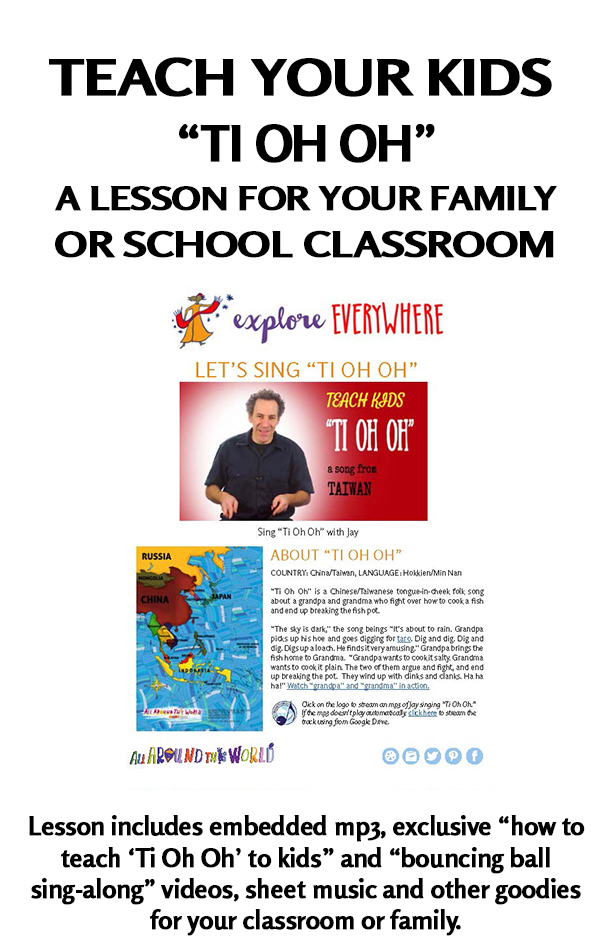
Ti Oh Oh

Taiwan for Kids -- Ti Oh Oh -- All Around This WorldCountry: China/Taiwan
Language: Hokkien

A Taiwanese tongue-in-cheek folk song about a grandpa and grandma who fight over how to cook a fish and end up breaking the fish pot…Ha Ha Ha!! In music class we dig for taro, find a fish, fight over salt and break and imaginary pot. And, of course, we laugh . . . HA HA HA! Watch “grandpa” and “grandma” in action. 

Ho oh beh loh oh!!
Ti oh oh beh loh oh
Grandpa digs for taro with his hoe
Dig and dig, dig and dig,
Does he find the taro?
Instead he finds a fish there and laughs.
Ha ha ha!!
Grandpa wants to cook it salty, grandma wants to cook it plain
The two of them have an awful fight, the pot it falls onto the ground and CRASH!!
Ha ha ha!!

Original lyrics:

天黑黑 要落雨
Ti oh oh beh loh ho
The sky is dark. It’s about to rain.


阿公仔举锄 頭 要掘芋
Ah gong ah gia di tao beh guut oh
Grandpa picks up his hoe and goes digging for taro.


掘呀掘 掘仔掘
Guut ah guut Guut ah guut
Dig and dig. Dig and dig.


掘着一尾旋留鼓
Guut dio ji beh suan liu goh
Digs up a loach.


依呀夏都真正趣味
Yi ah het doh jin jia chu bi
He finds it very amusing.


Repeat


阿公要煮咸 阿妈要煮淡
Ah gong beh zu giam Ah ma beh zu jia
Grandpa wants to cook it salty. Grandma wants to cook it plain.


二个相打弄鼓锅 弄鼓锅
Neng eh xio pa luung pua dia luung pua dia
The two of them argue and fight, and end up breaking the pot.


依呀夏都乡当差当枪 哈哈哈
Yi ah het doh long dong qi dong qiang Ha ha ha
They wind up with clinks and clanks. Ha ha ha

Many thanks to Yenche Tioanda for the transliteration and translation.

How to sing with Jay each week in your home or classroom Support All Around This World on Patreon Enjoy interactive All Around This World lessons in your home or classroom