Countries Archives: Uganda

Africa for Kids – The Amagunjju


Teach Kids About Africa – "Uganda's Royal Dance" -- All Around This World

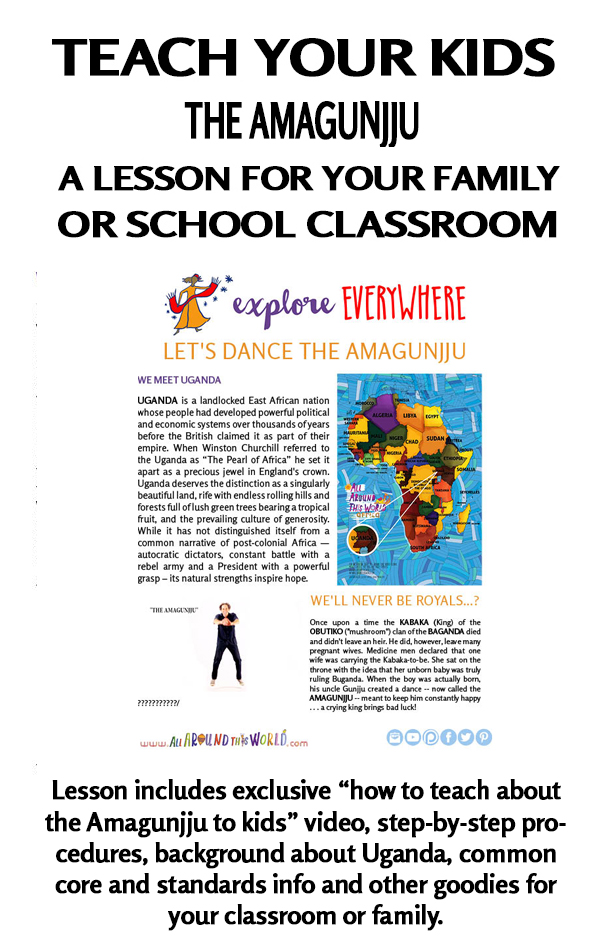
LET’S DANCE THE AMAGUNJJU

Once upon a time the KABAKA (King) of the OBUTIKO (“mushroom”) clan of the BAGANDA died and didn’t leave an heir. He did, however, leave many pregnant wives. Medicine men declared that one wife was carrying the Kabaka-to-be. She sat on the throne with the idea that her unborn baby was truly ruling Buganda. When the boy was actually born, his uncle Gunjju created a dance — now called the AMAGUNJJU — meant to keep him constantly happy . . . a crying king brings bad luck!

PLEASE NOTE: The lesson and embedded video are NOT “How to dance the Amagunjju” tutorials. The goal of this lesson is to provide the tools for you to treat your very youngest students to their first introduction to the Amagunjju and to inspire you to get up and dance together. (Your dance moves can’t be any worse than mine!) Ideally the lesson will be the first step on your and your students’ road to further amagunjju exploration.

How to sing with Jay each week in your home or classroom Support All Around This World on Patreon Enjoy interactive All Around This World lessons in your home or classroom

Akadinda

The akadinda is a Ugandan xylophone that is so large that three musicians play it at the same time. Traditionally the akadinda was an instrument o important in the Bagandan court that the King welcomed one trained masters to live in the Palace to provide music for the royals and exhaustively train apprentices.

There is also a Ugandan royal xylophone called the amadinda. How are they different? The East Africa Living Encyclopedia tells us. (Spoiler alert: one is big, the other is bigger.)

How to sing with Jay each week in your home or classroom Support All Around This World on Patreon Enjoy interactive All Around This World lessons in your home or classroom

Ngoma Drums

“Ngoma” is a term used in many parts of Africa to refer to a kind of drum, a style of drumming or, in its broadest use, the manner of learning about the world by engaging in cultural endeavors like music and dance, or even “a creative social space for engaging with the community.” In Tanzania “ngoma” means “drum” and can refer to literally hundreds of different kinds of local drumming, dancing and  song.

How to sing with Jay each week in your home or classroom Support All Around This World on Patreon Enjoy interactive All Around This World lessons in your home or classroom
bb

Lesson 2: Uganda

All Around This World’s exploration of Africa includes sing-along, dance-along classroom and homeschool lessons about Uganda for kids . . . Meet the world through music –“come to class” with Jay.

All Around This World Map Featuring Uganda for kids

When British statesman Winston Churchill referred to the Uganda as “The Pearl of Africa” after spending some time there in the early 1900s (likely echoing the words of previous British visitor H.M. Stanley) he set the small East African apart from as a singularly precious jewel in the Empire’s African crown. Uganda deserves the distinction as a supremely beautiful land, rife with endless rolling hills and forests full of lush green trees bearing tropical fruit, and the prevailing culture of generosity, especially concerning the welcoming of guests, may have made Churchill feel as if the nation was born just for him. In truth Uganda is an extraordinarily ethnically diverse nation whose people had developed powerful political and economic systems over tens of thousands of years of being populated before the British claimed it as their own. And, in truth, Uganda’s distinction from other colonies in Africa did not result in its being able to avoid the narrative that has become all too common in the post-colonial era — autocratic dictators, military coups, constant battle with a rebel army and a President who has been ruling for decades and just won’t quit.

Fortunately for Uganda, despite a very present colonial legacy, despite Idi Amin and Joseph Kony and a very stubborn Museveni, the nation’s longer term strengths remain. And after decades of relative economic and political stability, Uganda’s densely fertile land and its diverse yet tightly-woven ethnic groups — not to mention its energetic and melodic music, some of which we hear on the AATW: Africa CD — provide ample hope for the Ugandan people. Visit Uganda today and you will find not the war-torn nation of Idi Amin — that was way back in the ’70s! — but an optimistic, albeit complex society that aspires to put the recent (colonial and post-colonial) past behind it and forge as boldly as possible forward, into the future.

Our pages and lessons about Uganda for kids are still in process. Ample content about Ugandan music, dance, food and daily life to come.

[mappress mapid=”15″ center=”1.4, 32.3″ zoom=”6.9″]

[mappress mapid=”16″ center=”1.4, 32.3″ zoom=”6.9″]

How to sing with Jay each week in your home or classroom Support All Around This World on Patreon Enjoy interactive All Around This World lessons in your home or classroom

1. We Are Happy (Hola!)

We sing “We Are Happy” as our hello song at the beginning of every All Around This World Latin America class, changing the greeting to match the featured country of the week. “We Are Happy” didn’t start as a Spanish hello song, but instead as a mashup of two songs the Abayudaya of Uganda sing to greet important visitors to Nabugoye Hill, which is a small area a few miles outside of the Eastern Ugandan city of Mbale. The Abayudya of Uganda are a small community of about 500 Luganda-speaking Bagandans who have been practicing Judaism for over 80 years. Abayudaya community leaders Rabbi Gershom Sizomu and his brother JJ Keki wrote the two greeting songs and led the community in singing them for Jay when he first visited in late 1999.

Country Uganda (original)/ On CD:Dominican Republic
Language: this “Spanish hello song” was originally in English, Luganda and Hebrew
Genre on CD: Merengue
Instruments on CD: Piano, Trombone, Trumpet

[wpspoiler name=”Lyrics of All Around This World: Latin America version” open=”true” style=”aatw-video”]Ooh, bop bop bop! Ooh, bop bop bop.
We are happy, we are happy on this day.

¡Hola everybody! (“Hello” in Spanish),
Bom dia everybody! (“Good morning” in Portuguese),
Buiti binafi everybody! (“Good morning” in Garifuna),
Imaynallam everybody! (“How are things going?” in Quechua)[/wpspoiler]

How to sing with Jay each week in your home or classroom Support All Around This World on Patreon Enjoy interactive All Around This World lessons in your home or classroom
bbb

Credits

Vocals: Jay Sand

Piano/Keyboard: John Stengel

Drums/percussion: Francois Zayas

Instrumental engineering: Mark Wolfe, AudioMind, Philadelphia

Vocals engineered by Erich Miller, Philadelphia

You can listen to the original verson of "We Are Happy" on the Smithsonian Folkways release, Abayudaya: Music from the Jewish People of Uganda.
"We Are Happy" and "Hello" © Gershom Sizomu and J.J. Keki, arrangement by Jay Sand with permission, Instrumental arrangement by Arturo Stable