Genres Archives: Cumbia

Cumbia generally originated on Colombia’s Caribbean coast, fusing rhythms used in African courtship dances brought to Colombia during times of slavery with melodies from both indigenous Colombians and Spanish colonizers. The Bolivian cumbia often incorporates Afro-Bolivian “saya,” which is a form of Afro-Bolivian percussion performed using multiple drums playing polyrhythms, accompanied by much singing and dancing.

Tambora

A tambora is a bass drum that appears in various forms in various parts of Latin America. It is usually a double-headed drum, sometimes carried and sometimes fixed on a stand, sometimes with cymbals attached to provide for varying types of sound.

COUNTRY: Colombia, Dominican Republic, Peru
KEY GENRES: Cumbia, Merengue, Vallenato

How to sing with Jay each week in your home or classroom Support All Around This World on Patreon Enjoy interactive All Around This World lessons in your home or classroom

Guacharaca

A guacharaca is a Native American percussion instrument originated by the Tairona people of Colombia that has come to be part of contemporary Colombian genres like cumbia and vallenato. The instrument is fashioned from the ridged trunk of a small palm tree and is played with a hard wire fork attached to a wooden handle.

COUNTRYColombia
KEY GENRESCumbia, Vallenato

How to sing with Jay each week in your home or classroom Support All Around This World on Patreon Enjoy interactive All Around This World lessons in your home or classroom

Quena

The quena is a traditional bamboo or wooden flute used in many kinds of music found in the Andean mountains. A common quena has six finger holes and one hole for the thumb. The musician controls the airflow with both his or her mouth and fingers, creating a naturally rich tone.

COUNTRY: Andes (Argentina, Bolivia, Ecuador, Chile, Colombia, Peru, Venezuela)
KEY GENRES: Cumbia (Andean Cumbia), Nueva Cancion

FEATURED ON: Niño Colla (AATW: Latin America), Tambobambino (AATW: Latin America)


How to sing with Jay each week in your home or classroom Support All Around This World on Patreon Enjoy interactive All Around This World lessons in your home or classroom

Cajón

The cajón is a rectangular wooden box that percussionists sit upon, tilt slightly forward and slap with their hands to create the sounds of a drum. It first appeared in coastal Peru in the 1800s and became a fixture of Afri-Peruvian forms of music. The instrument could conceivably descend from a family of box-like musicians from West and Central Africa, or perhaps it arose more recently within the last century when musical Cuban fishermen used crates to ship cod. During the era of Peruvian slavery, when slave-owners forbade slaves from making music, slaves used common household items or seemingly innocuous items like shipping crates as instruments.

COUNTRY: Peru, Colombia
KEY GENRES: Afro-Peruvian, Cumbia

[/wpspoiler] [wpspoiler name=”Funky cajon solo by Juro videon” open=”true” style=”aatw-video”]

How to sing with Jay each week in your home or classroom Support All Around This World on Patreon Enjoy interactive All Around This World lessons in your home or classroom

Charango

The charango, a small, high pitched Bolivian/Andean stringed instrument that traditionally was made from the shell of an armadillo, is a staple instrument of Andean music. The charango first appeared in South America in the 1800s, though its exact origin is unclear. Was it a descendant of the vihuela, which the Spanish brought with them when they colonized? Did indigenous musicians who had learned to play Spanish vihuelas and guitars create such a small instrument in order to be able to hide it when Spanish authorities prohibited them from performing their own music? Whatever its origins, the charango’s bright sound has become a characteristic of several Andean genres, like Andean Cumbia, Huayno and Pasillo

COUNTRY: Colombia, Ecuador, Peru
KEY GENRES: Cumbia (Andean Cumbia), Huayno, Pasillo

FEATURED ON: Niño Colla (AATW: Latin America), Tambobambino (AATW: Latin America)

How to sing with Jay each week in your home or classroom Support All Around This World on Patreon Enjoy interactive All Around This World lessons in your home or classroom

Cumbia (Colombia, Mexico, Peru)

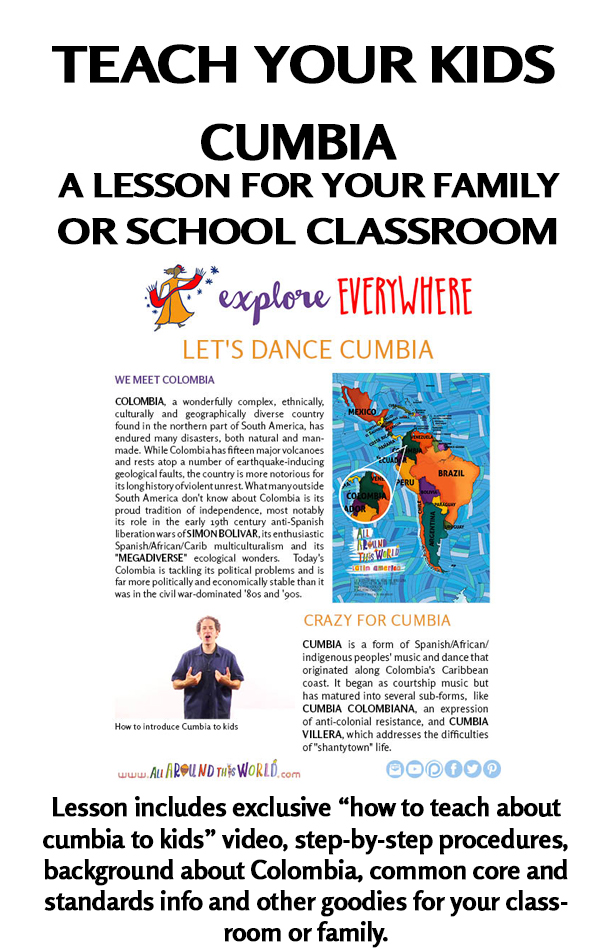
All Around This World Lesson for Classrooms and Homeschool -- Let's Dance CumbiaCumbia is a genre of music that originated on Colombia’s Caribbean coast as a ritual courtship dance of African slaves. At first only drums and claves accompanied the dance, but as Spanish colonial influence seeped into the music, guitars began to appear. Says Wikipedia, “According to legend, the accordion was added after a German cargo ship carrying the instruments sank as a load of accordions washed ashore on the northwest coast of Colombia.” Whether or not this is true, it’s a great story. Other instruments are:

tambora, a large two-headed drum that the drummer plays with sticks,

maracas and cajon (at 3:30–more about the cajon below), and sometimes

the congas, a Cuban hand drum with African ancestry.

Put that all together to a 4/4 “two-step” rhythm and you get…cumbia, cumbia and more cumbia!

Today the genre has spread beyond Colombia popular all over Latin America, especially in Mexico. “Andean Cumbia” blends the indigenous music of Andean nations such Bolivia, Ecuador and Peru with the rhythmic beat. In Peru it has even developed into a distinct subgenre known as Chicha.

A primer

PLEASE NOTE: The lesson and embedded video are NOT “How to dance the Cumbia” tutorials. The goal of this lesson is to provide the tools for you to treat your very youngest students to their first introduction to cumbia and to inspire you to get up and dance together. (Your dance moves can’t be any worse than mine!) Ideally the lesson will be the first step on your and your students’ road to further cumbia exploration.

COUNTRY: Colombia, Mexico, Peru
KEY INSTRUMENTS: Accordion, Cajon, Claves, Congas, Guitar, Maracas, Tambora
SONGS ON AATW: LATIN AMERICA CD: Niño Colla, Tambobambino

[mappress mapid=”16″ center=”-8, -60″ zoom=”3″]
How to sing with Jay each week in your home or classroom Support All Around This World on Patreon Enjoy interactive All Around This World lessons in your home or classroom

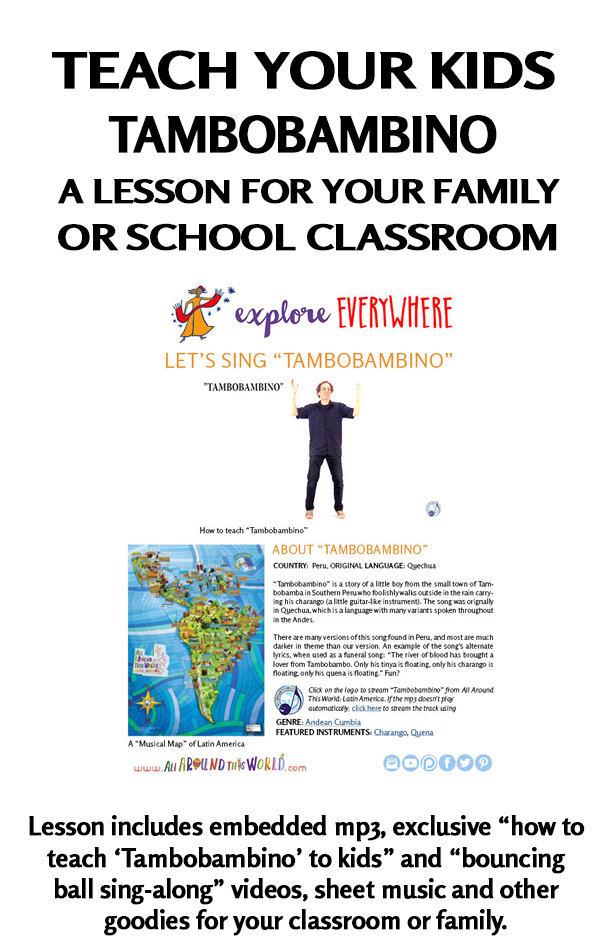
18. Tambobambino


An All Around This World classroom and homeschool lesson -- Tambobambino -- Andean folk songThis Andean folk song is a story of a boy from the small town of Tambobamba in Southern Peru who foolishly walks outside in the rain carrying his charango (a little guitar-like instrument). There are many versions of this song found in Peru, and most are much darker in theme than this one. An example of the song’s alternate lyrics, when used as a funeral song: “The river of blood has brought a lover from Tambobambo. Only his tinya is floating, only his charango is floating, only his quena is floating.” Wisely, All Around This World decided to not use the alternate lyrics in class.

The song was orignally in Quechua, which is a language with many variants spoken throughout in the Andes.

Country: Peru
Language:
Quechua
Genre on CD:
Andean Cumbia
Instruments on CD: Charango, Quena

LYRICS OF ALL AROUND THIS WORLD VERSION

Tambobambino maqt’acha, tambobambino maqt’acha,

Tambobambino maqt’acha, Oh what a foolish boy you are.

¡Wifalita wifala, wifalata wifala, Wifalita wifala, wifalala, wifala!

How to sing with Jay each week in your home or classroom Support All Around This World on Patreon Enjoy interactive All Around This World lessons in your home or classroom

Credits

Vocals: Sofia Rei
Spoken and background vocals: Jay Sand
Charango and quena/panpipes: Patricio Acevedo

Vocals recorded at Headgear Recording, Brooklyn, New York

Instruments engineered by Erich Miller

"Tambobambino" is traditional, arrangement by Jay Sand, Instrumental arrangement by Arturo Stable

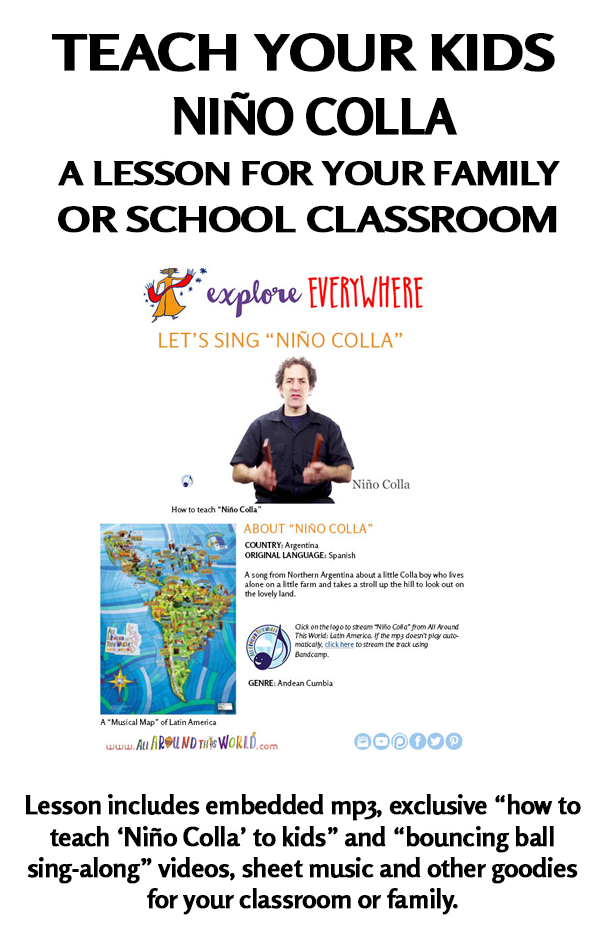
11. Niño Colla


An All Around This World classroom and homeschool lesson from Argentina -- "Niño Colla" -- A Spanish song about a boy

Niño Colla is a Spanish song about a boy from the Coya (Kolla) community of Northern Argentina who, living alone on his little ranch, sets off on a walk up into the hills. In the original he is wearing a “poncho,” a sombrero and one leather sandal, known as an “ojota.” He is also accompanied by his donkey and dog and plays his quena flute on the way.

Most Kolla live in “yungas,” which are “misty forests” found high in the Andes mountains. When the Kolla people have made the international news over the last couple decades the story usually has to do with their protesting agribusiness and mining interests encroaching on the yungas and other native lands.

Country: Argentina

Language: Spanish
Genre on CD: Andean Cumbia

Instruments on CD: Quena, charango


Meet Kollamarka, a generations-old performing ensemble that celebrates Andean music

How to sing with Jay each week in your home or classroom Support All Around This World on Patreon Enjoy interactive All Around This World lessons in your home or classroom

Credits

Vocals: Pedro Ortiz

Charango and quena/panpipes: Patricio Acevedo

Percussion: Arturo Stable

Engineered by Erich Miller

Niño Colla is traditional, English lyrics and arrangement by Jay Sand, Instrumental arrangement by Arturo Stable