Plena is a an Afro-Puerto Rican rhythmic genre that developed in the early 20th century in southern Puerto Rico as “the newspaper of the people.” Lyrics of plena songs would often be topical, addressing social themes or offering political satire. There are many drums used in plena, but one that almost always appears–though not in our song–a small hand drum known as a pendereta, which improvises over the rhythms of other drums.
Timbales come in sets of two shallow, high-pitched drums, to which a percussionist often attaches other instruments like cymbals, cowbells and claves. Timbales appear in Latin musical genres from salsa to mambo to reggaeton. Sometimes a percussionist hits the top of the timbales, other time s/he keeps time hitting the sides. A little bit about the timbales, Enjoy a timbale solo, or two, or three.
“Requinto’ is a term used in both Spanish and Portuguese that refers to an instrument that is a smaller version of another instrument. For example, the requinto guitar, which is part of the customary Mexican son jarocho ensemble, is proportionally smaller than a normal guitar. In Puerto Rican plena, “requinto” refers to a small hand drum that has a high enough tone to improvise over the sounds of other instruments.
The cuatro is a small Caribbean and South American stringed instrument that descended from the Portuguese cavaquinho. “Cuatro” means “four” and most cuatros have four strings, though the instrument is adapting to its frequent use in several genres of music, from bawdy Puerto Rican guaracha to lively Trinidadian parang.
The guiro is a staple percussion instrument found in many Latin-American types of music. Traditionally it is made of a hollow gourd with parallel notches cut into a side; musicians play it by scraping a wooden stick along the ridges.
A pandeiro is a kind of hand drum that has become essential to Brazilian samba and several other Brazilian genres like Choro, and capoeira. The drum is small and has jingles around its rim. The musician holds the pandeiro in one hand and strikes the other side with the other hand.
Plena, also nicknamed “el periodico cantado (“the sung newspaper”), formed as a distinct Puerto Rican musical genre in the late 1800s when sugar cane plantation laborers, manual workers and former slaves moved to the urban areas and communicated the news of the day to each other through music and dance. A plena ensemble consists of a variety of percussion instruments such as guiros, congas, timbales, maracas and panderos (small tamborines), as well as a 4-stringed Puerto Rican guitar known as a cuatro. The plena has no fixed rhythmic form, but, unlike bomba which is primarily African, weaves in a multitude of rhythms from Puerto Rico’s Spanish, African and Taino cultures. Enjoy the plena by grooving along with these gentlemen, who obviously are celebrating after having just came back from a great day together shopping at the red shirt store.
COUNTRY: Puerto Rico (U.S.) KEY INSTRUMENTS: Accordion, Bass, Cuatro, Guiro, Pandeiro, Saxophone, Trombone SONG ON AATW: LATIN AMERICA CD: La Luna
This is an infectious Puerto Rican plena, which is a form of Spanish-influenced Puerto Rican folk music that has been known as “the periodico cantado,” or “sung newspaper;” the lyrics of plena songs are often comments on happenings in the community, the country and the world at large. This Drummer’s guide to Pilon and Plena describes plena as a Spanish influenced genre whose roots “are in the slaves, sugar cane laborers, farmers and others who migrated to the urban areas of Puerto Rico.”
Lyrics of All Around This World version:
Bailala, bailala
I love to dance the plena, bailala.
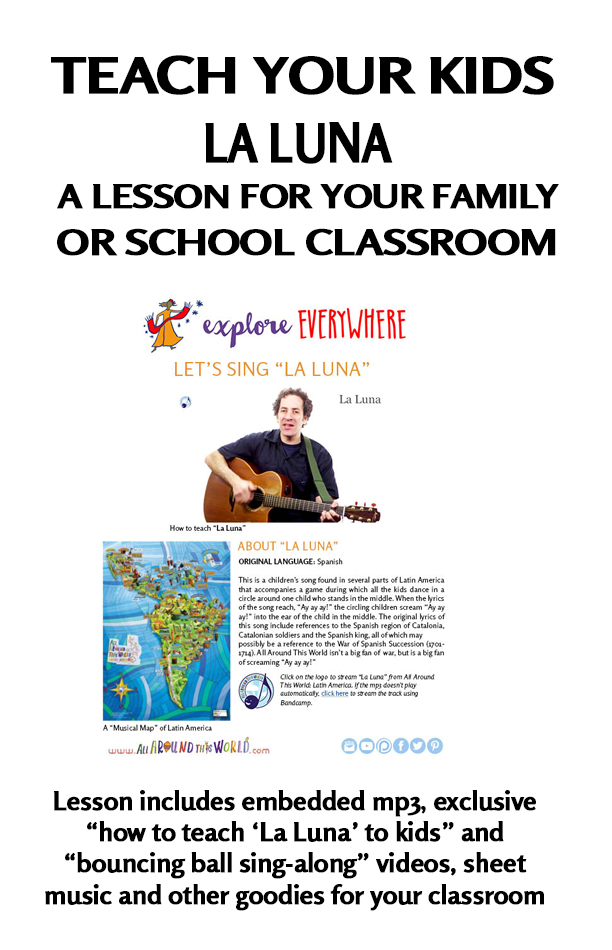
This is a Spanish song about the moon found in several parts of Latin America that accompanies a game during which all the kids dance in a circle around one child who stands in the middle. When the lyrics of the song reach, “Ay ay ay!” the circling children scream “Ay ay ay!” into the ear of the child in the middle. The original lyrics of this song include references to the Spanish region of Catalonia, Catalonian soldiers and the Spanish king, all of which may possibly be a reference to the War of Spanish Succession (1701-1714)? The words in the All Around This World version of this Spanish song about the moon are more poetic: “I’d like to be the moon way up high high high…. I’d like to be a dove so I could fly fly fly….”
Country: (many) Language: Spanish Genre on CD: Plena Instruments on CD: Bass, Drum kit, Hand percussion, Trombone, Trumpet
LYRICS OF ALL AROUND THIS WORLD VERSION
Quisiera ser tan alto como la luna,
Ay-ay-ay! Como la luna
Quisiera ser paloma y poder volar,
Ay-ay-ay! y poder volar
I’d like to be as the moon way up high, high, high,
Ay-ay-ay! way up high, high, high.
I’d like to be a dove so I could fly fly fly,
Ay-ay-ay! I could fly fly fly
Why the heck didn’t Al Around This World get this guy to record La Luna on our CD?
Credits
Vocals: Tony Perez Bass: Rob Hagopian Piano/Keyboard: John Stengel Trombone: James Negron
Trumpet: Nelson Miranda Drums/percussion: Francois Zayas Additional percussion and engineering: Arturo Stable
Engineering and co-production of drums, keyboards and bass by Mark Wolfe at AudioMind.
We are revising the AllAroundThisWorld.com site and are currently using a new (better!) site — ExploreEverywhere.com — to tell you all about our curriculum offerings and how to become one of our teachers. That said, if you were on ExploreEverywhere, you clicked to find more information about a song or lesson, and landed here, you’re in the right place! Some links may be broken and a detail or two may be out of date…but close the popup window and enjoy!