Soca is a genre that first appeared in 1963 when calypso musician Ras Shorty added Indian instruments to the arrangement of his hit song, “Cloak and Dagger.” (Here’s a short bio of Shorty.) Shorty referred to the sound he created–an infectious hybrid of caplypso, African rhythms and Indian instruments–as “solka,” the true “SOul of CAlypso.” Today’s soca has expanded to include elements of rap, reggae, disco and electronic genres while still maintaining its initial bounding beat.
Soca is a faster version of calypso that has substantial influence throughout the Caribbean. Trinidadian musician Ras Shorty generally receives credit for originating it in 1963 when he added Indian instruments such as the dholak and the the tabla to calypso. In the 1970s calypsonians such as Shorty had also added soul, disco and funk, transforming the genre into internationally popular dance party music. Today soca remains popular throughout the Caribbean, especially the more overtly East Indian chutney. A brief history.
COUNTRY:Trinidad and Tobago KEY INSTRUMENTS: Bass, Dhantal, Dholak, Drum kit, Guitar, Tabla, Trumpet, Trombone SONG ON AATW: LATIN AMERICA CD: Wan Boto
A mid-’90s Caribbean mega-hit by nine time Calypso King, the Barbadian musician Stedson Wilshire, otherwise known as “Red Plastic Bag,” “RPB” or sometimes even just “Bag.” In the song RPB declares his general disdain for dub/ragga music, in which deejays speak, often incomprehensibly, over the pounding beat.
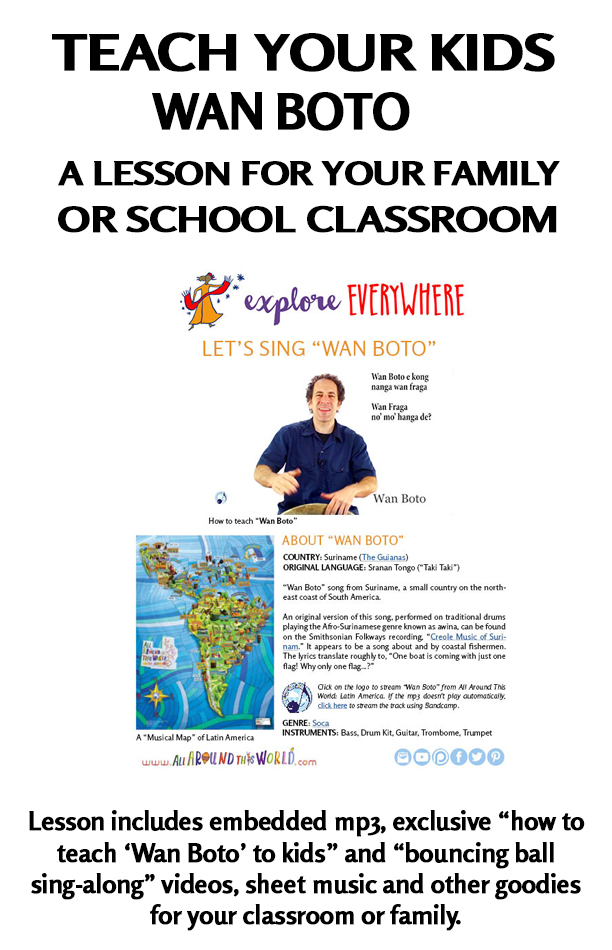
A Caribbean drumming song, originally from Suriname, which is a small country on the Caribbean coast of South America. Unlike any other country in South America Suriname was primarily a colony of the Netherlands, so the culture and colonial language are not Spanish or Portuguese, but Dutch. Suriname has a very diverse population composed of substantial percentages of East Indians (primarily Hindu descendants of Northern Indian laborers who replaced Africans after the abolition of slavery), “Creoles” (people of European descent born in Suriname), Indonesians and “Maroons” (descendants of escaped slaves). There is also an active minority of indigenous people such as Carib, Arawak and Amerindians who retain their original languages and religions. The official language of Suriname is still Dutch, but many in the country speak Sranan (sometimes called Sranan Tongo, or “Taki Taki,”) which is a creole language that draws upon Dutch, English, Portuguese and a few African languages.
An original version of our call-and-response Caribbean drumming song, performed on traditional drums playing the Afro-Surinamese genre known as awina, can be found on the Smithsonian Folkways recording, “Creole Music of Surinam.” It appears to be a song about and by coastal fishermen. The lyrics translate roughly to, “One boat is coming with just one flag! Why only one flag…?”
Language: Sranan Tongo (“Taki Taki”) Genre on CD: Soca
(original genre: Kaseko) Instruments on CD: Bass, Drum kit, Guitar, Trombone, TrumpetLYRICS OF ALL AROUND THIS WORLD VERSION
Wan boto e kong nana wan fraga
Wan fraga no’ mo’ hanga de?!?!
One boat is coming with just one flag
Wan fraga no’ mo’ hanga de?!?! Setish B. and Carlo Jones (on sax) plays kaseko
We are revising the AllAroundThisWorld.com site and are currently using a new (better!) site — ExploreEverywhere.com — to tell you all about our curriculum offerings and how to become one of our teachers. That said, if you were on ExploreEverywhere, you clicked to find more information about a song or lesson, and landed here, you’re in the right place! Some links may be broken and a detail or two may be out of date…but close the popup window and enjoy!