Genres Archives: Son Jorocho

From the southern coastal plain of Veracruz, son jarocho is harp music with a highly repetitive musical structure and improvisational lyrics. This Mexican genre of son demonstrates the more African and Creole influences in that part of the country.
“A classic example of the son jarocho is “La Bamba,” which features a distinct three-chord repeated pattern underlying a simple verse (or verses), which allow for variation and improvisation. Some jarocho songs feature call-and-response vocals as well as Cuban claves, a further demonstration of the African and Caribbean influences. A conjunto jarocho (jarocho ensemble) typically consists of one or two arpas jarochas (harps) along with guitar relatives the jarana and the requinto. The lead harpist also tends to be the lead singer, and will punctuate his or her verses with rapid passages of harp solos and underscore the lyrics with complex accompaniment. The requinto tends to add improvisational lines around the harp in what is overall a highly energetic form.
Jarocho songs are used to accompany several dances, which include the zapateado (footwork) characteristics found in several of Mexico’s regional forms. One of the living legends of this genre is Graciana Silva, a jarocha (woman from Veracruz) who continues to perform and record this traditional form today. While the genre was not widely known outside Mexico, in the 1950s, Chicano rock musician Richie Valens recorded his seminal version of “La Bamba,” and unknowingly exposed American teens to some of Mexico’s traditional music history. —Rebeca Mauleon”

Lesson 1: South and Central Asia–Genres of Music

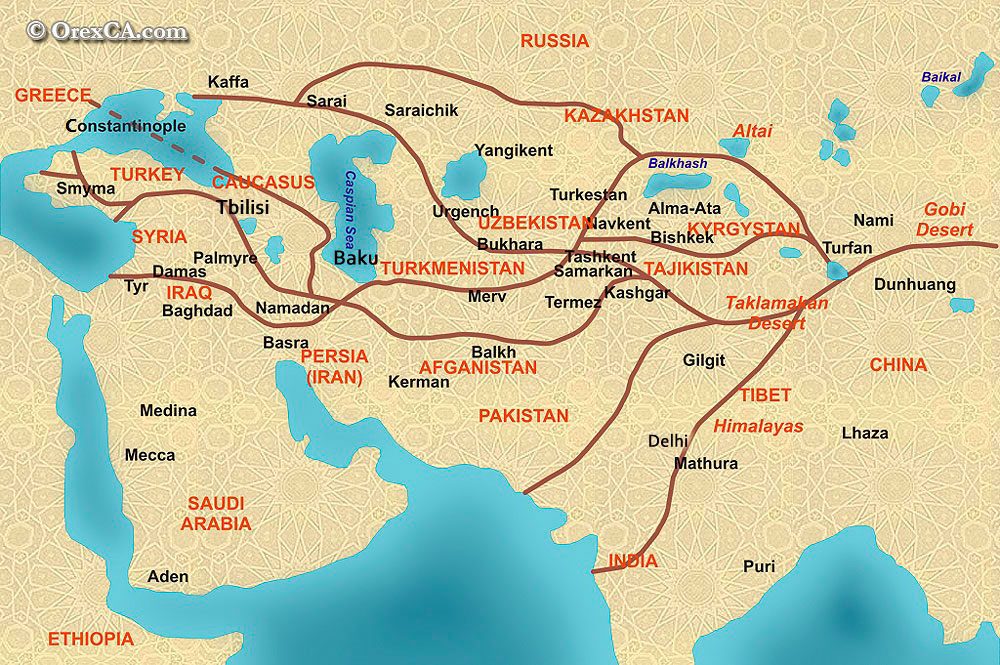
Let’s start our exploration of the musical genres of South and Central Asia by touching upon the music of Central Asia, which developed over several thousand years during which the region, though almost all landlocked and almost impenetrably vast, was a literal crossroads for merchants, travelers and rampaging maraudersThe Silk Road was a network of trade routes that crisscrossed the region, ultimately connecting China with the West. (Get your bearings: a map of the Silk Road.) This jumbling of people and purposes led Central Asian music to develop fluidly, placing great value on diversity.

Most Central Asian music is built around the concept of a “maqam,” which is the system of relationships between notes that determines how a particular composition “feels.” For the musically-minded among you, this is somewhat akin to the Western concept of “scales,” though it’s more directly analogous to the idea of “modes.” Whereas a scale merely refers to the particular relationships between notes that sound differently, a mode, like maqam, has more to do with the mood or impression generated by the way a particular set of notes sounds when played together.The music of various regions of Central Asia differs in mood based upon each part of the region’s unique history and therefore features different maqamat (plural of maqam). The following list from National Geographic’s entry on Central Asian Classical music may, upon first glance, seem confusing, but read it carefully, and follow the YouTube links to examples of each music, and you may start to get a sense of the way multiple cultures fused their musics over the centuries to develop unique maqamat:

“Regional traditions of Central Asian maqam include:

— SHASH MAQAM (six maqams), which flourished in the historically multicultural cities of Bukhara and Samarkand, and whose performers and audiences included Tajiks, Uzbeks, and Central Asian (“Bukharan”) Jews. Listen to a shash maqam on YouTube, and make sure to look at the description of the video for a history of the shash maqam.

— KHOREZM MAQÂM, linked to the feudal city-state of Khiva; Ferghana-Tashkent maqâm, which was cultivated by the nineteenth-century rulers of the Qoqand Khanate. Watch the “khorezm” dance from Tashkent. (Khiva and Tashkent are in Uzbekistan.)

— the UYGHUR ON IKKI MAQAM. On ikki (“twelve”) maqam comprises a related but somewhat more distant complex of styles and repertories that may well have followed its own course of development over many centuries in the oasis cities of what is now the Xinjiang-Uighur Autonomous Region of China. Watch a Uyghur dance based upon the maqam.”

If you want to delve deep music from the region and happen to find some extra change in your couch cushions you should get your hands on the nine volume Smithsonian Folkways set, “Music of Central Asia”, which will introduce you to Tengir-Too from the mountains of Kyrgyzstan, Homayun Sakhi, master of the Afghan Rubab and, of course, Bardic Divas. Woo hoo! You should also open your ears to The Silk Road Ensemble, an extraordinary collection of Central Asian musicians that came together with the inspiration of cellist Yo Yo Ma.

We have to go only slightly south from Central Asian countries like Afghanistan to end up in Pakistan and then India, a fact that’s actually essential to understanding the different between two primary genres of South Asian classical musicNorth Indian (Hindustani) and South Indian (Carnatic) musics are both based upon many similar concepts but are also as fundamentally different as the North and South Indian cultures from which they arise. The most common and most simplistic (though not altogether untrue) explanation for the difference between Hindustani and Carnatic musics is that historically Northern India has had more cultural interchanges with Central Asian peoples, especially with Muslims, than has the South. When Northern Indian music developed in the 13th and 14th centuries it did so hand in hand with the Islamic-inspired musics of Afghanistan and Persia. South Indian music rose in the 15th and 16th centuries in relative isolation.

Both Hindustani and Carnatic compositions twist and turn and can come across as labyrinthine, but at the heart each relies on two basic concepts: rag, the way a melody develops from note to note, and tal, a composition’s rhythm. Since we introduced maqam as a melodic concept above let’s dig a bit into the rhythmic essence of taal.

“Taal,” which literally means “clap,” somewhat corresponds to meter in Western music though “tala” don’t operate according to a linear concept of measures. Instead, tala exist in the form of cycles. Each taal cycle has a particular number of beats and repeats many times over the course of a composition, allowing musicians a framework and fundamental jumping-off point for improvisation. For example, Hindustani classical music’s most common taal is “Teental” a 16 beat cycle that is composed of four groups of four beats. Other taals include:

— Deepchandi taal, 14 beats divided 3-4-3-4

— Ektaal, 12 beats divided 2-2-2-2-2-2

— Jhaptaal (at about 1:50), 10 beats divided 2-3-2-3

— Kaharva taal (performed by six year old Harshwardhan Sharma) 8 beats divided 4-4

— Rupak taal, 7 beats divided 3-2-2

— Dadra taal, 6 beats divided 3-3

Thanks to WorldMusicGuru.com for most of the above YouTube demonstrations of the tala.

Tabla players communicate the many ways to drum a taal by creating a “theka,” which is a particular arrangement of tabla strokes known as “bols.” (For an overview of these concepts check out WorldMusicGuru’s video introduction to Hindustani rhythm.)


Explore these genres of music from South and Central Asia:
[mappress mapid=”16″ center=”27, 78″ zoom=”4″]


Chimurenga

Zimbabwe is home to some of Africa’s most melodically gifted musicians, many of whom blend traditional instruments and rhythms with the electric instruments of modern African pop. For example, Thomas Mapfumo, known as “The Lion of Zimbabwe,” has pioneered Chimurenga music, which has become the voice of a proud Zimbabwean people (“chimurenga” is the Shona word for “revolutionary struggle”). Chimurenga features the mbira, an ancient Shona thumb piano, and is known to follow mbira music’s 12 beat polyrhythms, breaking the 12 beats into either four measures of three beats each or three measures of four beats each. Mapfumo came to musical prominence as part of Hallelujah Chicken Run Band–surely one of the best-named bands ever–which formed in the darkest days of Rhodesian colonialism when the Mangura Copper Mine hired musicians including Mapfumo, some of whom worked as chicken-tenders, to entertain its weary miners. Watch Mapfumo perform “Moyo Wangu.” Listen to the Chicken Run Band’s “Ndiyani Angandiudze” on YouTube. Hear a public radio feature on the Chicken Run Band.

How to sing with Jay each week in your home or classroom Support All Around This World on Patreon Enjoy interactive All Around This World lessons in your home or classroom

Malian Blues

Musicologists and music-lovers alike revere Mali as “the birthplace of the blues.” Mali’s traditional music draws on the tales of ancient griots, who effectively kept the country’s historical record by singing songs of praise about its nobility. Malian blues fuses plaintive groit-inspired narrative with the shuffling rhythm that’s the staple of American bayou blues. Global musicians regard Malian blues legend Ali Farka Toure as one of the most important guitar players of all time, noting his musical residence at the crossroads between traditional African and American musics. His 1994 CD with American guitarist Ry Cooder, “Talking Timbuktu,” demonstrated his blues prowess as well as his ability to blend disparate African cultures into a unified African statement–Toure (read a posthumous profile) sings in 11 languages on the album. In this YouTube video, Toure jams with blues guitarist Corey Harris (read about his love of Malian blues) and waxes philosophical about African-Americans’ deep connection to Africa.

How to sing with Jay each week in your home or classroom Support All Around This World on Patreon Enjoy interactive All Around This World lessons in your home or classroom

Salsa (History)

Salsa is certainly a Latin form, with Latin origins both historically and musically, but it’s also undeniably a product of New York. As early as the 1940s New York City was a global center of Cuban dance music, with big bands such as MACHITO AND HIS AFRO-CUBANS combining Latin music with swing. In the 1950s, New York’s PALLADIUM BALLROOM primarily featured lively Latin dance music known as MAMBO, which had originated in Cuba. (Wikipedia’s entry on mambo tells us, “[t]he word ‘mambo’ means ‘conversation with the gods’ in Kikongo, the language spoken by Central African slaves taken to Cuba.” Whether or not that’s true, that’s pretty cool.) In the ’50s Machito and his band played mambo, as did singer and bandleader TITO RODRIGUEZ and percussionist/bandleader TITO PUENTE. By the earliest 1960s most popular Latin bands specialized instead in CHA CHA CHA, which was similar to mambo, but was slightly easier to dance.

[Watch vocalist, maraca player and bandleader Machito (Frank Grillo) and His Afro-Cubans perform their hit “Nague” | Watch Tito Rodriguez (on timbales) perform alongside Puerto Rican baseball player Orlando Cepeda | Watch Puente and his band play “Five Beat Mambo“]

In the 1960s, political problems between the United States and Cuba effectively stopped public communication between Cuban and American musicians. Whereas for a generation advances in Cuban music quickly hopped up America’s East coast to New York, in Cuba in 1963, MOZAMBIQUE, a vigorous dance style that fused mambo with the “conga” music of Cuban street carnivals, was only popular in Cuba. In New York, Puerto Rican pianist, EDDIE PALMIERI, heard mozambique and created a similar, though not identical, rhythm, that he also called mozambique. Without the regular interplay with Cuban musicians, Cuban mozambique and New York mozambique developed independently.

Watch a video of Palmieri’s “Sujetate La Lengua” from his 1965 album, Mozambique | Eddie Palmieri & vocalist Ismael Quintana perform, “Puerto Rico”/”Adoracion”]

In 1966 the Palladium lost its liquor license and the mambo effectively disappeared. A younger generation of New York-based Latin musicians replaced it with LATIN BOOGALOO, which was a mix of Cuban music and American Rhythm & Blues that featured both Spanish and English lyrics. [Watch Joe Cuba perform his Latin boogaloo hit, “Bang Bang,” in the 1960s] By the late ’60s, though, as almost every element of American life became “political,” Latino youth in New York City opened an eastern branch of the Chicago-born YOUNG LORDS, a radical community organization–detractors continued to call them a “street gang” for years beyond they were actually a street gang–that promoted Puerto Rican independence and the empowerment of people in poverty. The Young Lords also boldly embraced Latin culture, celebrating Latin music in particular as an essential element of Latin pride. [Learn about the Young Lords on YouTube by watching, “Fighting Much More than Poverty.”]

In the context of such social and political change, FANIA RECORDS, introduced above, launched in 1967 and began to release a series of recordings, mainly based in the traditions of Cuban son montuno and Puerto Rican plena, that increasingly blurred the lines between various Latin genres. Fania promoted this musical boundary-busting as the emergence of a new, culturally powerful, pan-Latin movement…SALSA!! Whether this was a marketing scam or an actual musical evolution, “the Fania sound” soon became so popular in the the “Nuyorican” community–the millions of people of Puerto Rican descent
who live in New York City–that in 1971 the FANIA ALL-STARS, a band of top Latin musicians who recorded for Fania, organized by Dominican band leader and flautist JOHNNY PACHEO, sold out a concert at New York’s Yankee Stadium.

[Watch Johnny Pacheo perform “Lamento De Un Guajiro” with Ismael Miranda and with Hector Casanova, both live in the ’70s | Watch the Fania All-Starts perform “La Debilidad” on TV and a riveting performance of “Anacaona” in 1971, including a behind-the-scenes look at a studio recording session]

Throughout the ’70s the New York salsa sound spread around the Latin world, with New York-based Fania artists like trumpeter WILLIE COLÓN becoming international stars and with international stars like Cuban vocalist CELIA CRUZ becoming New York-based Fania artists.

Top Latin musicians like Panamanian vocalist/lyricist/political activist RUBEN BLADES–who started his career in the mid-’70s working in the Fania mailroom–ultimately created in many Latin genres, and in the U.S. there was still a Latin music scene outside of salsa–EDDIE PALMIERI and MANNY OQUENDO played New York mozambique, for example, and TITO PUENTE, soared as a master of Latin Jazz–but in New York’s saucy late night dance clubs and in the record collections of Nuyorican youth, salsa ruled.

[Watch Willie Colón and Puerto Rican vocalist HECTOR LAVOE perform “La Murga” | Watch Celia Cruz & Tito Puente perform “Quimbara” | Watch Manny Oquendo (on timbales) y Conjunto Libre’s fantastic performance of “Elena, Elena” | Watch Ruben Blades and Willie Colón perform “Ojos,” apparently after taking their band shopping for hats.]

In the early 1980s Cuban musicians who had emigrated to the United States as part of the Mariel boatlift were surprised to find the most popular Latin genre was salsa, which sounded to them like Cuban music from the 1950s. As they integrated into the American Latin music scene they added more Cuban rhythms and spurred the development of Latin jazz. Still, at the same time salsa was spreading around the globe, inspiring musicians everywhere to create their own local variants. [Watch Jo Arroyo and his band perform the Colombian salsa song “La Noche” at Carnaval in Barnquilla, fusing New York’s salsa with Colombian cumbia and vallenato.] Salsa also birthed its own sub-genres, like the pop-oriented (and not always critically acclaimed) “salsa romantica,” which was salsa with lyrics that focused on love, and with music that emphasize melody and romantic lyrics over Afro-Cuban rhythms. [Watch salsa romantico singer José Alberto perform, “El Canario” in 1990, with two exuberant backing dancers in tow] Throughout the ’90s and to the present day, while “traditional” salsa remains popular in dance clubs far and wide, artists like innovative Puerto Rican hip hop band CALLE 13 continue to find new ways to weave it into their contemporary creations. [Watch Calle 13 and Ruben Blades doing a Latin roll call while performing “La Perla” on the Latin Grammies, complete with taiko drummers, posturing hip hop kids, backround dancers wielding bamboo and two acrobats they seem to have stolen from Cirque du Soleil.]

How to sing with Jay each week in your home or classroom Support All Around This World on Patreon Enjoy interactive All Around This World lessons in your home or classroom

Swamp Blues

Early British guitarists also found inspiration in “swamp blues,” a subgenre of blues that developed in the ’50s and was a variation of slower tempo, Louisiana-style blues music that also incorporated elements of Cajun and, eventually, zydeco music. Swamp blues records like those by LIGHTNIN’ SLIM featured shuffling boogie-style beats, a bit of percussion and wailing harmonica.

[Watch Lightnin’ Slim play swamp blues in 1972]

Azerbaijan–Language

The official language of Azerbaijan is a Turkic language known as either “Azerbaijani” or “Azeri” that is not only prevalent in Azerbaijan– underline; font-weight: normal;” target=“_blank” href=”http://allaroundthisworld.us2.list-manage1.com/track/click?u=830c09f859d1ec8dec0bbaac8&id=8459d7366e&e=ba719a1606″ target=”_blank”>Perso-Arabic script and also embrace Persian, rather than
Russian words. Today, Azeri in Azerbaijan appears mainly in Latin script, leaving Azeris to be able to communicate with their Iranian kin less through writing than through the increasingly divergent spoken word.

Algeria–Music


Algeria’s dominant musical export is Rai, a pulsing, vibrant music that often mixes traditional Arabic scales and structures with modern synthesized effects reminiscent of disco. Rai, which means “opinion,” has been a thorn in the political side of successive Algerian governments since the ’70s. Most of the internationally popular Rai musicians are expatriates whose music inspires political resistance and resonates with the fierce independence of the Algerian people.

How to sing with Jay each week in your home or classroom Support All Around This World on Patreon Enjoy interactive All Around This World lessons in your home or classroom

Lesson 9: Pitcairn and the Bounty

[wpspoiler name=”Map of Pitcairn” ][mappress mapid=”15.2″ center=”-25, -128.3″ zoom=”8″][/wpspoiler]

PITCAIRN:

The small volcanic island of Pitcairn is very isolated, even by Pacific standards; the tiny speck sit in the far South Pacific, about 1,350 miles southeast of Tahiti. And, also even by Pacific standards. Pitcairn has an unexpected and unparalleled history.

In 1787 a boat called the Bounty set sail from England bound for Tahiti in order to pick up a cargo of breadfruit saplings to transport to Jamaica to feed slaves working on the plantations there. Bounty sailors, who had taken almost a year to reach Tahiti, were quite content on the welcoming, subtropical Tahiti. Many of the sailors fell in love with Tahitian women during their stay there, including the master’s mate, a sailor named Fletcher Christian.

When the Bounty left Tahiti for the second part of its journey the crew and the boat’s commander William Bligh, fell into conflict over what the crew claimed was Bligh’s inhumane treatment of the vessel’s sailors. Led by Christian, the crew mutinied and cast Bligh off the Bounty, sending him and 18 loyal sailors adrift on a 23 foot long boat. Remarkably, Bligh and these sailors survived a 3,600 mile, seven week ordeal and eventually landed in the now-Indonesian island of Timor. Meanwhile, Christian
and the Bounty returned to Tahiti. While sixteen of the men decided to stay there, Christian
and eight others, afraid of being found and arrested for their mutiny, set sail for isolated islands where they could build their own lives along with twelve Tahitian women and six Tahitian men.

For a couple months Bounty bobbed from island to island and in 1790 finally found Pitcairn, a then-uninhabited and very lonely little blip. The sailors took all the food and goods they had brought with them, hauled them up a hill now known as “Hill of Difficulty to the Edge,” then ran Bounty ashore and burned the boat so no one passing by at sea would be able to spot them.

The tiny group built shelters and set about creating a small, isolated society. Unfortunately their peace on Pitcairn didn’t last long. The British sailors didn’t treat the Tahitians well and the Tahitians–yes, ironically–rebelled. All but three of the men who originally came to the island died in the fighting. Over the next few years there was more dissent and other troubles; by 1800, a sailor named John Adams was the only male survivor. There were ten Tahitian women and twenty-three children.

John Adams took his role as patriarch of Pitcairn seriously and led the community in building sturdy houses around an English-style commons. There was enough vegetation on the island, and the occasional pig, to sustain them. Adams was not a learned man but he was a devout Christian; he shepherded the islanders through a period of spiritual peace and relative calm. In 1814 when the British naval commanders finally found Adams the islanders’ piety impressed them. They decided not to arrest Adams for his role in the mutiny, and instead to support Pitcairn by opening it up to supply visits from other islands. Since Adams died in 1829 Pitcairners have known him as “Father.”

In 1831 the islanders, fearing their population, though less than 70, would outstrip the resources of the land, emigrated together to Tahiti. The islanders weren’t happy there; they had become used to their particular fusion of European sensibilities, pious Christianity and Polynesian sense of peace. They also found themselves dying of diseases Tahitians had to which they weren’t immune. Within the year they had returned to Pitcairn. Unfortunately, in 1832 a settler named Joshua Hill joined them and took the island’s leadership, becoming a dictator and cruelly punishing islanders for even the smallest transgression.In 1838 the islanders removed Hill from the islands by force and, seeking order, drew up a constitution that was the first in the British Empire to include female suffrage and mandatory education. Throughout the rest of the 1800s the islanders weathered severe storms and bouts with influenza and developed a rather stable society, though again population growth outstripped resources. In 1856 all 194 Pitcairners left for the then-uninhabited former British convict-inhabited Norfolk Island. In 1858, several islanders returned. They restricted immigration by all outsiders other those who the islanders deemed welcome on the island. One of these immigrants was a missionary who convinced the islanders to stop following the Church of England and become Seventh Day Adventists.

Pitcairners lived in relative peace throughout the 1900s, struggling economically but receiving support from Britain as a member of the Commonwealth. Most of the islands’ under-100 inhabitants continued to be descendants of the original mutineers. In 1999, however, Pitcairn returned to international attention when a number of women on the island accused many men on the islands of abuse and sexual assault. In 2004, seven men–half the island’s male population–faced charges. Four ultimately were convicted and were jailed on Pitcairn. Not a pleasant story, but no doubt not the end of Pitcairn’s unlikely tale.

More information:

Pitcairn’s history, according to the government of Pitcairn (with no mention of the 2004 trial) | Infoplease.com’s summary of the story of the Bounty and Pitcairn (which tells the whole tale)

Lesson 7: The Marianas

[wpspoiler name=”Map of the Marianas” ][mappress mapid=”15″ center=”15, 145.7″ zoom=”8″][/wpspoiler]

We continue our tour of Micronesia with a brief exploration of Guam and the Northern Marianas, two groups of islands that used to count as one group of islands, at least until outside powers intervened. Today both Guam and the Northern Marianas are territories of
the United States, so if you live in the U.S. you may one day ask yourself, “what’s the deal with Guam and the Northern Marianas?” Read below for one take on the deal.

THIS WEEK’S GREATEST HIT:


— Enjoy J.D. Crutch perform “Langet-hu I Asagua-hu” and you prepare for Guamanian Fiesta.

FUN LINKS TO SHARE WITH THE KIDS:

Enjoy some Chamorro music:

— tease your friends while competing with them to see who can sing the best Kantan Chamorrita. Kantan Chamorrita is part of a widespread global tradition of jousting through poetry and song, which appears in the Caribbean as an “extempo war,” in Lebanon as “zajal” (blurry, but you get the idea), in Greenland as a “drum dance” and in the U.S. as a rap battle.

Introducing the belembaotuyan, “Guam’s only original musical instrument”

Meet Chamorro rocker J.D. Crutch


Lesson 4: Iran

When U.S. President George W. Bush declared Iran part of the “Axis of Evil” in his 2002 State of the Union speech, lumping it with the then-Saddam-led Iraq and the nearly impenetrable North Korea, many Iranians were taken aback. Relations between the United States and Iran had been chilly to say the least since the Islamic revolution of 1979. Still, by 2002 there was at least the possibility of a thaw. The Iranian President at the time was Mohammad Khatami, a reformer who risked his political career on the idea of maintaining a positive dialogue with the West. Unlike Iraq and North Korea, Iran was a multiparty state whose people democratically elected their government (with some important caveats–see below). Also, Iran, being predominantly Shiite Muslim, was not a country that supported Afghanistan’s Taliban or Al Qaeda, whose September 11, 2001 attack had inspired Bush’s speech. In fact, Al Qaeda, which has a Sunni leadership, has actually long listed Shi’a among their enemies. None of the September 11 hijackers was from Iran. So while Iranians with knowledge history were unlikely to have found Bush’s “Axis of Evil” inclusion stunning, to Iranians, being called “evil” was a severe public and personal insult. Paradoxically, many analysts say Bush’s “Axis of Evil” comment weakened Iran’s reformers like Khatami, dividing them in thereby helping the hard-line conservatives defeat them. Go figure.

This week All Around This World is going to meet “evil” Iran. Chances are good that when we learn about the country’s history, its culture, its music and even some of its recent leaders, we may still find ourselves on opposite sides of any number of political or religious arguments, but “evil…?”

Oh and one thing to be sure to know before we explore Iran. Persians are not Arabs! Ethnic Persians trditionally speak Persian. Arabs traditionally speak Arabic. In contemporary geopolitical usage, Iranians are people who are citizens of Iran. There are some Iranian Arabs, just like there are millions of Iranian Kurds and Azeris. (Iran is far from ethnically monolithic.) Most Persians and most Iranians are Muslim, as are most Arabs, but being “Persian” or “Arab” does not make you Muslim, just like being “Israeli” does not necessarily mean you’re Jewish…good?