Genres Archives: Son

Cuban son originated in the eastern part of Cuba, essentially as a fusion of Spanish melodies and African rhythms. Around the 1920s, performing groups began to take songs written in this Afro-Cuban style and apply increasingly intricate instrumentation to it–first the tres (introduced below), guitar, bass, bongos, maracas and claves, then the trumpet and eventually other horns. Son became less popular in the 1950s when big bands playing a variety of dance styles became popular in Havana and New York, but reemerged as a distinct genre with the recording of the popular album “Buena Vista Social Club.”

The heart and soul of Cuban son is “the clave,” a rhythmic pattern that serves as the cornerstone for not only son, but the genres that developed from it, such as salsa. (Learn about the clave and why it’s important in Latin music.)

Má Teodora

Country: Cuba
Language: Spanish

Genre of original: Son

“Má Teodora” is reputed to be the oldest Cuban son, dating, perhaps (though not definitely) way back to the late 1500’s/early 1600’s when the West African rhythm that became known as the Clave met early Spanish melodies and lyrical forms. In the original, our friend Teodora has gone out to gather and chop wood for the fire. Throughout the song Teodora chops wood and we all dance. Learn about the legend of Má Teodora.

Lyrics of All Around This World version:

¿Donde esta la Má Teodora?
Rejando la leña está

¿Donde esta la Má Teodora?
Rejando la leña está

Original lyrics:
¿Dónde está la Má Teodora? Rajando la leña está.
Con su palo y su bandola Rajando la leña está.

A fines del mil quinientos
Por la provincia oriental,
Doña Ginés lanzó al viento
Su gran creación popular.

Má Teodora le decían
Cuando nos compuso el son.
A La Habana lo traía,
En música linda entró.

Son oriental, tan cubano,
La Habana te enriqueció.
Lo español y lo africano.
En tu arte se fundió.
Baila conmigo este son,
Goza el ritmo sabrosón.
Baila conmigo este son,
Goza el ritmo sabrosón.

Carpenter ha demostrado
Que Má Teodora existió
Y Muguercia lo ha negado
Y yo gozo el bacilón.

El son un tres necesita,
No hay tango sin bandoneón
Y el baile de esa chiquita
Me exige mucha emoción.
Baila conmigo este son,
Goza el ritmo sabrosón.
Baila conmigo este son,
Goza el ritmo sabrosón.

Baila conmigo este son.
Rajando la leña está.
Má Teodora baila este son.
Rajando la leña está.

Rajando la leña está.

Corta… la leña.
Corta… la leña.
Má Teodora baila este son.
Corta… la leña. Corta… la leña.
Má Teodora baila este son.
Corta… la leña. Corta… la leña.
Rajando la leña está. Corta… la leña.
Corta… la leña. Rajando la leña está.

How to sing with Jay each week in your home or classroom Support All Around This World on Patreon Enjoy interactive All Around This World lessons in your home or classroom

Guiro

The guiro is a staple percussion instrument found in many Latin-American types of music. Traditionally it is made of a hollow gourd with parallel notches cut into a side; musicians play it by scraping a wooden stick along the ridges.

COUNTRY: Brazil, Cuba, Puerto Rico (U.S.) and many others around the region
KEY GENRES: Plena, Salsa, Samba, Son and many more

How to sing with Jay each week in your home or classroom Support All Around This World on Patreon Enjoy interactive All Around This World lessons in your home or classroom

Son (Cuba)

Son, which means “sound” in Spanish, powerfully forged African rhythms with instruments and folk melodies of Cuba’s Spanish community. Son music arose in the early 20th century, became known internationally in the ’30s and ’40’s when conjunto ensembles added instruments like conga drums to the mix, and fell from popularity when Cuban big bands playing a variety of styles began to draw tourist crowds in Havana the ’50s. Son worked its way into many other forms of Cuban music and all but disappeared as its own distinct style until about two decades ago when a group of well-known Cuban musicians recorded an album of classic Cuban music, including some son songs, called “The Buena Vista Social Club,” inspiring an international son revival.

COUNTRY: Cuba
KEY INSTRUMENTS: Bass, Bongo, Claves, Guiro, Maracas
SONG ON AATW: LATIN AMERICA CD: Los Pollitos

About Cuban son | About son conjuntos

[mappress mapid=”16″ center=”-8, -60″ zoom=”3″]

How to sing with Jay each week in your home or classroom Support All Around This World on Patreon Enjoy interactive All Around This World lessons in your home or classroom

21. Los Pollitos


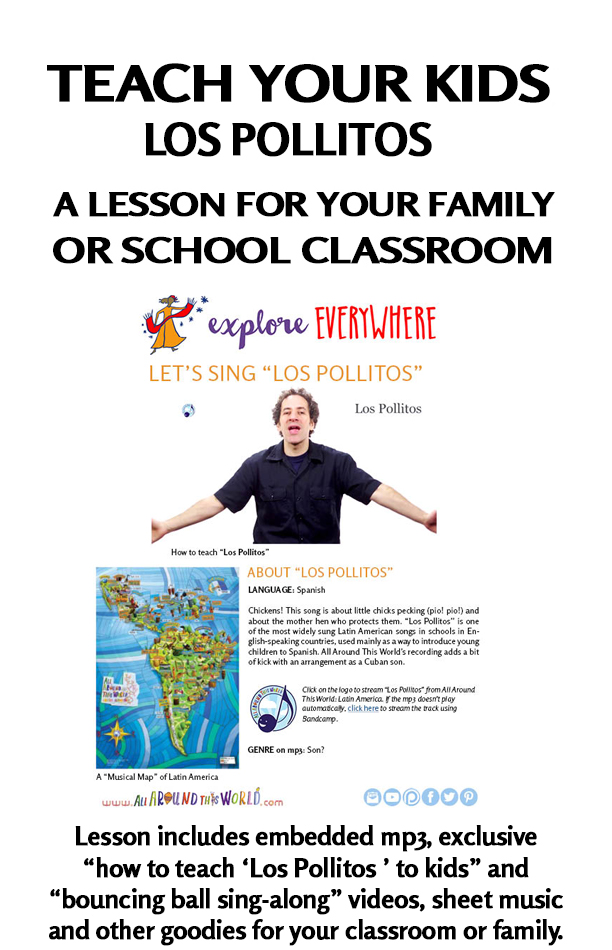
An All Around This World classroom and homeschool lesson about Latin America -- "Los Politos" -- A Spanish song about chickensChickens! This song is a Spanish song about chickens pecking (pio! pio!) and about the mother hen who protects them. “Los Pollitos” is one of the most widely sung Latin American songs in schools in English-speaking countries, used mainly as a way to introduce young children to Spanish. All Around This World’s version adds a bit of kick with an arrangement as a Cuban son.

Country: (many)
Language: Spanish
Genre on CD: Son
Instruments on CD Bass, Congas, Piano, Trumpet
LYRICS OF ALL AROUND THIS WORLD VERSION

All the little chicks say pio pio pio when they are hungry and when they are cold.
Mother chicken looks for corn and wheat. She will give them shelter and something to eat.
Under mama’s wing the little chickens keep, until the next morning they are all asleep.

Los pollitos dicen pío, pío, pío, cuando tienen hambre cuando tienen frío.
La gallina busca el maíz y el trigo, les da la comida y les presta abrigo. Bajo de sus alas, acurrucaditos. duermen los pollitos hasta el otro día!


¡Ecuador tiene mucho talento!

How to sing with Jay each week in your home or classroom Support All Around This World on Patreon Enjoy interactive All Around This World lessons in your home or classroom

Credits

Vocals: Tony Perez
Piano/Keyboard: John Stengel
Percussion: Arturo Stable

Trumpet: Nelson Miranda

Traditional, arrangement by Jay Sand, Instrumental arrangement by Arturo Stable

Piano/keyboard engineered by Mark Wolfe at AudioMind

Vocals and horns engineered by Erich Miller