Murga is a rambunctious form of public musical theater performed primarily during Carnival in Argentina and Uruguay. There are usually over a dozen performers in a murga–Wikipedia very specifically says “a maximum of 17”–and they’re almost always men. The group performs a play that consists of theatrical, satirical songs and broad dances. Each ensemble performs in several neighborhoods throughout Carnival. The percussion battery consists of a bombo (a bass drum a drummer attaches to him or herself with a strap and plays horizontally), a redoblante (snare) and platillos (loud cymbals).
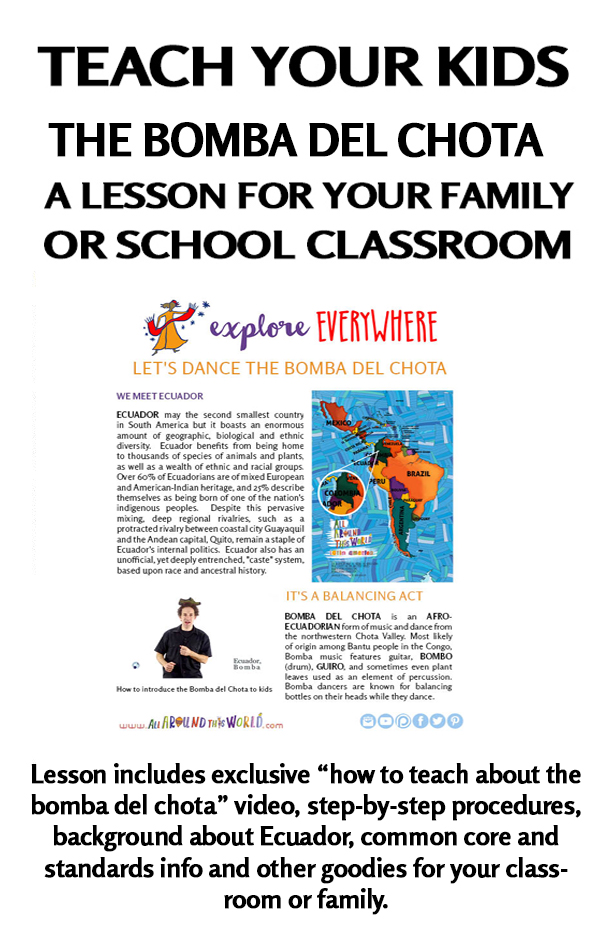
The Bomba del Chota originated with African ancestors’ of today’s Afro-Ecuadorians who arrived in Ecuador in the late sixteenth century when several slave-bearing ships crashed on the country’s coast. Today there are two main sub-genres of Afro-Ecuadorian music:
— the marimba-based music of Esmeraldas, which has direct ties to African (Bantu) genres that use marimba, and
— the more Spanish-influenced yet still distinctly African “bomba” from the Chota Valley.
As a group Afro-Ecuadorians fare slightly better (economically and socially) than Ecuador’s indigenous population, but they still face poverty and many other entrenched challenges. For many, Afro-Ecuadorian music is a statement of cultural separateness and an expression of Afro-Ecuadorian cultural and political pride.
PLEASE NOTE: The lesson and embedded video are NOT “How to dance the Bomba del Chota” tutorials. The goal of this lesson is to provide the tools for you to treat your very youngest students to their first introduction to Ecuadorian bomba and to inspire you to get up and dance together. (Your dance moves can’t be any worse than mine!) Ideally the lesson will be the first step on your and your students’ road to further Ecuadorian bomba exploration.
Porro began as a variant of Cumbia but has developed into a distinct form of music and dance. The style originated as folk music from Colombia’s Caribbean region but has developed into a public and celebratory music and couple/ballroom dance. Some of the most energizing porro ensembles are composed of brass, brass and more brass–trumpets, trombones and tubas aplenty.
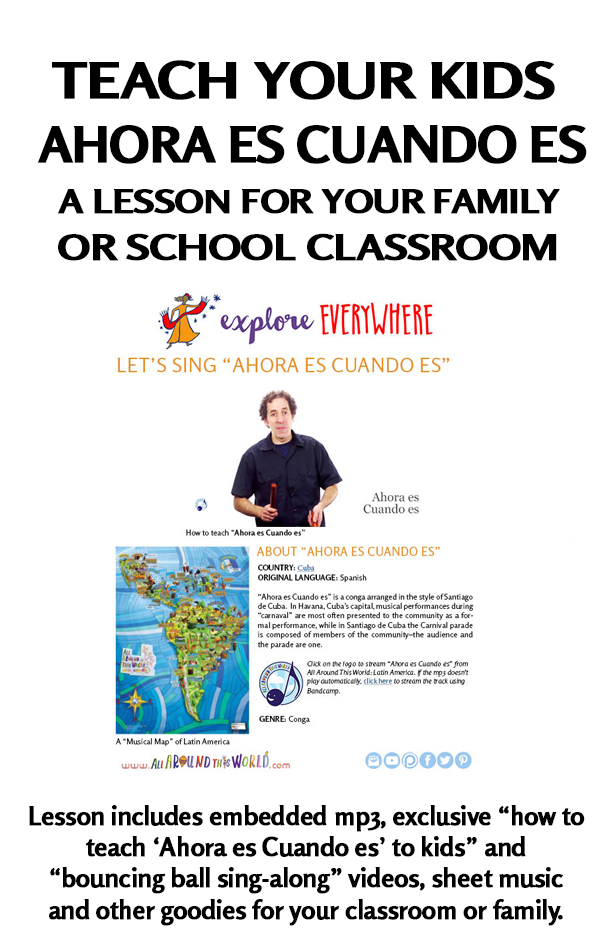
A Spanish carnival song arranged in the style of a conga from Santiago de Cuba. You can hear a bit of percussion from original from the Smithsonian Folkways album “Carnaval in Cuba.” In Havana, Cuba’s capital, musical performances during “carnaval” are most often presented to the community as a formal performance, while in Santiago de Cuba the Carnival parade is composed of members of the community–the audience and the parade are one.
Country: Cuba Language: Spanish Genre on CD: Conga Instruments on CD: much hand percussion, Bottles, CampanasLYRICS OF ALL AROUND THIS WORLD VERSION
Ahora es cuando es, ahora es cuando es
Now is the time, now is the time
Join the conga party in Santiago de Cuba
Credits
Percussion, vocals, engineering: Arturo Stable Vocals: Jay Sand Trombone: James Negron
We are revising the AllAroundThisWorld.com site and are currently using a new (better!) site — ExploreEverywhere.com — to tell you all about our curriculum offerings and how to become one of our teachers. That said, if you were on ExploreEverywhere, you clicked to find more information about a song or lesson, and landed here, you’re in the right place! Some links may be broken and a detail or two may be out of date…but close the popup window and enjoy!