Instruments Archives: Cajon

Cajón

The cajón is a rectangular wooden box that percussionists sit upon, tilt slightly forward and slap with their hands to create the sounds of a drum. It first appeared in coastal Peru in the 1800s and became a fixture of Afri-Peruvian forms of music. The instrument could conceivably descend from a family of box-like musicians from West and Central Africa, or perhaps it arose more recently within the last century when musical Cuban fishermen used crates to ship cod. During the era of Peruvian slavery, when slave-owners forbade slaves from making music, slaves used common household items or seemingly innocuous items like shipping crates as instruments.

COUNTRY: Peru, Colombia
KEY GENRES: Afro-Peruvian, Cumbia

[/wpspoiler] [wpspoiler name=”Funky cajon solo by Juro videon” open=”true” style=”aatw-video”]

How to sing with Jay each week in your home or classroom Support All Around This World on Patreon Enjoy interactive All Around This World lessons in your home or classroom

Cuban Rumba


[wpspoiler name=”Meet Afro-Cuban Rumba” open=”true” style=”aatw-video”][/wpspoiler]

COUNTRY: Cuba

About the Cuban Rumba:

http://www.bailasociety.tv/public/439.cfm

Rumba:
Rumba — not to be confused with “rhumba,” which was a term that Americans used to describe Cuban music in the ’30s — began in the mid-1800s as a form of gathering and dance music performed by African-descended laborers.  According to Latin Music USA, “Rumba was originally performed on everyday objects to avoid the ban on African instruments.  A wine barrel was played like a drum, a wooden crate was tapped on with spoons, and the shipyard’s hardwood dowels were struck together (and became an instrument: claves).”  About the rumba | Learn the 3-2 rumba claves | Learn the 2-3 rumba claves | Rumba Yambu on YouTube

Mambo

COUNTRY: Cuba, Mexico, United States

Mambo:
In the 1930s, Cuban big band musicians added some elements of son to danzón to form an up-tempo dance music called MAMBO. The mambo is based on the 3-2 clave and uses a 4/4 beat (look above and at the Everything is a Drum rhythmic overview for a hint about what this means), with a dancer counting “quick quick slow,” moving his/her feet on the second beat of the four beat phrase, shifting weight to the other foot on the third, and returning to the original foot on the fourth. In other words, “1-2-3, 5-6-7.” MAMBO became most popular not in Cuba, but in Cuban refugee communities in New York and Mexico City. About the MAMBO | In Havana, dancing the MAMBO

Festejo (Peru)

Festejo, a word derived from the Spanish “fiesta,” is a form of celebratory Afro-Peruvian music. Festejo lyrics often provide historical accounts of the Afro-Peruvian population’s emancipation from slavery or celebrate some other type of popular liberation. The festejo dance is lively and witty, featuring gyrating hips and intricate footwork known as zapateado.

COUNTRY: Peru
KEY INSTRUMENTS: Bongo, Cajita, Cajon, Congas, Quijada
SONG ON AATW: LATIN AMERICA CD: Citron


[mappress mapid=”16″ center=”-8, -60″ zoom=”3″]

How to sing with Jay each week in your home or classroom -- learn about festejo in music class Support All Around This World on Patreon Enjoy interactive All Around This World lessons in your home or classroom

Afro-Peruvian (Peru)

Afro-Peruvian music blends Spanish, African and indigenous melodies and rhythms with energetic flair. Some of the most popular rhythms accompany dances such as the marinera, an intricate courtship dance in 6/8 time, the festejo, a fast celebration dance also done in 6/8 and the lando, a 3/4 rhythm that comes from an African fertility dance. The genre’s most widely used instrument is the CAJON, a box drum with Peruvian origins that has since spread to Cuba and has even become an instrumental part of flamenco. Watch Fernando “Polo” Balanta play the Peruvian cajon. Another percussion instrument that appears in Afro-Peruvian ensembles is the donkey jawbone, or quijada, which the player scrapes with a stick to make the loose teeth rattle.

More information:
About Afro-Peruvian rhythms | Watch Afro-Peruvian dance ensemble Pero Negro performing on YouTube

COUNTRY: Peru
KEY INSTRUMENTS: Cajon, QuijadaSONG ON AATW: LATIN AMERICA CD: Citron (festejo)

[mappress mapid=”16″ center=”-8, -60″ zoom=”3″]

How to sing with Jay each week in your home or classroom Support All Around This World on Patreon Enjoy interactive All Around This World lessons in your home or classroom

Cumbia (Colombia, Mexico, Peru)

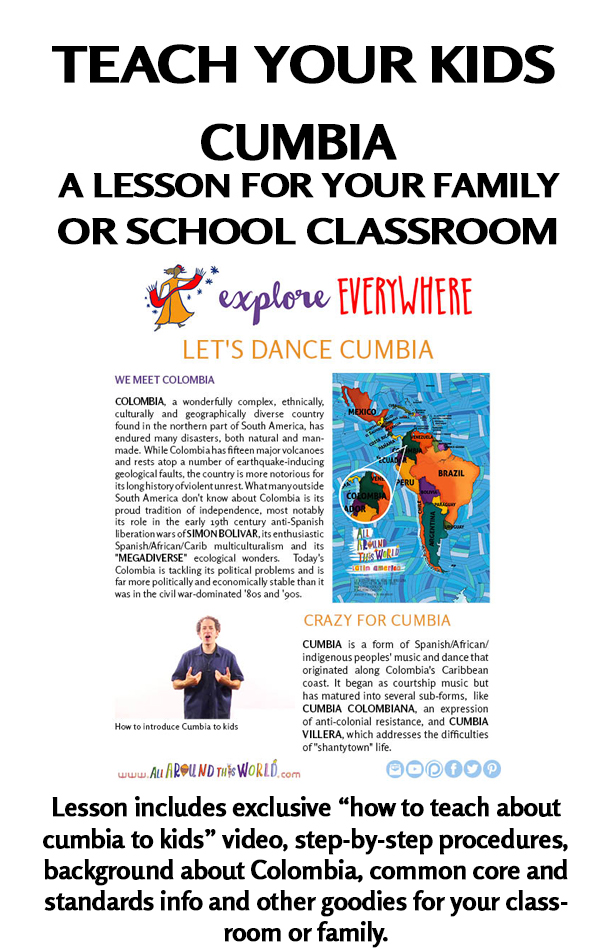
All Around This World Lesson for Classrooms and Homeschool -- Let's Dance CumbiaCumbia is a genre of music that originated on Colombia’s Caribbean coast as a ritual courtship dance of African slaves. At first only drums and claves accompanied the dance, but as Spanish colonial influence seeped into the music, guitars began to appear. Says Wikipedia, “According to legend, the accordion was added after a German cargo ship carrying the instruments sank as a load of accordions washed ashore on the northwest coast of Colombia.” Whether or not this is true, it’s a great story. Other instruments are:

tambora, a large two-headed drum that the drummer plays with sticks,

maracas and cajon (at 3:30–more about the cajon below), and sometimes

the congas, a Cuban hand drum with African ancestry.

Put that all together to a 4/4 “two-step” rhythm and you get…cumbia, cumbia and more cumbia!

Today the genre has spread beyond Colombia popular all over Latin America, especially in Mexico. “Andean Cumbia” blends the indigenous music of Andean nations such Bolivia, Ecuador and Peru with the rhythmic beat. In Peru it has even developed into a distinct subgenre known as Chicha.

A primer

PLEASE NOTE: The lesson and embedded video are NOT “How to dance the Cumbia” tutorials. The goal of this lesson is to provide the tools for you to treat your very youngest students to their first introduction to cumbia and to inspire you to get up and dance together. (Your dance moves can’t be any worse than mine!) Ideally the lesson will be the first step on your and your students’ road to further cumbia exploration.

COUNTRY: Colombia, Mexico, Peru
KEY INSTRUMENTS: Accordion, Cajon, Claves, Congas, Guitar, Maracas, Tambora
SONGS ON AATW: LATIN AMERICA CD: Niño Colla, Tambobambino

[mappress mapid=”16″ center=”-8, -60″ zoom=”3″]
How to sing with Jay each week in your home or classroom Support All Around This World on Patreon Enjoy interactive All Around This World lessons in your home or classroom

12. Citron


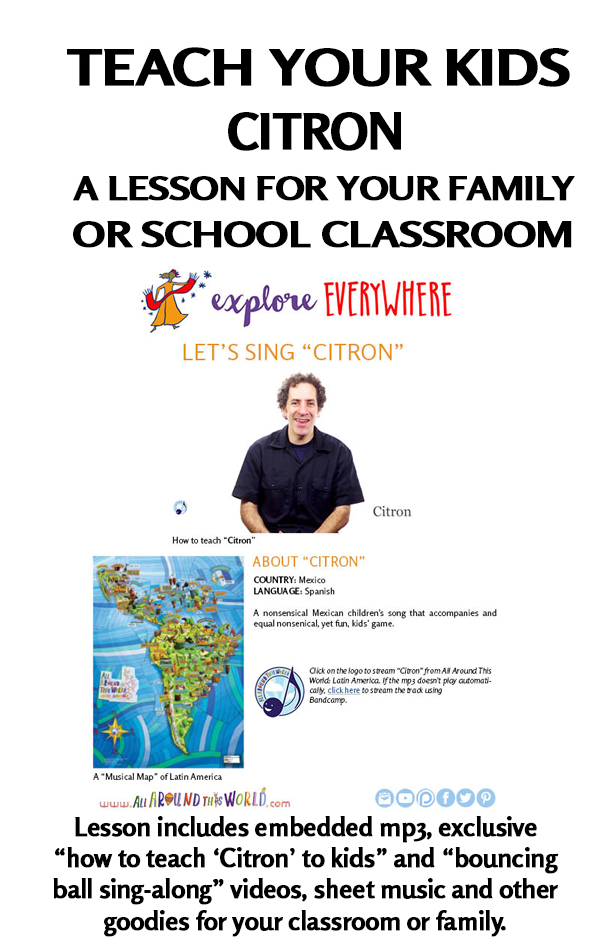
An All Around This World classroom and homeschool lesson from Mexico -- "Citron" -- A Mexican kinds song“Al Citron” is a Mexican kids song and children’s game. Kids sit in a circle and pass stones around clockwise, trying not to mess up the pattern as the tempo gets faster. As with many kids songs, the lyrics make no sense, but no one seems to care.

Country: Mexico (original)/Peru (on CD)
Language: Spanish
Genre on CD: Afro-Peruvian, Festejo

LYRICS OF ALL AROUND THIS WORLD VERSION

Al Citron de un fandango,
Sango sango,
Sabare de la randela,
con su triki triki tron.


Mexican kids play Al Citron

How to sing with Jay each week in your home or classroom Support All Around This World on Patreon Enjoy interactive All Around This World lessons in your home or classroom

Credits

Vocals: Giovana Robinson

Guitar: Patricio Acevedo

Instrumental arrangement by Arturo Stable

Engineered by Erich Miller