Instruments Archives: Claves

Latin Jazz

In the 1950s and ’60s American dancehall bands, which had for decades mainly performed dances and compositions that originated in the U.S., began to actively communicate with Latin musicians and add Latin dances like the mambo, samba and cha-cha-cha to their repertoires. Bebop band leaders like Dizzy Gillespie also wove Latin elements into their music, and in turn American jazz began to appear all over Latin America, fusing with Latin rhythms to become “Latin Jazz.” Latin jazz was syncopated like American jazz but didn’t emphasize the same beats, giving the music a different feel. The form introduced Latin instruments into jazz bands such as congas and bongos (both Afro-Cuban), the claves, the timbales and even the cowbell.

Latin bandleaders like TITO PUENTE, ARTURO SANDOVAL and PAQUITO D’RIVERA became popular in the U.S. in this time, as did a new trend, one that blended Brazilian samba with jazz, called “bossa nova” (which, conveniently, literally translates as “new
trend.”) American saxophone player STAN GETZ performed with Brazilian bossa nova musicians such as ANTONIO CARLOS JOBIM and JOÃO GILBERTO and receives due credit for popularizing the style in the U.S.

[Watch Tito Puente (on timabales) perform live in Montreaux in 1980 | Watch saxophonist Paquito D’Rivera perform live in Bern 1992 | Watch Arturo Sandoval and his band play, “Mam Bop,” in 1998 | Watch saxophone player Stan Getz share bossa nova with California in 1983]

Trova


[wpspoiler name=”Listen to Malaga performed by Trovadores, Trio Matmoros” open=”true” style=”aatw-video”][/wpspoiler]

In the 19th century in eastern Cuba, specifically in and around Santiago de Cuba, guitar-playing singers known as “trouvadores” traveled the land performing poetic and passionate Spanish-inspired songs, especially boleros in 2/4 time (as opposed to the Spanish bolero, which is in 3/4). [About the bolero | bolero on the front porch stoop in Santiago de Cuba] Wikipedia’s entry on trova introduces some of the “founders” of TROVA and follows the genre from the 1800’s into the politically-inspired post-Cuban revolution Nueva Trova of the 1960s. Watch Nuevo TROVA singer Silvio Rodriquez perform “Ojala.”

Salsa (U.S., Puerto Rico, Cuba)

Salsa is Puerto Rico’s most danceable musical export. The musical progeny of Cuban son from which it borrows its signature 3-2 and 2-3 clave patterns, the genre may have started in Cuba and Puerto Rico but really took root in the ’60s and ’70s in New York City where Puerto Rican immigrants fused son, mambo and little guaracha to make an extraordinary new musical form. Stars like Frankie Ruiz, Willie Colon, and Panamanian superstar Rubén Blades brought the music to the U.S., to Latin America, and by the mid ’70s to the world. Salsa bands are usually ambitions affairs, featuring many percussion instruments and horns, though the basic stripped-down ensemble consists of just claves, güiro, timbale, cowbell and congas. If you want to build your own rhythm, take a look at Stephen’s salsa page or the Salsa Beat Machine where you’ll be able to turn on and off the instruments as if you were leading your own big band. Speaking of which, see Colon and Blades together make a powerful duo on “Tiburon.”

COUNTRY: United States, Puerto Rico (U.S.), Cuba
KEY INSTRUMENTS: Bass, Bongo, Claves, Congas, Cowbell, Guiro, Maracas, Saxophone, Timbales, Trombone, Trumpet
SONG ON AATW: LATIN AMERICA CD: Un Barco Chiquitito (Cuban salsa)


How to sing with Jay each week in your home or classroom Support All Around This World on Patreon Enjoy interactive All Around This World lessons in your home or classroom

Cuban Rumba


[wpspoiler name=”Meet Afro-Cuban Rumba” open=”true” style=”aatw-video”][/wpspoiler]

COUNTRY: Cuba

About the Cuban Rumba:

http://www.bailasociety.tv/public/439.cfm

Rumba:
Rumba — not to be confused with “rhumba,” which was a term that Americans used to describe Cuban music in the ’30s — began in the mid-1800s as a form of gathering and dance music performed by African-descended laborers.  According to Latin Music USA, “Rumba was originally performed on everyday objects to avoid the ban on African instruments.  A wine barrel was played like a drum, a wooden crate was tapped on with spoons, and the shipyard’s hardwood dowels were struck together (and became an instrument: claves).”  About the rumba | Learn the 3-2 rumba claves | Learn the 2-3 rumba claves | Rumba Yambu on YouTube

Son (Cuba)

Son, which means “sound” in Spanish, powerfully forged African rhythms with instruments and folk melodies of Cuba’s Spanish community. Son music arose in the early 20th century, became known internationally in the ’30s and ’40’s when conjunto ensembles added instruments like conga drums to the mix, and fell from popularity when Cuban big bands playing a variety of styles began to draw tourist crowds in Havana the ’50s. Son worked its way into many other forms of Cuban music and all but disappeared as its own distinct style until about two decades ago when a group of well-known Cuban musicians recorded an album of classic Cuban music, including some son songs, called “The Buena Vista Social Club,” inspiring an international son revival.

COUNTRY: Cuba
KEY INSTRUMENTS: Bass, Bongo, Claves, Guiro, Maracas
SONG ON AATW: LATIN AMERICA CD: Los Pollitos

About Cuban son | About son conjuntos

[mappress mapid=”16″ center=”-8, -60″ zoom=”3″]

How to sing with Jay each week in your home or classroom Support All Around This World on Patreon Enjoy interactive All Around This World lessons in your home or classroom

Mambo

COUNTRY: Cuba, Mexico, United States

Mambo:
In the 1930s, Cuban big band musicians added some elements of son to danzón to form an up-tempo dance music called MAMBO. The mambo is based on the 3-2 clave and uses a 4/4 beat (look above and at the Everything is a Drum rhythmic overview for a hint about what this means), with a dancer counting “quick quick slow,” moving his/her feet on the second beat of the four beat phrase, shifting weight to the other foot on the third, and returning to the original foot on the fourth. In other words, “1-2-3, 5-6-7.” MAMBO became most popular not in Cuba, but in Cuban refugee communities in New York and Mexico City. About the MAMBO | In Havana, dancing the MAMBO

Punto Guajiro

The PUNTO GUAJIRO is a rural form of Spanish-inspired, African-influenced poetic music that originated in Western and Central Cuba in the 17th century. The music mixes 3/4 and 6/8 rhythms and is usually performed with an ensemble consisting of various types of guitars, which musicians pick–“punteando,” (hence the “punto”) instead of strumming (rasgueado)–as well as claves, a guiro and the metal guito-like scraper known as a guayo. Singers often improvise their songs, singing about life, love and everything between. There are many styles of punto | Punto Guajiro in a broken-down barn


COUNTRY: Cuba

Cuban Bolero (Cuba)

Cuban bolero–not to be confused with the Spanish music of the same name–originated in the 19th century as lyrical romantic music, performed on two Mexican-style guitars to Haitian rhythms. About the Cuban bolero | bolero on the front porch stoop in Santiago de Cuba

COUNTRY: Cuba
KEY INSTRUMENTS: Guitar, Claves, Congas, Maracas, Piano
SONG ON AATW: LATIN AMERICA CD: Azulão

[mappress mapid=”16″ center=”-8, -60″ zoom=”3″]

How to sing with Jay each week in your home or classroom Support All Around This World on Patreon Enjoy interactive All Around This World lessons in your home or classroom

Cumbia (Colombia, Mexico, Peru)

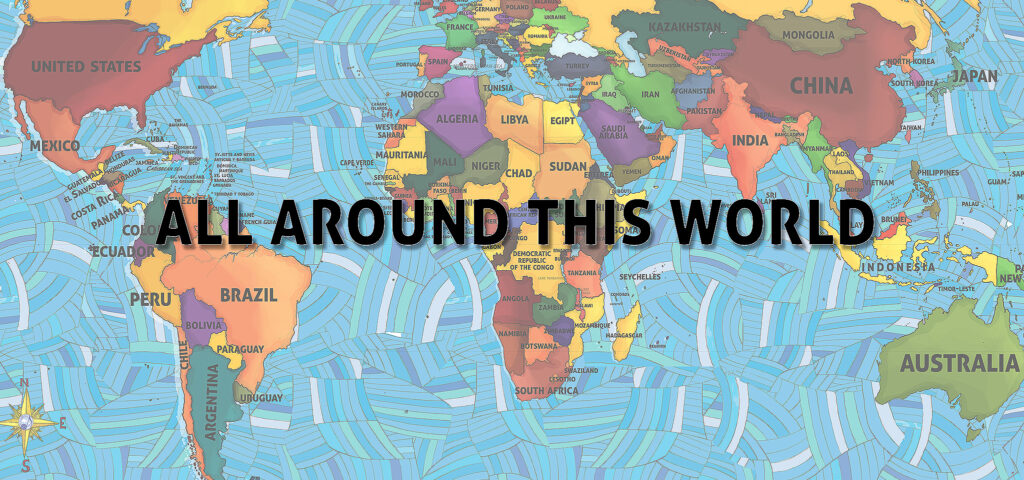
All Around This World Lesson for Classrooms and Homeschool -- Let's Dance CumbiaCumbia is a genre of music that originated on Colombia’s Caribbean coast as a ritual courtship dance of African slaves. At first only drums and claves accompanied the dance, but as Spanish colonial influence seeped into the music, guitars began to appear. Says Wikipedia, “According to legend, the accordion was added after a German cargo ship carrying the instruments sank as a load of accordions washed ashore on the northwest coast of Colombia.” Whether or not this is true, it’s a great story. Other instruments are:
tambora, a large two-headed drum that the drummer plays with sticks,

maracas and cajon (at 3:30–more about the cajon below), and sometimes

the congas, a Cuban hand drum with African ancestry.

Put that all together to a 4/4 “two-step” rhythm and you get…cumbia, cumbia and more cumbia!

Today the genre has spread beyond Colombia popular all over Latin America, especially in Mexico. “Andean Cumbia” blends the indigenous music of Andean nations such Bolivia, Ecuador and Peru with the rhythmic beat. In Peru it has even developed into a distinct subgenre known as Chicha.

A primer

PLEASE NOTE: The lesson and embedded video are NOT “How to dance the Cumbia” tutorials. The goal of this lesson is to provide the tools for you to treat your very youngest students to their first introduction to cumbia and to inspire you to get up and dance together. (Your dance moves can’t be any worse than mine!) Ideally the lesson will be the first step on your and your students’ road to further cumbia exploration.

COUNTRY: Colombia, Mexico, Peru
KEY INSTRUMENTS: Accordion, Cajon, Claves, Congas, Guitar, Maracas, Tambora
SONGS ON AATW: LATIN AMERICA CD: Niño Colla, Tambobambino

[mappress mapid=”16″ center=”-8, -60″ zoom=”3″]

How to sing with Jay each week in your home or classroom Support All Around This World on Patreon Enjoy interactive All Around This World lessons in your home or classroom