Son Jarocho is a Spanish/Creole/African musical fusion from Mexico’s southern coastal plain area of Veracruz. Son Jarocho musicians gather often in public festive musical and dance parties called fandangos during which all members of the community are welcome to participate in making music.
Instruments particular to the genre include a jarana, a quijada, a requinto, a mariumbula, a harp and a wooden dancing platform known as a tarima that the musicians actually consider a percussion instrument and factor into the arrangement of traditional songs.
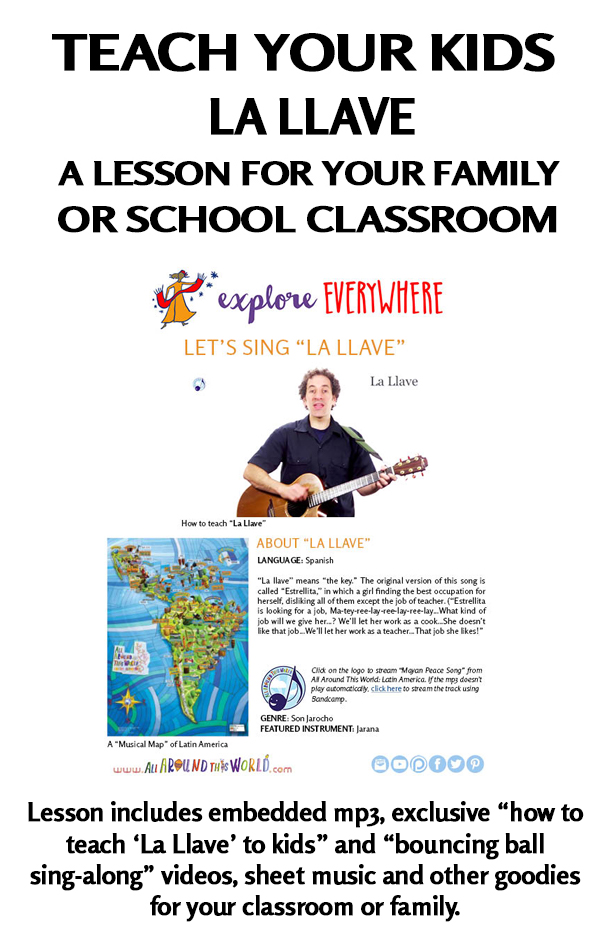
“La llave” means “the key.” All Around This World adapted this from a Spanish folk song called “Estrellita” which is about a girl finding the best occupation for herself, disliking all of them except the job of teacher. (“Estrellita is looking for a job, Ma-tey-ree-lay-ree-lay-ree-lay…
What kind of job will we give her…? We’ll let her work as a cook…She doesn’t like that job…We’ll let her work as a teacher…That job she likes!” Another commonly sung version is the story of a castle and a key to the castle, which the singer has unfortunately lost at the bottom of the sea. Fortunately, a little girl, perhaps “Estrellita,” is enlisted to look for it.
Country: (many) Language: Spanish Genre on CD: Corrido (jarocho style) Instrument on CD: Jarana
LYRICS OF ALL AROUND THIS WORLD VERSION
¿Donde esta la llave? Mate-rile-rile-rile
¿Donde esta la llave? Mate-rile-rile-ro
Where is the key? Mate-rile-rile-rile
Where is the key? Mate-rile-rile ro. (pon!) Gabriel Guzman, who sings La Llave on our CD, and Radio Jarocho perform live at The Greene Space
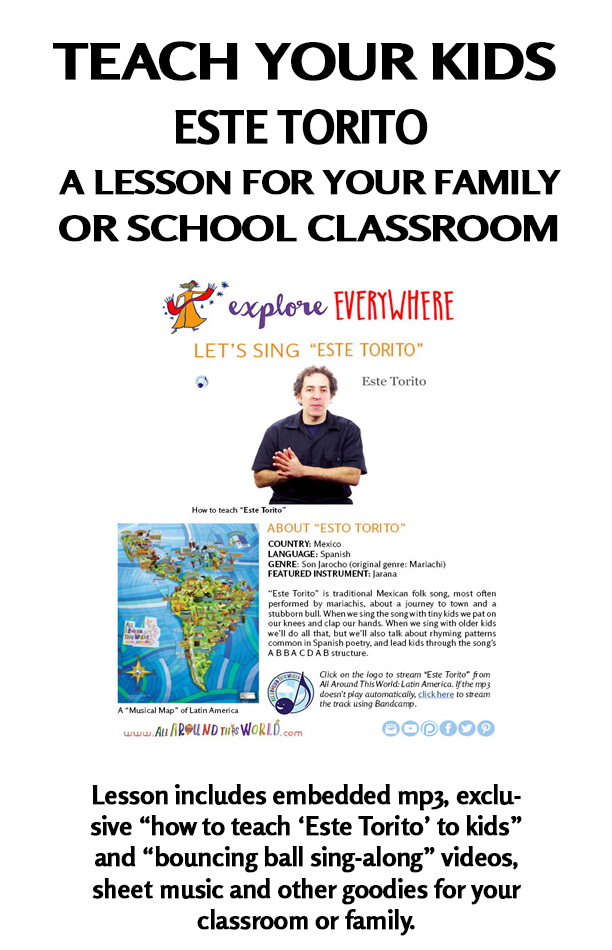
“Este Torito” is traditional Mexican folk song, most often performed by mariachis, about a journey to town and a stubborn bull. When we sing the song with tiny kids we pat on our knees and clap our hands. When we sing with older kids we’ll do all that, but we’ll also talk about rhyming patterns common in Spanish poetry, and lead kids through the song’s A B B A C D A B structure.
COUNTRY: Mexico LANGUAGE: Spanish GENRE: Son Jarocho (original genre: Mariachi) FEATURED INSTRUMENT: JaranaLYRICS OF ALL AROUND THIS WORLD VERSION
Este torito que traigo lo traigo desde Tepango,
Lo traigo desde Tapango, este torito que traigo
Y lo vengo manteniendo con cascaritas de mango.
Este torito que traigo lo traigo desde Tepango,
This little bull I am bringing comes here from Tepango
He comes here from Tepango, the little bull I am bringing
To get him to come here with me I feed him lots of mango.
This little bull I am bringing, he comes here from Tepango
Mariachi Vargas plays El Torito as part of a grand mariachi poppourri
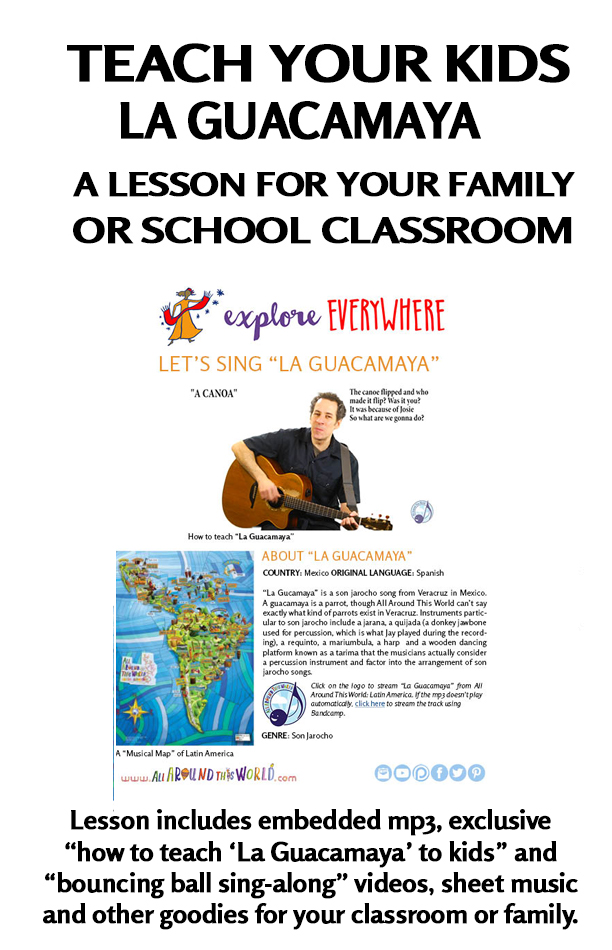
“La Gucamaya,” a son jarocho classic from Veracruz in Mexico, is much more than just any old Spanish song about a bird. A guacamaya is a parrot, though All Around This World can’t say exactly what kind of parrots exist in Veracruz. Instruments particular to son jarocho include a jarana, a quijada (a donkey jawbone used for percussion, which is what Jay played during the recording), a requinto, a mariumbula, a harp and a wooden dancing platform known as a tarima that the musicians actually consider a percussion instrument and factor into the arrangement of son jarocho songs.
Pobrecito guacamaya, you’re a hungry little bird
You’re a hungry little bird pobrecito guacamaya
Pobrecito guacamaya, I will share my food with you
If you only help me too, pobrecito guacamaya
Fly, fly, fly, can you teach me how to fly?
Pobrecito guacamaya, we can leave the world behind
Vuela, vuela, vuela, can you teach me how to fly?
Pobrecito guacamaya, we can leave the world behind.
Gabriel Guzmán: jarana, vocals
Julia del Palacio: bailadora, vocals
Juan Carlos Marín: requinto, vocals
Emmanuel Huitzil: marimbol
Carlos Cuestas: leona, vocals
We are revising the AllAroundThisWorld.com site and are currently using a new (better!) site — ExploreEverywhere.com — to tell you all about our curriculum offerings and how to become one of our teachers. That said, if you were on ExploreEverywhere, you clicked to find more information about a song or lesson, and landed here, you’re in the right place! Some links may be broken and a detail or two may be out of date…but close the popup window and enjoy!

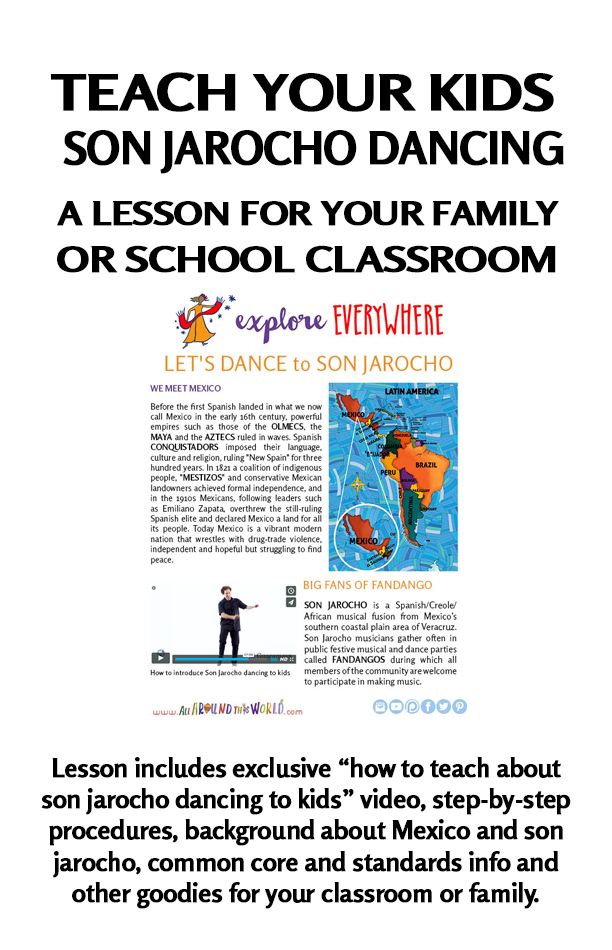 Son Jarocho is a Spanish/Creole/African musical fusion from Mexico’s southern coastal plain area of Veracruz. Son Jarocho musicians gather often in public festive musical and dance parties called fandangos during which all members of the community are welcome to participate in making music.