Instruments Archives: Timbales

Latin Jazz

In the 1950s and ’60s American dancehall bands, which had for decades mainly performed dances and compositions that originated in the U.S., began to actively communicate with Latin musicians and add Latin dances like the mambo, samba and cha-cha-cha to their repertoires. Bebop band leaders like Dizzy Gillespie also wove Latin elements into their music, and in turn American jazz began to appear all over Latin America, fusing with Latin rhythms to become “Latin Jazz.” Latin jazz was syncopated like American jazz but didn’t emphasize the same beats, giving the music a different feel. The form introduced Latin instruments into jazz bands such as congas and bongos (both Afro-Cuban), the claves, the timbales and even the cowbell.

Latin bandleaders like TITO PUENTE, ARTURO SANDOVAL and PAQUITO D’RIVERA became popular in the U.S. in this time, as did a new trend, one that blended Brazilian samba with jazz, called “bossa nova” (which, conveniently, literally translates as “new
trend.”) American saxophone player STAN GETZ performed with Brazilian bossa nova musicians such as ANTONIO CARLOS JOBIM and JOÃO GILBERTO and receives due credit for popularizing the style in the U.S.

[Watch Tito Puente (on timabales) perform live in Montreaux in 1980 | Watch saxophonist Paquito D’Rivera perform live in Bern 1992 | Watch Arturo Sandoval and his band play, “Mam Bop,” in 1998 | Watch saxophone player Stan Getz share bossa nova with California in 1983]

Salsa (U.S., Puerto Rico, Cuba)

Salsa is Puerto Rico’s most danceable musical export. The musical progeny of Cuban son from which it borrows its signature 3-2 and 2-3 clave patterns, the genre may have started in Cuba and Puerto Rico but really took root in the ’60s and ’70s in New York City where Puerto Rican immigrants fused son, mambo and little guaracha to make an extraordinary new musical form. Stars like Frankie Ruiz, Willie Colon, and Panamanian superstar Rubén Blades brought the music to the U.S., to Latin America, and by the mid ’70s to the world. Salsa bands are usually ambitions affairs, featuring many percussion instruments and horns, though the basic stripped-down ensemble consists of just claves, güiro, timbale, cowbell and congas. If you want to build your own rhythm, take a look at Stephen’s salsa page or the Salsa Beat Machine where you’ll be able to turn on and off the instruments as if you were leading your own big band. Speaking of which, see Colon and Blades together make a powerful duo on “Tiburon.”

COUNTRY: United States, Puerto Rico (U.S.), Cuba
KEY INSTRUMENTS: Bass, Bongo, Claves, Congas, Cowbell, Guiro, Maracas, Saxophone, Timbales, Trombone, Trumpet
SONG ON AATW: LATIN AMERICA CD: Un Barco Chiquitito (Cuban salsa)


How to sing with Jay each week in your home or classroom Support All Around This World on Patreon Enjoy interactive All Around This World lessons in your home or classroom

Mambo

COUNTRY: Cuba, Mexico, United States

Mambo:
In the 1930s, Cuban big band musicians added some elements of son to danzón to form an up-tempo dance music called MAMBO. The mambo is based on the 3-2 clave and uses a 4/4 beat (look above and at the Everything is a Drum rhythmic overview for a hint about what this means), with a dancer counting “quick quick slow,” moving his/her feet on the second beat of the four beat phrase, shifting weight to the other foot on the third, and returning to the original foot on the fourth. In other words, “1-2-3, 5-6-7.” MAMBO became most popular not in Cuba, but in Cuban refugee communities in New York and Mexico City. About the MAMBO | In Havana, dancing the MAMBO

Danzón


[wpspoiler name=”Danzon la Bella Cubana” open=”true” style=”aatw-video”][/wpspoiler]

COUNTRY: Cuba, Mexico, Puerto Rico (U.S.)

In the 1790s, French colonists fleeing the Haitian Revolution settled in Cuba and brought with them the Contradanza, which was a “sequence dance,” in which people danced together to make particular figures. By the 1850s the classical Contradanza, danced primarily in Havana by upper and upper-middle class “Europeanized” Cubans, was known as “DANZÓN.” By the early 1900s former slaves had begun to do the contradanza, infusing it with the syncopated “cinquillo” rhythm, bringing it out of the socialites’ dance halls and “into the street.” Over time, the contradanza in 2/4 (see the Everything is a Drum rhythm guide for an intro to time signatures) grew not only into the danzón, but also into the popular habanera rhythm. The contradanza in 6/8 eventually helped form the clave. About danzón | Lord Tiger’s introduction to danzón | A Cuban flute danzón | Cuba: Rhythm in Motion | An introduction to danzón styles via YouTube

Formal Cuban dance music of the late 1800s and early 1900s. Danzón drew its main inspiration from European sequence dances like the contradanza, though it added some African instruments like the timbales and the guiro.

Later, danzón ensembles called charangas added cello, flute and pianos. About danzón | A Cuban flute danzón

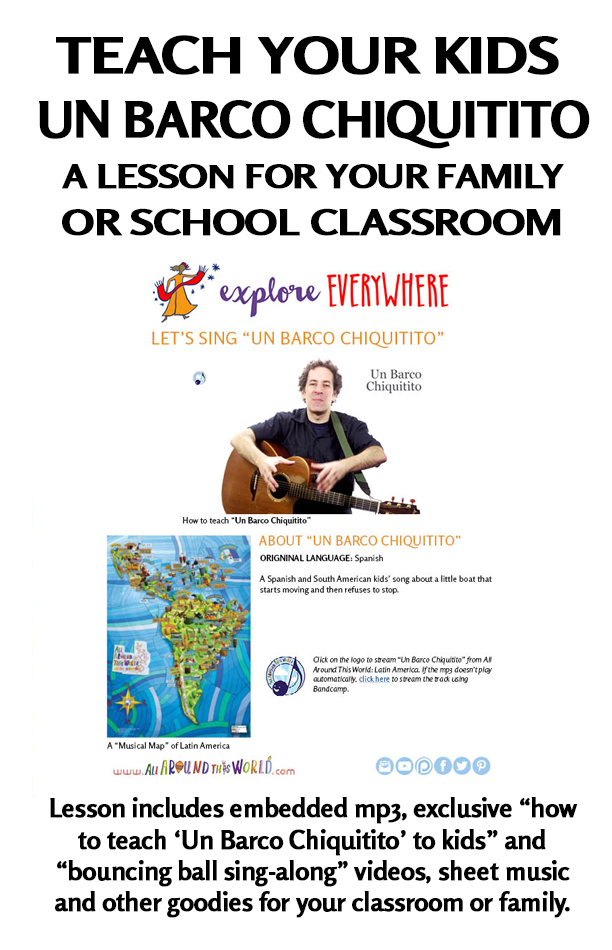
10. Un Barco Chiquitito


An All Around This World classroom and homeschool lesson from South America -- "Un Barco Chiquitito" -- Spanish song about a boat

“Barco chiquitito” is a Spanish song about a boat — a fantastic little boat, in our opinion. There are several versions of this song, but in the most widely sung, there is a little boat that can’t set sail for seven weeks, during which time provisions start to run out. In one translation, crew members get so hungry they eat their boots “with red sauce and a walnut,” get very sick and have to turn back. While our version is still a Spanish song about a boat, we not only let the ship sail, but say that it’s unable to stop sailing, then we also sing about an airplane that can’t stop flying, and, in class, we go through other modes of transport and say they can’t stop going either (a car, a bicycle, a pogo stick….).

Country: (many)

Language: Spanish
Genre on CD: Cuban salsa

Instruments on CD: Bass, Congas, Drum kit, Piano, Timbales, Trombone, TrumpetLYRICS OF ALL AROUND THIS WORLD VERSION

Habia una vez un barco chiquitito
Que no podia, no podia, no podia parar.

Once upon a time there was a little boat
And it could, and it could, and it could not stop.

How to sing with Jay each week in your home or classroom Support All Around This World on Patreon Enjoy interactive All Around This World lessons in your home or classroom
 

Credits

Vocals: Tony Perez
Bass: Rob Hagopian
Piano/Keyboard: John Stengel
Trombone: James Negron

Trumpet: Nelson Miranda
Drums/percussion: Francois Zayas
Percussion: Arturo Stable

Drums, keyboard and bass engineered and co-produced by Mark Wolfe at Audio Mind.

Vocals and horns engineered by Erich Miller

Original is "Un Barco Chiquitito" © Alpha Film Music on behalf of Smithsonian Folkways Recordings, translation and arrangement by Jay Sand with permission, Instrumental arrangement by Arturo Stable
Listen to an original version performed by Octavio Corvalan on the Smithsonian Folkways release, "Vamos a Cantar: Let Us Sing: A Collection of Children's Songs in Spanish."