Instruments Archives: Trombone

Ska

SKA is driving, danceable music that rose in 1950’s Jamaica, fusing Jamaican “mento” with American R&B. Ska became popular internationally in the 1960s, really took hold in early ’70s England where it fused with early punk, and is still popular today. We love this video clip from “This is Ska!,” a 1964 BBC documentary that introduced ska to a generation of British youth. After watching this bit you will want to watch the whole documentary. Here goes.

Ska music 101 | “This is ska!” | A brief history of ska | Variants of ska dancing/”skanking”

Zouk

COUNTRY: Martinique, Guadeloupe

Martinique’s most internationally known style is Zouk which is an energetic, highly danceable blend of all the above. Zouk started in the 1960s as Caribbean dancehall music but has since become more musically complex, adding sounds from other Martinican styles such as beguine, and kadans.  There are many styles of Zouk dancing, but the traditional Caribbean Zouk features two steps that go along with the music: 1-2, 1-2. In Brazilian Zouk there are three steps: 1-3-4, 1-3-4…

More information:
The history of Zouk | Tracing Zouk to its Dominican roots | Heritage Institute’s Zouk overview, including an introduction to several ZOUK dance styles

Compas


In the early 20th century Haiti developed a tradition of “twobadou” (troubadour) music, which was a personal, folksy style like American blues. In the ’30s and ’40s, big bands had replaced “twobadou” as the most popular music and by the ’50s Haitian band leader Nemours Jean-Baptiste had pioneered a style known as COMPAS, which wedded Haitian folk music with merengue rhythms (1-2, 1-2–we’ll look at meremgue below), African percussion and American big band jazz. According to AllMusic.com’s brief introduction to COMPAS, “Although similar to merengue, compas has a more driving rhythm; its moderate tempo is paced by a steady bass, which anchors the drum and cowbell percussion.” Or, as The New York Times puts it: “COMPAS, Haiti’s pop music, is a mass of rhythmic complication, in which syncopations are accented and pass for downbeats, and rhythms interlock and repeat, all for the benefit of dancers.” Watch COMPAS favorites Tabou Combo perform live in L’Olympia.

Documentary about Kompas Direct:http://www.youtube.com/watch?v=WuPBupAHsLs

Timba


[wpspoiler name=”Los Van Van perform Temba, Tumba, Timba” open=”true” style=”aatw-video”][/wpspoiler]

TIMBA is upbeat dance music that developed in the 1990s as a synthesis of Cuban jazz, rock, rumba, disco and funk. It’s a”street level” form whose lyrics focus on urban issues among Cuban youth. TIMBA has a similar tempo and rhythm to salsa and uses many of the same instruments, but the instruments are used somewhat differently. For example, so says Wikipedia’s entry on timba, “Salsa bassists have standardized on bombo-ponche bass tumbao. This is sometimes used in TIMBA, but much more often a clave-aligned tumbao is used, and it is often specific to the song in question, while the bombo-ponche tumbaos of salsa, by definition, always use the same rhythm from song to song. Most importantly, TIMBA bassists stop and start their tumbaos, one of the defining aspects of timba gears. In salsa, the bass tumbao is omnipresent.” Couldn’t be clearer! Seriously, while salsa bands rarely have a drum kit with a kick drum, in timba a drum kit is essential, or at least a timbale player adds a kick drum, which s/he plays while standing. Also, TIMBA is known for “crossing the clave,” meaning that some of the instruments may be playing the 3-2 clave while others will simultaneously be playing the 2-3 (look above for an overview of clave). Scandalous. Listen to La Timba Loca for an example.

Mambo

COUNTRY: Cuba, Mexico, United States

Mambo:
In the 1930s, Cuban big band musicians added some elements of son to danzón to form an up-tempo dance music called MAMBO. The mambo is based on the 3-2 clave and uses a 4/4 beat (look above and at the Everything is a Drum rhythmic overview for a hint about what this means), with a dancer counting “quick quick slow,” moving his/her feet on the second beat of the four beat phrase, shifting weight to the other foot on the third, and returning to the original foot on the fourth. In other words, “1-2-3, 5-6-7.” MAMBO became most popular not in Cuba, but in Cuban refugee communities in New York and Mexico City. About the MAMBO | In Havana, dancing the MAMBO

Soca (Trinidad and Tobago)

Soca is a faster version of calypso that has substantial influence throughout the Caribbean. Trinidadian musician Ras Shorty generally receives credit for originating it in 1963 when he added Indian instruments such as the dholak and the the tabla to calypso. In the 1970s calypsonians such as Shorty had also added soul, disco and funk, transforming the genre into internationally popular dance party music. Today soca remains popular throughout the Caribbean, especially the more overtly East Indian chutney. A brief history.

COUNTRY: Trinidad and Tobago
KEY INSTRUMENTS: Bass, Dhantal, Dholak, Drum kit, Guitar, Tabla, Trumpet, Trombone
SONG ON AATW: LATIN AMERICA CD: Wan Boto

[mappress mapid=”16″ center=”-8, -60″ zoom=”3″]

How to sing with Jay each week in your home or classroom Support All Around This World on Patreon Enjoy interactive All Around This World lessons in your home or classroom

Choro (Brazil)

Choro is a type of instrumental “lament” that originated in Rio in the 19th century. The original choro trio consisted of a flute, guitar and cavaquinho (which actually looks like a small, four-stringed guitar). Samba and bossa nova eventually replaced choro as Brazil’s main musical form, but amateur choro circles called “rodas de choro” kept it alive. Today it is undergoing somewhat of a revival.

COUNTRY: Brazil
KEY INSTRUMENTS: flute, guitar, cavaquinho

[mappress mapid=”16″ center=”-8, -60″ zoom=”3″]

How to sing with Jay each week in your home or classroom Support All Around This World on Patreon Enjoy interactive All Around This World lessons in your home or classroom

Highlife

Highlife is rollicking dance music that arose in the coastal towns of Ghana in the 1920s and fused, as Alisdair.com’s brief introduction to highlife explains it, “indigenous dance rhythms and melodies with Western sounds began in the coastal towns of Ghana, including regimental brass bands, sea shanties, hymns; European foxtrots and Caribbean kaiso, with African rhythms of Liberia (dagomba), Sierra Leone (ashiko and goombe) and Fante (osibisaba). In the 1940s Ghanaian band leader E.T. Mensah and his musical contemporaries, reacting to the proliferation of foreign genres like the waltz and rumba in the big band music popular with whites who lived in Ghana, consciously sought out syncopated African rhythms (now known as Highlife rhythms) to underlie their own compositions. In the ’50s Mensah and his Tempos band traveled about West Africa spreading highlife to nations like Nigeria, which embraced it wholeheartedly and soon came to rival Ghana as the most prominent home of the genre. Today’s highlife blares from what seems like every car stereo in the region, becoming an indelible part of the natural environment, almost as ubiquitous as air.

More info:

More about Mensah at RetroAfrica.com | Watch this tribute to Mensah on YouTube | See kids pretend to be George Darko and his band

How to sing with Jay each week in your home or classroom Support All Around This World on Patreon Enjoy interactive All Around This World lessons in your home or classroom

Samba (Brazil)

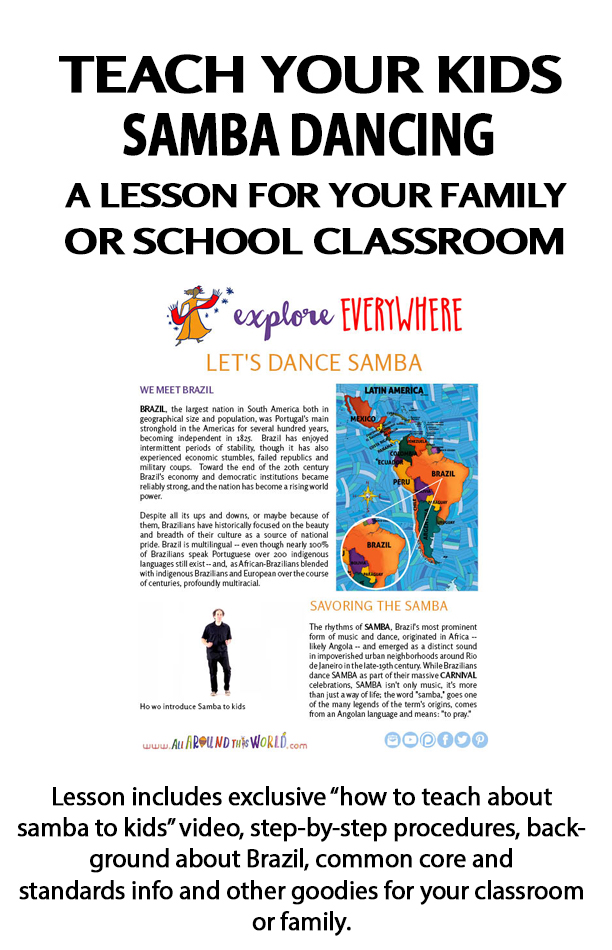
All Around This World lesson for classrooms and homeschool -- Let's Dance Samba from BrazilSamba is Brazil’s most prominent and arguably its most joyous music and dance form (though just one of many!). While Brazilians dance samba in public as part of their massive Carnival celebrations, parading in breathtaking numbers–literally in the tens of thousands, all members of community-building musical institutions known as samba schools–through the heart of Rio’s aptly named Sambadrome, they also dance at almost any time throughout the year, in almost any venue, to mark almost every occasion. (Check out a percussion unit practicing for Carnival.) The genre isn’t only music, it’s more than just a way of life; the word “samba,” goes one of the many legends of the term’s origins, comes from an Angolan language and means: “to pray.”

The distinctive dance motion and its energizing 2/4 rhythms may be an eastern Brazilian interpretation of rhythms that originated in Angola, the Congo, or even as a development of batuque music from Cape Verde, but is just as likely an amalgam of all those and more. It is certainly a form that began in Africa, traveled in the deep, dark holds of slave ships to the New World, and began to emerge as a distinct sound in impoverished urban neighborhoods around Rio de Janiero in the late-19th century. The first popular samba recordings appeared in the early 1920s and rapidly became part of Brazil’s soul.

Samba has now grown to become a blanket genre with a number of sub-genres, such as samba-enredo (the kind of samba performed at Carnival), samba-cancao (samba song), samba de breque (in which the song stops, or “brakes,” and the vocalist fills the spaces with declarations), samba-pagode (a form of party music that has become identified with pop), samba-reggae, and many more.

PLEASE NOTE: The lesson and embedded video are NOT “How to samba” tutorials. The goal of this lesson is to provide the tools for you to treat your very youngest students to their first introduction to samba and to inspire you to get up and dance together. (Your dance moves can’t be any worse than mine!) Ideally the lesson will be the first step on your and your students’ road to further samba exploration.

PERCUSSION:

One of the most exciting elements of samba is the onslaught of percussion instruments ensembles bring forth when they perform. While every instrument has its own sound and serves its own particular purpose, the cumulative effect is meant to so energize a listener that s/he has not choice but to dance. Some of the primary percussion items include the…

CAIXA:
Very similar to a snare drum, though it has two or four wires/cables/snares that run along the top of the drum, rather than along the bottom like the typical drum kit snare. The caixa is played with drumsticks and either suspended around the neck on a strap or held on the shoulder to send the sharp rhythm out over a procession. Often musicians play several types or caixas with several types of rhythms. Hear the caixa in action.

CUICA:
The cuica is a Brazilian “talking drum” (or, more descriptively, “laughing drum”). The drum only has one head. The drummer makes the distinct “laughing” sound by putting a hand inside the instrument and rubbing a wet cloth across a resonating cane of bamboo. Listen to the cuica and, if you understand Portuguese, learn about it too.

SURDO:
The surdo is a large bass drum that provides the deep, underlying percussive motion for a procession. Performers tune two surdos to different notes and play them in both complementary rhythm and tone, emphasizing the downbeats of the measure. A third surdo plays a rhythm, known as a “cutter,” between the first two surdo beats. Watch some surdo drums at work in the forefront of this performance by PhillyBloco.

PANDEIRO:
The pandeiro is a kind of tambourine that has a single head and jingles (“pratinelas”) arranged in pairs around its frame. Some masterful pandeiro playing.

TAMBORIM:
A small single-headed hand drum hit by a thin stick to make a sharp sound that cuts across all the other percussion, usually on an off-beat. Often the tamborim players lead the procession. Watch the smiling Tamborim Unidos da Tijuca in motion in 2009.

TIMBAL
(also spelled as TIMBAU): The timbal is a conical Brazilian kettle drum most often found in Bahia. (Not to be confused with the Cuban timbales.) Watch timbal drummers on the move with Percussao Brasileira.

More information:

The History of Samba | Want to learn to samba? Start here. | Want your baby to teach you how to samba? Start here.

COUNTRY: Brazil
KEY INSTRUMENTS: Agogô, Banjo (4-string), Bass, Caixa, Cavaquinho, Chocalho, Cuíca, Ganza, Güiro, Hand-repique, Pandeiro, Repinique, Saxophone, Surdo, Tamborim, Tantã, Trombone, Trumpet
SONG ON AATW: LATIN AMERICA CD: Bambo du Bambu

[mappress mapid=”16″ center=”-8, -60″ zoom=”3″]
How to sing with Jay each week in your home or classroom Support All Around This World on Patreon Enjoy interactive All Around This World lessons in your home or classroom

23. Goodbye (Adios!)

When All Around This World classes visit Latin America we use our beloved “We Are Happy” as our Spanish goodbye song. SEE YA!

Country: Uganda (original)/Dominican Republic
Language: originally Luganda
Genre on CD: Merengue
Instruments on CD: Piano, Trombone, Trumpet

LYRICS:

We say goodbye, but we’re not sad,
because of all the fun we had
We are happy, we are happy on this day

¡Adios everybody! (“Goodbye” in Spanish),
Tchau everybody! (“Goodbye” in Portuguese),
Ayo everybody! (“Goodbye” in Garifuna),
[A-wa-lyah] everybody! (“I’m leaving” in Quechua)

How to sing with Jay each week in your home or classroom Support All Around This World on Patreon Enjoy interactive All Around This World lessons in your home or classroom

Credits

VocaLs: Jay Sand

Piano/Keyboard: John Stengel

Drums/percussion: Francois Zayas

Engineering and co-production of drums, keyboard and bass by Mark Wolfe, AudoMind, Philadelphia

Vocals engineered by Erich Miller, Philadelphia

You can listen to the original verson of "We Are Happy" on the Smithsonian Folkways release, Abayudaya: Music from the Jewish People of Uganda.
"We Are Happy" and "Hello" © Gershom Sizomu and J.J. Keki, arrangement by Jay Sand with permission, Instrumental arrangement by Arturo Stable