Andean Cumbia combines the traditional melodies and instruments of the Andes mountains with the Afro-Colomibian cumbia (introduced in the description of “Un Coya.”) In Peru, cumbia is often equated with a related but not exactly similar form called Chicha, which emerged during the Amazonian oil boom of the ’60s when many Peruvians immigrated from the highlands to urban areas, settling mainly in shantytowns. Chicha has developed into a modern popular genre infused with electronic instruments and energizing percussion.
The quena is a traditional bamboo or wooden flute used in many kinds of music found in the Andean mountains. A common quena has six finger holes and one hole for the thumb. The musician controls the airflow with both his or her mouth and fingers, creating a naturally rich tone.
The cajón is a rectangular wooden box that percussionists sit upon, tilt slightly forward and slap with their hands to create the sounds of a drum. It first appeared in coastal Peru in the 1800s and became a fixture of Afri-Peruvian forms of music. The instrument could conceivably descend from a family of box-like musicians from West and Central Africa, or perhaps it arose more recently within the last century when musical Cuban fishermen used crates to ship cod. During the era of Peruvian slavery, when slave-owners forbade slaves from making music, slaves used common household items or seemingly innocuous items like shipping crates as instruments.
The charango, a small, high pitched Bolivian/Andean stringed instrument that traditionally was made from the shell of an armadillo, is a staple instrument of Andean music. The charango first appeared in South America in the 1800s, though its exact origin is unclear. Was it a descendant of the vihuela, which the Spanish brought with them when they colonized? Did indigenous musicians who had learned to play Spanish vihuelas and guitars create such a small instrument in order to be able to hide it when Spanish authorities prohibited them from performing their own music? Whatever its origins, the charango’s bright sound has become a characteristic of several Andean genres, like Andean Cumbia, Huayno and Pasillo
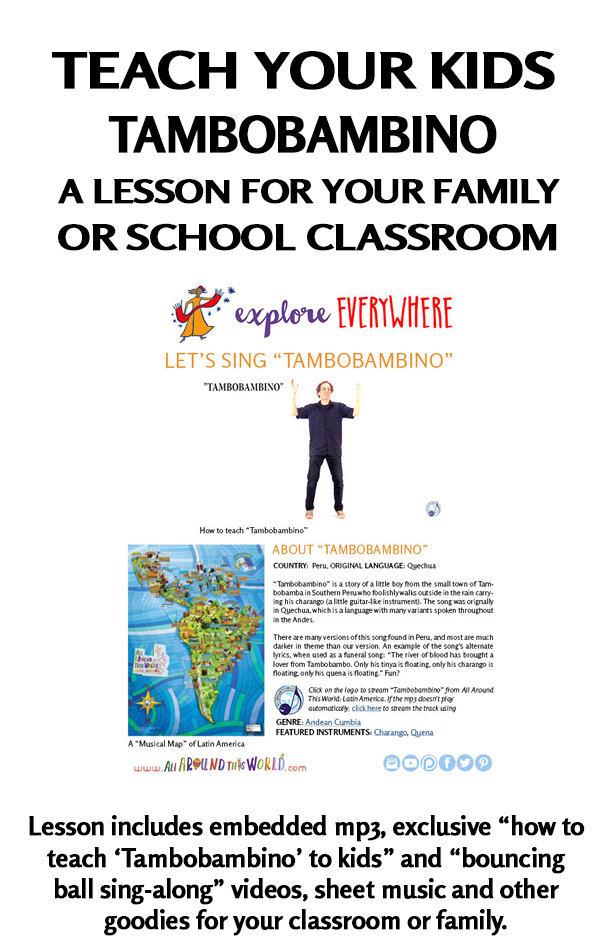
This Andean folk song is a story of a boy from the small town of Tambobamba in Southern Peru who foolishly walks outside in the rain carrying his charango (a little guitar-like instrument). There are many versions of this song found in Peru, and most are much darker in theme than this one. An example of the song’s alternate lyrics, when used as a funeral song: “The river of blood has brought a lover from Tambobambo. Only his tinya is floating, only his charango is floating, only his quena is floating.” Wisely, All Around This World decided to not use the alternate lyrics in class.
The song was orignally in Quechua, which is a language with many variants spoken throughout in the Andes.
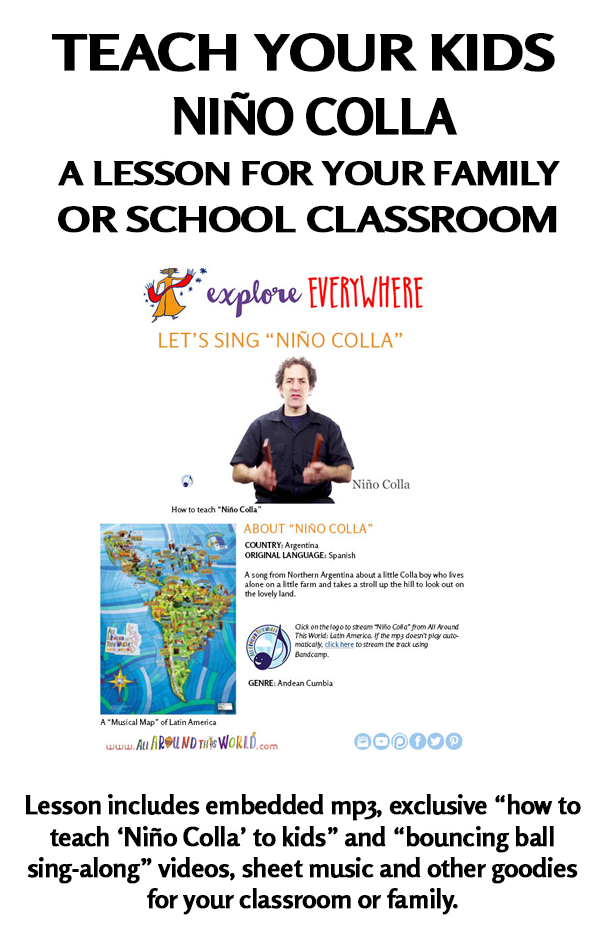
Niño Colla is a Spanish song about a boy from the Coya (Kolla) community of Northern Argentina who, living alone on his little ranch, sets off on a walk up into the hills. In the original he is wearing a “poncho,” a sombrero and one leather sandal, known as an “ojota.” He is also accompanied by his donkey and dog and plays his quena flute on the way.
Most Kolla live in “yungas,” which are “misty forests” found high in the Andes mountains. When the Kolla people have made the international news over the last couple decades the story usually has to do with their protesting agribusiness and mining interests encroaching on the yungas and other native lands.
Meet Kollamarka, a generations-old performing ensemble that celebrates Andean music
Credits
Vocals: Pedro Ortiz
Charango and quena/panpipes: Patricio Acevedo
Percussion: Arturo Stable
Engineered by Erich Miller
Niño Colla is traditional, English lyrics and arrangement by Jay Sand, Instrumental arrangement by Arturo Stable
We are revising the AllAroundThisWorld.com site and are currently using a new (better!) site — ExploreEverywhere.com — to tell you all about our curriculum offerings and how to become one of our teachers. That said, if you were on ExploreEverywhere, you clicked to find more information about a song or lesson, and landed here, you’re in the right place! Some links may be broken and a detail or two may be out of date…but close the popup window and enjoy!